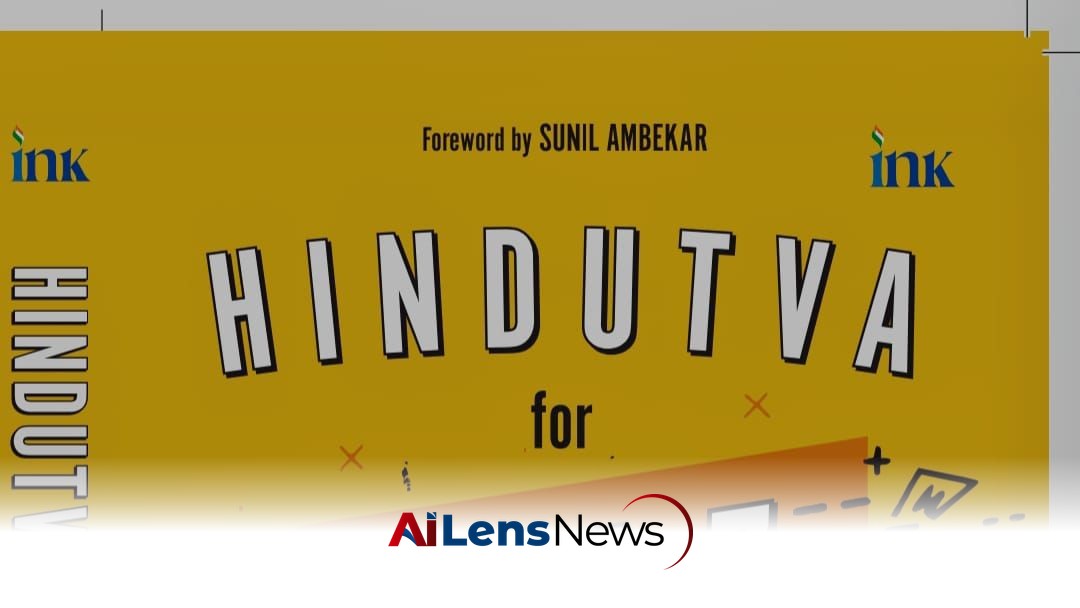


Yuvraj Pokharna's 'Hindutva for Gen Z' aims to clarify the concept of Hindutva, challenging misconceptions and encouraging informed discourse among the youth.
New Delhi, India Jul 18, 2026 ALN: Globally launched by Sri Sri Ravi Shankar, 'Hindutva for Gen Z' by Yuvraj Pokharna seeks to help Gen Z better understand the terminology of ‘Hindutva’ and the narratives shaping public discourse across digital and mainstream media. The book encourages informed thinking and independent decision-making by providing context around topics actively discussed in contemporary society.
Written from the vantage point of an activist-cum-columnist, ‘Hindutva for Gen Z’ rests on a clear central thesis: Hindutva is not a rigid religious dogma or a political ‘ism’; it is the lived ‘state of being Hindu’—a civilizational essence and a universal way of life—Dharma.
Yuvraj Pokharna, a Surat-based author, activist, and media panelist, brings urgency and precision to his writing on Hindutva, Islamic Jihad, politics, and public policy. As the general advisor to Kirti Setu and a former educator, he continues to drive socio-political dialogue at the intersection of tradition and modernity.
To delve deeper into the concepts and intellectual facets that inform ‘Hindutva for Gen Z’, Sonakshi Datta interviewed Yuvraj about his latest release.
What major topics related to Hindutva are part of present public discourse?
The topics dominating the discourse currently include temple restoration, state taxation of Hindu places of worship, place-name reclamation, the caste system's origins, Nehruvian secularism versus genuine pluralism, the global campaign against Hindu identity termed ‘Hindumisia’, the Uniform Civil Code, and the fundamental question of what Hindutva means versus its misrepresentation.
These issues arise because they challenge a narrative established post-1947 that treated Hindu civilizational memory as something to be managed, diluted, or apologized for. For instance, temple control is not a minor administrative matter; it is the only faith in this country whose places of worship are taxed and administered by the government, while every other faith enjoys full autonomy. This is not secularism; it is selective treatment masquerading as secularism.
Moreover, the caste system is often weaponized in this conversation. Many are unaware that the rigid birth-based hierarchy seen today was significantly hardened by colonial census policies. The original Vedic varna system was fluid and merit-based, a distinction that is rarely part of mainstream discussions.
What the uninformed reader, especially Gen Z, needs most is context. These are not random cultural skirmishes; they are battles over civilizational continuity. Understanding how certain frameworks were imposed from outside and how Hindu society was conditioned to view itself through those lenses is crucial. My book breaks down these concepts in short, standalone essays, allowing readers to engage with the material at their own pace.
How can the youth comprehend that Hindutva is not a radical form of Hinduism?
The core deduction is straightforward: Hindutva is not an ‘ism’ at all. It is the essence of being Hindu, the natural expression of a civilization that has evolved over millennia. It is not a political ideology or a supremacist doctrine. Understanding this distinction dismantles the fascist label often associated with it.
What is often concealed is that this civilization possesses an extraordinary capacity for pluralism and inquiry. The Rig Veda states, ‘Ekam sat vipra bahudha vadanti’—Truth is one; the wise call it by many names. This foundational philosophy does not align with fascism, which cannot accommodate diversity.
The labels of fascism and radicalism are lazy constructs designed to delegitimize any assertion of Hindu civilizational confidence. When a Hindu asserts their temples deserve autonomy, it is labeled communal. When they demand an honest recounting of history, it is deemed dangerous. Such labeling is a strategy to prevent people from discovering the truth.
What I want young readers to take away is that Hindutva does not ask you to hate anyone; it asks you to stop hating yourself and your heritage. This distinction between a lived civilizational essence and a manufactured political slur is vital.
What myth-busting facts does your book cover?
Several myths are addressed, including the misconception that the caste system is an ancient Vedic invention. In reality, colonial census operations played a significant role in rigidifying what was once a more fluid varna arrangement. The British needed fixed categories to manage society, creating or hardening existing ones.
Another myth is that Hindu society is uniquely oppressive. When compared to other civilizations, the selective outrage becomes apparent. The constitutional asymmetry regarding temple control is indefensible; Hindu temples are uniquely under state control and taxation, while other religious institutions are not. This is not secularism but selective treatment.
The narrative of Hindu terror is another manufactured myth, selectively applied while downplaying more organized radicalism. Additionally, ancient Indian contributions to fields like mathematics and surgery are often overlooked, with the civilization unfairly labeled as primitive.
Lastly, the most significant myth is that Hindutva is anti-pluralism. It is rooted in civilizational confidence, not aggression. Confidence does not require diminishing others, and these documented patterns are deliberately fragmented in current discourse.
What factors contribute to misinformation about Hindutva?
The roots of misinformation trace back to colonial scholarship, which framed Hinduism as chaotic and inferior. This framing was functional; a civilization made to feel ashamed is easier to govern. Post-independence, ‘minorityism’ was packaged as secularism, creating a hierarchy where Hindu assertion became suspect while other identities were celebrated.
This has led to cultural amnesia among young Indians, who know more about imported ideologies than their own traditions. To counter this, clarity and access to the intellectual lineage of Hinduism are essential. Young people need information without guilt or caricature. This book aims to provide that clarity.
Second, confidence is crucial. Hindu consciousness should not be aggressive but should recover the civilization's right to exist on its own terms. Books and curricula that treat Hindu thought as a serious tradition are necessary for decolonizing the mind.
Why is ‘Hindutva for Gen Z’ a must-read for all generations?
The questions addressed in this book are civilizational, not just generational. The confusion around Hindutva, the distortion of Indian history, and the asymmetry in secularism affect every Indian trying to navigate the noise surrounding these topics. While Gen Z has grown up in a distorted information environment, the issues resonate with all ages, making this book relevant for everyone.
To learn more about the latest developments in Hinduism, stay updated with our exclusive reports and analyses on AiLensNews.

