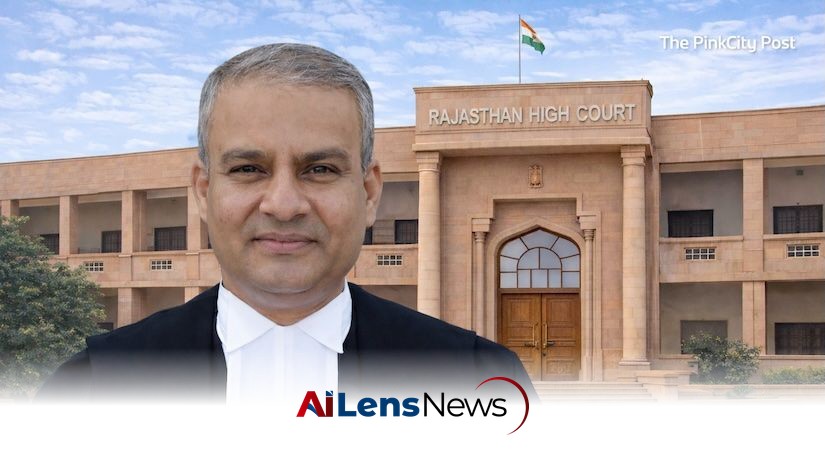


The Rajasthan High Court upheld the attachment of a Gurudwara, emphasizing that faith does not equate to ownership of religious property.
New Delhi, India Aug 13, 2026 ALN: Jodhpur: The Rajasthan High Court has upheld the attachment of a Gurudwara in Hanumangarh district and the appointment of the Station House Officer as receiver under Sections 164 and 165 of the Bharatiya Nagarik Suraksha Sanhita, 2023, holding that long association with a religious institution or its management cannot be equated with ownership or exclusive possession of the land on which the institution stands.
Justice Farjand Ali held that the distinction between the institution and the property must be maintained, and that a person cannot convert mere physical presence, religious association, management or long-standing access into a proprietary or legally enforceable right over the property in the absence of a lawful source of title.
Dealing with the petitioner’s claim founded on her continued presence at the Gurudwara since 2016, the Court observed:
“There may be devotees who have been visiting the same temple, mosque, church, dargah or Gurudwara for 40 years or more. Their continued presence may undoubtedly demonstrate deep faith and religious attachment, but faith cannot be converted into a claim of ownership or exclusive possession over the religious property. The distinction is subtle but fundamental.”
The petition under Section 528 BNSS assailed the order dated Nov 18, 2025 passed by the Additional Sessions Judge No. 2, Hanumangarh in Criminal Revision No. 176/2025, by which the Revisional Court had affirmed the order dated Oct 3, 2025 of the Sub-Divisional Magistrate, Pilibangan, directing attachment of the Gurudwara premises and appointing the SHO, Police Station Goluwala, as receiver.
The petitioner, Bibi Harmeet Kaur, claimed to have been serving as the Mukhya Sewadar of Gurudwara Mehtabgarh Sahib since 2016 and to have been handling its management and day-to-day affairs. A dispute over the management and control of the Gurudwara arose between her and another group of villagers largely from the Sikh community, which led to preventive proceedings and, eventually, to the registration of two cross FIRs.
According to FIR No. 243/2025, lodged on the written report of ASI Vijay Singh who was himself present at the spot in connection with patrolling and security arrangements, a mob of approximately 50 to 60 persons armed with lathis, swords, gandasis and spears approached the rear gate of the Gurudwara at about 3:15 AM on Oct 3, 2025 and, despite being restrained by the police personnel, attempted to gain entry by scaling the boundary wall. Seventeen persons were named in the FIR and offences under Sections 109(1), 121(1), 132, 331(6), 307, 223(b), 191(2), 191(3) and 190 of the Bharatiya Nyaya Sanhita, 2023 were registered. A cross FIR bearing No. 244/2025 was registered in respect of the very same occurrence on the report of the petitioner herself.
Senior Advocate Vikas Balia, appearing for the petitioner, submitted that the impugned orders were mechanical and suffered from non-application of mind, that the petitioner’s possession and her status as Mukhya Sewadar stood admitted from the complaint of the SHO itself, and that the dispute, taken at its highest, related to the management of the Gurudwara and not to land, water or boundaries, and therefore fell outside the ambit of Sections 164 and 165. It was further contended that there was no emergent situation warranting attachment, particularly when the alleged miscreants had already been arrested. Reliance was placed on a communication issued by the Shiromani Gurudwara Parbandhak Committee and on the decision of the same Court in Ashoknath Chela Kevalnath v State of Rajasthan.
On the claim that the petitioner had been appointed by the SGPC, the Court recorded that neither the learned Senior Counsel nor the Additional Advocate General could point to any statutory provision, rule, established practice, tradition or convention under which the managerial affairs of every Gurudwara must be centrally controlled by the SGPC. The Court additionally sought the assistance of members of the Sikh community practising at the Bar, whose response was “unanimous and categorical” that Gurudwaras are ordinarily established by local devotees from their own contributions and resources and are thereafter managed by a committee constituted locally for that purpose.
Turning to the scope of the preventive jurisdiction, the Court held that before initiating a proceeding under Section 164 BNSS or moving an application under Section 165(1), circumstances suggesting imminent danger of breach of peace must be shown with the assistance of cogent and reliable material and not by way of a vague or bald assertion. While reiterating that proceedings under Sections 164 and 165 are not proceedings for declaration of title, the bench held that the nature, legality and basis of the possession asserted cannot be completely divorced from consideration, and that a person asserting possession “cannot seek protection merely on the strength of physical occupation when the very basis of such exclusive possession has not been shown to have a lawful foundation.”
Drawing a distinction between private property and a place of worship, the Court observed that a religious place is intended to remain accessible to persons irrespective of their religion, faith or denomination, subject to duly prescribed and uniformly applicable restrictions such as regulated timings, and that entry there cannot ordinarily be questioned merely because a person belongs to a different faith or has not obtained individual permission. To illustrate that an institution is not reducible to its bricks, the judge pointed to the Court building itself, which derives its significance not from the land upon which it stands but from the judicial institution functioning within it.
Rejecting the contention that Sections 164 and 165 do not authorise the Magistrate to dispossess a person already in possession, the Court stated:
“If the preventive authority is faced with a situation where rival groups are repeatedly confronting each other, weapons are being carried, police personnel are being obstructed and attempts are being made to forcibly enter a religious premises, then the authority is not expected to remain a silent spectator merely because one faction asserts that it was previously in possession. Preventive jurisdiction is intended precisely to avert such a situation. The object is preservation of peace and not declaration of a winner.”
Noting that the then SHO appointed as persona designata had been subjected to aspersions by the petitioners and had since been transferred, the Court directed the present SHO, Police Station Goluwala, to undertake a fresh assessment of the prevailing law and order situation and submit a report to the Superintendent of Police, Hanumangarh, which is thereafter to be placed before the competent authority for an appropriate decision upon an objective assessment of the prevailing circumstances.
The petition was accordingly dismissed as devoid of merit and the orders dated Oct 3, 2025 and Nov 18, 2025 were affirmed, with the clarification that the dismissal shall not operate as an adjudication of title, ownership or permanent management rights over the Gurudwara or the land in question, and that the parties remain at liberty to agitate their substantive rights before the competent forum. The order, pronounced on Aug 12, 2026, opens with a passage from Mahatma Gandhi’s article in Harijan of March 18, 1933, in which he wrote that temples, mosques and churches “are an answer to man’s craving somehow to reach the UNSEEN.”
Title: Harmeet Kaur Alias Bibi v State of Rajasthan
Case No.: S.B. Criminal Miscellaneous (Petition) No. 10651/2025
Citation: [2026:RJ-JP:35881]
Counsel for petitioner: Mr. Vikas Balia, Senior Advocate assisted by Mr. Nitin Goklani; Mr. RDSS Kharlia; Mr. DS Thind
Counsel for respondent: Mr. Dhirendra Singh, Senior Advocate assisted by Ms. Priyanka Borana; Mr. Rajendra Kumar Soni; Mr. Deepak Chaudhary, AAG assisted by Mr. Vikram Singh Rajpurohit, DyGA
To learn more about the latest developments in Sikhism, stay updated with our exclusive reports and analyses on AiLensNews.

