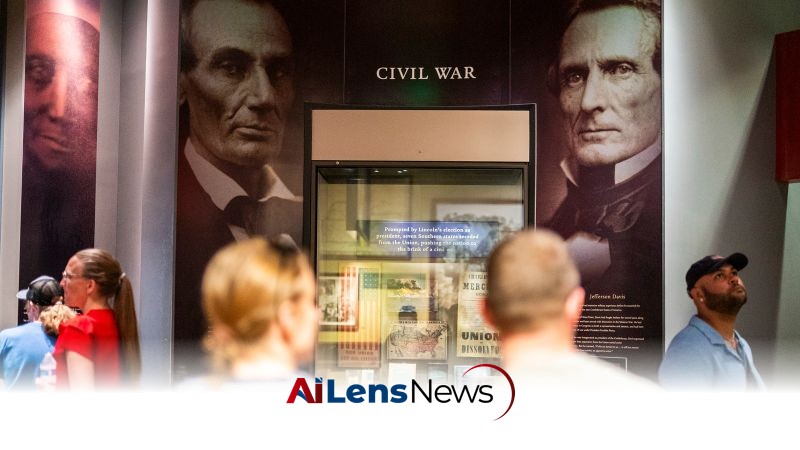


President Trump has mandated the installation of signs outside the Smithsonian's National Museum of American History, claiming the exhibits contain 'inaccurate information.'
Washington DC, United States Jul 25, 2026 ALN: President Donald Trump on Friday ordered the National Park Service (NPS) to install temporary signage near the Smithsonian’s National Museum of American History, warning of what the administration views as "inaccurate information" presented in the institution’s exhibits. This move has sparked significant debate over the intersection of politics, history, and public education, as well as the role of government in shaping narratives about the past.
The executive order mandates that the NPS, which controls the sidewalks outside of several Smithsonian museums along the National Mall, installs signs promoting a White House report that criticized the exhibits at the National Museum of American History. The report, released on July 4 by the White House Domestic Policy Council, accused the Smithsonian of advancing "radical," left-wing ideologies and promoting "an extreme political activism that seeks to transform our country." This assertion reflects broader concerns among some political factions regarding perceived biases in educational and cultural institutions.
The order specifies that the signage “shall notify visitors that the Museum exhibits should be renovated consistent with the findings” in the report and directs them to “locations and resources for accurate information” about the country’s history. However, the order does not elaborate on what those alternative resources should be, raising questions about the administration's criteria for determining historical accuracy and the sources it deems credible.
Critics have accused the Trump administration of attempting to leverage the museum to re-write the history presented in its exhibits to favor a conservative worldview. This contention points to a larger trend observed in recent years, where various political factions have sought to influence educational content to align with their ideological perspectives. The implications of such actions extend beyond the Smithsonian, as they could set a precedent for other institutions and raise concerns about academic freedom and historical integrity.
In a fact sheet released by the White House, it was stated, “President Trump is fighting back to restore one of the Nation’s greatest civic treasures to its founding mission and purpose and reestablish truth in the Nation’s historical narrative.” This statement underscores the administration's perspective that it is acting in the public interest to correct what it perceives as historical inaccuracies. However, the definition of "truth" in historical contexts is often subjective and can vary significantly among different scholars, educators, and political groups.
Friday’s order represents the latest effort by the Trump administration to re-write aspects of the nation’s history as presented in some of the country’s most prestigious museums and galleries. It follows a March 2025 executive order in which the White House sought to combat what it called “historical revisions” that cast the country’s history in a negative light. This ongoing campaign has raised alarms among historians, educators, and cultural leaders who argue that history should be presented in a nuanced manner that reflects multiple perspectives and complexities.
While the National Park Service falls under the purview of the Department of the Interior, the Smithsonian is an independent agency that is meant to operate outside the direct control of the executive branch. This independence is crucial for maintaining the integrity of the museum's exhibits and research. However, the government controls much of the museum system’s funding, which can create tensions between the institution's mission and the political priorities of the administration in power. Additionally, Vice President JD Vance's position on the Smithsonian board further complicates the relationship between the museum and the current government.
Smithsonian leaders have consistently stated that the institution will maintain its autonomy despite the administration’s repeated attempts to intervene with its exhibits and personnel decisions. This commitment to independence is vital for preserving the museum's credibility and ensuring that it can fulfill its mission to educate the public about American history in all its complexity. The Smithsonian’s leadership has emphasized the importance of scholarly rigor and integrity in curatorial practices, which they believe are essential for fostering an informed citizenry.
The decision to install signage at the Smithsonian raises broader questions about the role of museums in society. Museums are often seen as custodians of cultural heritage and historical narratives, and their exhibits can significantly influence public understanding of history. As such, any attempts to alter their narratives can provoke public outcry, especially from those who view such changes as politically motivated or ideologically driven.
This situation also highlights the ongoing cultural and political battles over how history is taught and remembered in the United States. As debates over issues such as race, immigration, and national identity continue to evolve, the role of institutions like the Smithsonian in shaping public discourse about these topics becomes increasingly significant. The potential for political interference in historical narratives raises concerns about the future of historical scholarship and the integrity of educational institutions.
In conclusion, the Trump administration's order to install signage at the Smithsonian’s National Museum of American History is a reflection of the broader tensions between politics and history. As various factions seek to assert their narratives over the past, the implications for public education, historical integrity, and institutional autonomy remain profound. The Smithsonian, as a leading cultural institution, faces the challenge of navigating these pressures while remaining committed to its mission of providing accurate and comprehensive representations of American history.
To learn more about the latest developments in Political Controversies, stay updated with our exclusive reports and analyses on AiLensNews.

