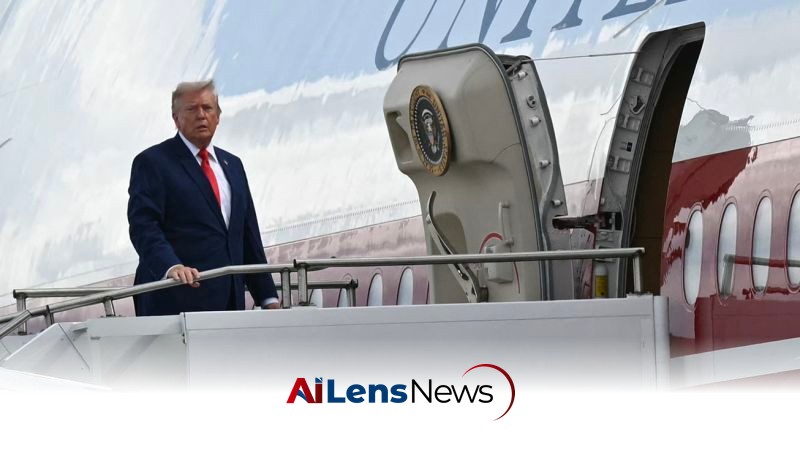


President Trump grapples with mixed signals from allies as he seeks a resolution to the ongoing conflict with Iran, with pressures mounting for de-escalation.
Washington DC, United States Aug 1, 2026 ALN: Just past 10 a.m. on Wednesday, a delegation of Saudi officials arrived at the West Wing carrying a message for the White House.
Defense Minister Khalid bin Salman, on an unannounced visit to Washington, conveyed word to both President Donald Trump and Vice President JD Vance from his brother, the kingdom’s powerful crown prince, that Saudi Arabia wants the Iran war to deescalate — and that prolonging the conflict carries major risks, according to people familiar with the conversations.
A day earlier, another emissary had arrived through the same door with a different message. Israeli Prime Minister Benjamin Netanyahu, sitting with Trump in the Oval Office, voiced skepticism that diplomacy with Iran would prove fruitful, according to Israeli officials. Instead, the two discussed options for pressuring Iran, including renewing a full-scale war, those officials said.
The back-to-back meetings this week were scheduled coincidentally. But they nonetheless underscore the crosscurrents facing Trump as he seeks an exit ramp to a conflict that has extended well past his deadline.
As pressure mounts from fellow Republicans to wind the war down, it actually appears to be expanding, with new fronts opening up and virtually every country in the region now drawn in. Efforts at diplomacy are halting at best; a senior US official said resuming direct diplomacy with Iran does not appear imminent.
Despite Trump’s claims Iran is “begging” for a deal to end the violence, some US officials fear regime figures appear more committed than ever to wielding leverage over the Strait of Hormuz and firing missiles toward American troops.
Trump has grown frustrated at Tehran’s unwillingness to bend to his demands, leading to angry meetings behind the scenes and expletive-laced phone calls to his allies, according to US officials. He convened his Cabinet on Friday at Camp David, perhaps hoping to seize inspiration from the retreat’s past role in successful Middle East diplomacy.
“I think we just want to win,” the president said when asked how he planned to revive the stalled diplomatic efforts, offering few clues of how he intends to proceed. “They’ll get weaker. They’ll get a little stronger maybe now. Then they’ll get weaker. And then they’ll peter out.”
The ongoing threats from Iran have forced Trump to alter his own plans, most notably a swap in Air Force One aircraft on his return trip from Turkey earlier this month. The change was made amid ramped up threats from neighboring Iran, according to officials, and subsequent coverage of the issue infuriated and embarrassed the president.
Many of Trump’s allies are now worried the Iran war is threatening to engulf his presidency entirely, and with it, Republicans’ chances in upcoming midterm elections, according to some GOP operatives. A CNN survey this week found only 28% of Americans approved of his handling of the war.
Options for escalating the conflict have been presented to Trump and debated at length, and more military assets flowed to the region in anticipation of a go-ahead from the president. One plan conceived by Central Command would involve heavy bombardment over the course of one or two weeks to take out Iran’s missile capabilities, US officials said.
Asked Friday whether he planned to “go big” in escalation, Trump said he’d already gone that route. “We’re going big. We’ve already gone big,” he insisted.
During a hearing on Capitol Hill last week, Chairman of the Joint Chiefs of Staff Gen. Dan Caine acknowledged that it is unlikely Trump can accomplish all his previously stated objectives for the war with air bombing alone.
“Air power has its limits,” Caine told lawmakers at the time.
And Trump has so far held off, in part after hearing concerns from Caine about dwindling supplies of air defense interceptors. Other officials have also raised worries about the risks of high civilian casualties if Trump followed through on threats to strike infrastructure sites like bridges and water desalination plants.
“Who am I hurting there? I’m hurting the people, so I’m not looking to do that,” the president said during a Fox News interview this week.
At this point, diplomatic discussions among regional players revolve around a short-term agreement focused on reopening the Strait of Hormuz, according to people familiar with the discussions, that would allow Trump to claim a win. The waterway has become the center of the conflict after the US and Iran came away with very different interpretations of how the issue was addressed in last month’s memorandum of understanding.
Republicans, who have largely supported Trump over the course of the conflict but are increasingly concerned higher gas prices could hurt their party in the midterms, have conveyed in private conversations the importance of getting the conduit reopened, the GOP operatives said.
“Obviously, we want success there. We think that we’ve achieved a high level of military success there,” Senate Majority Leader John Thune said this week. “The question on the Strait of Hormuz is something that obviously the president and his team are trying to continue to negotiate, and hopefully they’ll land an outcome or a solution there in the near future.”
The White House said Iran would “continue to pay” until they come to the table in a way Trump accepts. “The United States signed an MOU with Iran and they broke it, shot at commercial ships, and killed American soldiers. President Trump is not going to stand by and allow this terrorist behavior to occur. Iran will continue to pay until they come to the table in, what President Trump deems, a meaningful way,” press secretary Karoline Leavitt said in a statement.
While mediators including Qatar and Pakistan are hurriedly working to revive diplomatic talks, there are few signs of any active negotiations. Instead, officials now fear Iran’s powerful revolutionary guards are firmly in control of the decision making, leaving the political figures the US has been talking with as figureheads.
Complicating matters are the internal dynamics of the IRGC itself, where a handful of senior commanders are all jockeying for control. That dynamic is a leading reason why US officials and regional partners fear the conflict is likely to drag on.
In the Oval Office this week, Trump hinted at the divide, saying attempted Iranian strikes at US positions had not been the work of the interlocutors his team is trying to engage.
“It was a different group than we’re dealing with,” he insisted. “They’ve already apologized.”
Trump has complained that it’s difficult to know who is making decisions inside Iran, and he sometimes casts doubt on the ability of the US and Tehran to arrive at any agreement.
“People want to talk, but they break their words so often,” he said Friday at Camp David. “All they do is make me angry. You know, they just make me angry.”
Still, his top envoy Steve Witkoff and son-in-law Jared Kushner have voiced confidence a deal can be reached.
To learn more about the latest developments in Political Controversies, stay updated with our exclusive reports and analyses on AiLensNews.

