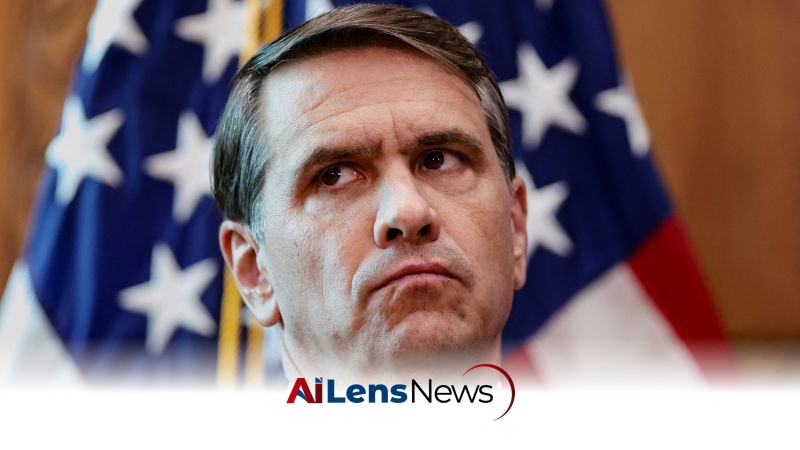


In a recent interview, Attorney General Todd Blanche refrained from committing to complete independence from the White House, raising concerns about the Justice Department's impartiality.
Washington DC, United States Aug 17, 2026 ALN: Attorney General Todd Blanche has recently come under scrutiny for his remarks regarding the independence of the Justice Department in relation to the White House, particularly in the context of the Trump administration. His comments, made during a Sunday appearance on NBC’s "Meet the Press," have raised significant concerns among critics who fear that the Justice Department may be acting as an extension of President Donald Trump’s political agenda rather than as an independent legal entity.
During the interview, Blanche was asked directly whether he would commit to always acting independently of the White House. His response, which was a firm "no," has sparked debates about the role of the Attorney General in relation to the presidency. He stated, "No, I’m not going to pledge that, and no attorney general should ever pledge that." This statement reflects a broader tension that has existed between the executive branch and the Department of Justice, particularly under administrations where political loyalty has been a focal point.
Blanche, who previously served as Trump’s personal defense attorney and was confirmed by the Senate after serving in an acting capacity since April, emphasized that President Trump has never asked him to act unethically or illegally. He asserted that the Justice Department would "prosecute without fear or any sort of favor," aiming to reassure the public that legal decisions would be made based on the law rather than political considerations.
However, Blanche's comments also indicated that he might take the president's views into account when making individual prosecution decisions. This admission has further fueled concerns regarding the potential for political influence over judicial matters. When pressed on whether Trump should have a say in specific cases, such as the recent dismissal of the Reflecting Pool vandalism case by the U.S. Attorney for the District of Columbia, Blanche acknowledged that every American, including the president, has a voice in prosecutions. He stated, "Will I take the president of the United States’ view on something into consideration? Yes, of course." This raises questions about the extent to which the Attorney General's decisions might be swayed by the president's opinions.
The Justice Department has faced criticism in recent years for appearing to engage in political dealings on behalf of Trump, particularly in cases involving individuals who have been perceived as political adversaries, such as former FBI Director James Comey and New York Attorney General Letitia James. Critics argue that such actions undermine the integrity of the Justice Department and its role as a neutral arbiter of the law.
In his interviews, Blanche attempted to clarify that he would not shy away from disagreeing with Trump when necessary. He stated, "The president loves disagreement," emphasizing that he would offer counsel to Trump that may not always align with the president’s views. He also dismissed the notion that Trump directly instructs him on legal matters, saying, "There’s that misnomer about President Trump – which is that he wakes up in the morning, calls me up, and says ‘Todd, go prosecute this.’ That’s absolutely not the case." This assertion aims to distance the Justice Department from accusations of being a tool for Trump’s political ambitions.
Blanche's comments on the Reflecting Pool case also highlighted the complexities of balancing political pressures with legal responsibilities. While he expressed support for U.S. Attorney Jeanine Pirro, he acknowledged that Trump had been frustrated with the outcome of the case. He defended Pirro’s overall performance, stating that judging her based on a single case is unfair, indicating a protective stance towards his colleagues within the Department.
Another significant issue that has arisen during Blanche's tenure is election integrity, a topic that has been a focal point for Trump, particularly following the controversial 2020 presidential election. During the interview, Blanche mentioned that the administration might seek the Supreme Court's intervention regarding efforts to obtain voter rolls from states ahead of the upcoming midterm elections. This move is part of a broader initiative by the Trump administration to scrutinize voter information, which has been fueled by Trump's unfounded claims that the 2020 election was stolen from him.
The administration has reportedly initiated legal action against approximately 30 states that have refused to comply with requests for unredacted voter rolls and other sensitive information. However, these efforts have not been without challenges; the administration has frequently faced legal setbacks in court, raising questions about the viability of its election integrity initiatives. When asked if he would consider appealing these court losses to the Supreme Court, Blanche responded that it was a "possibility," leaving the door open for further legal battles in this contentious area.
In summary, Attorney General Todd Blanche's recent statements have highlighted the ongoing debate surrounding the independence of the Justice Department and its relationship with the White House. His refusal to commit to absolute independence, combined with his acknowledgment of considering the president's views in prosecutorial decisions, has raised alarms among critics who fear that political motivations may unduly influence legal processes. As the Trump administration continues to navigate complex legal and political landscapes, the implications of these dynamics will likely resonate through the upcoming midterm elections and beyond, as the role of the Justice Department remains a pivotal element of American governance and legal integrity.
To learn more about the latest developments in Political Controversies, stay updated with our exclusive reports and analyses on AiLensNews.

