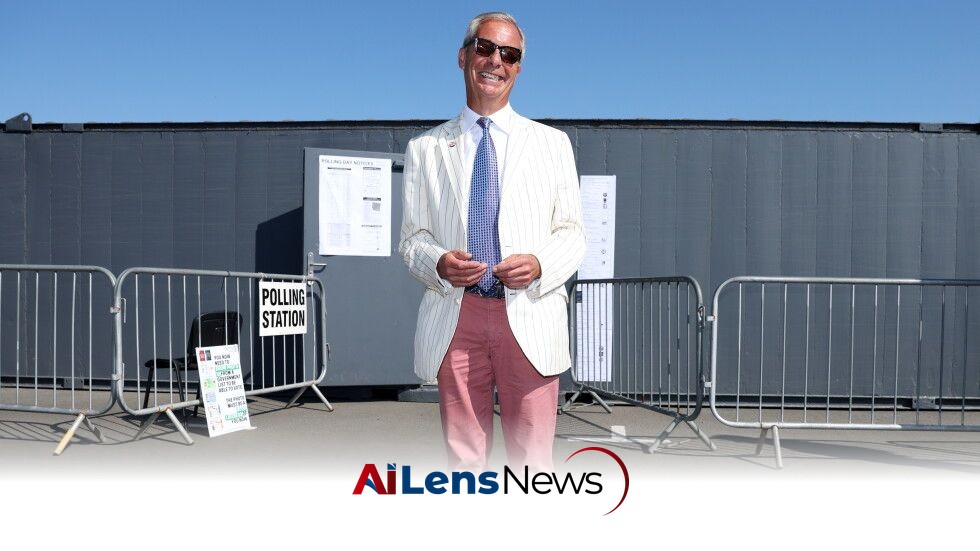


In a special election in Clacton, Nigel Farage competes against a range of unusual candidates, including Count Binface, amid scrutiny over his finances.
Washington DC, United States Aug 14, 2026 ALN: Nigel Farage, leader of the anti-immigration party Reform UK, had hoped a special election Thursday for his Parliament seat would help quell awkward questions about his finances. Farage, a prominent figure in British politics, has long been associated with the Brexit movement and has been a polarizing figure in discussions surrounding immigration and national sovereignty.
However, with the major parties refusing to field candidates in the election, voters in a small seaside resort outside London are choosing between a man with eyes on the prime minister’s office and a random assortment of candidates, led by a man wearing a trash can on his head. This unusual scenario underscores the current political climate in the UK, where traditional party lines are being blurred and unconventional candidates are gaining traction.
Farage triggered the vote last month when he quit his seat in the hope that it would put to bed questions about his finances and result in a resounding victory over his main political rivals from the Labour and Conservative parties. He characterized the election as a “people versus the establishment” contest, a narrative that has been central to his political brand since he first entered the political arena. Farage has often framed his political career as a battle against a perceived elite that is out of touch with the concerns of ordinary citizens.
However, his political foes described the move as a stunt and opted not to play ball. The absence of candidates from the Labour and Conservative parties suggests a strategic decision to avoid legitimizing what they perceive as an opportunistic maneuver by Farage. Instead, he is facing opponents like Count Binface, a political satirist posing as a comic space alien with a keen interest in earthly matters, including the positioning of a hand dryer in the men’s toilet in a pub in west London. This highlights a growing trend in British politics where satire and humor are being used as tools for political commentary and protest.
While Farage is widely expected to win the race, questions about the millions of pounds in donations that he had received will persist. These financial inquiries are not just a matter of personal scrutiny but reflect broader concerns about transparency and accountability in political financing in the UK. The implications of these financial questions could extend beyond this election, affecting Farage’s political future and the credibility of his party.
The election is a novelty with a record 34 candidates, including Howling Laud Hope of The Official Monster Raving Loony Party and Marcus White from the Everyone is God Party. The diversity of candidates reflects a vibrant, albeit chaotic, political landscape where voters are presented with an array of choices that often defy conventional political categorization. These candidates have pounded the streets of Clacton over the past few weeks as they seek to win the support of around 80,000 voters.
Given the numbers standing, Clacton residents will be presented with a ballot paper around 3 feet long (around 1 meter). This presents a logistical challenge for voters, who may find it cumbersome to navigate through such a lengthy list of candidates. The experience of voting in this election may serve as a microcosm of the broader electoral system, where an overwhelming number of choices can lead to confusion rather than clarity.
Turnout is widely expected to be low as it often is in special elections. In the July 2024 general election, Farage faced eight rivals and garnered 21,225 votes, or 46.2% of the total. Turnout was 58.7%, which indicates that while Farage has a solid base of support, it may not be enough to mobilize a significant portion of the electorate in a special election. This election is taking place during the summer holidays when thousands of voters will be far away from Clacton. Additionally, it coincides with another U.K. heatwave, which could further discourage voter turnout as citizens opt for leisure activities over participating in the electoral process.
Farage, who in 2024 was elected to Parliament at his eighth attempt in the strongly Brexit-backing town, has for months been facing what he considers to be unfair scrutiny of his finances. This scrutiny comes at a time when political figures are increasingly held accountable for their financial dealings, reflecting a growing public demand for transparency. Parliament’s standards watchdog is investigating an undeclared donation of 5 million pounds ($6.7 million) to Farage in 2024 from Christopher Harborne, a Thailand-based cryptocurrency billionaire. Farage maintains that he didn’t need to declare the money because it was a personal gift he used to fund his security and came before he was elected.
However, newly elected lawmakers must declare gifts worth more than 300 pounds ($400) received in the previous year if they are related to political activities. This rule is designed to prevent corruption and conflicts of interest, ensuring that lawmakers are accountable to their constituents. Farage’s situation raises important questions about the adequacy of current regulations and whether they effectively address the complexities of modern political financing.
When he stood down on July 7, he described the scrutiny as an “establishment hit job” and a media-driven “witch-hunt.” This rhetoric is not uncommon among political figures facing allegations of impropriety, as it serves to rally their base and frame the narrative in a way that portrays them as victims of an unjust system. His decision to stand down put a pause to the parliamentary investigation, but if he wins on Thursday, as most pollsters expect, it is set to start again.
If he’s found to have breached Parliament’s rules, then he could face a recall petition in Clacton, which may lead to another special election later this year, costing the British taxpayer hundreds of thousands of pounds more. The potential for a recall election underscores the precarious nature of Farage’s political future and the lasting impact of financial scrutiny on his career. The difference is that in that one, the other parties would choose to stand, potentially making it a more competitive race.
Farage’s decision came weeks after Andy Burnham returned to Parliament in a special election in the Makerfield constituency near Manchester. That campaign shone a positive spotlight on Burnham, triggering a chain of events that saw him become Britain’s prime minister a few weeks later following the resignation of Keir Starmer. The contrasting trajectories of Burnham and Farage highlight the unpredictable nature of political fortunes and the role that public perception plays in shaping electoral outcomes.
Any hope that Farage had that the Clacton campaign would be similarly positive for him was dashed when the other political parties failed to play ball and he was left standing against the likes of Count Binface. This underscores the challenges facing traditional political figures in an era where satire and humor are increasingly being embraced by the electorate as valid forms of political expression.
Under Binface’s black cape, trash can and ample body armor that looks straight out of a low-budget sci-fi film, is a middle-aged comedian named Jon Harvey trying to keep his cool during a sweaty summer. His unique approach to candidacy reflects a growing trend in British politics where unconventional candidates are gaining traction. He has been a regular candidate in high-profile elections before, having previously stood against then prime ministers Boris Johnson and Rishi Sunak. His persistence in running for office highlights the belief that humor and satire can serve as powerful tools for political engagement.
He says his repeated candidacies are aimed at promoting the beauties of Britain’s centuries-old democracy where even the most high-profile politicians are above no one — including someone from his fictional native planet of Sigma IX. This perspective resonates with many voters who feel disillusioned with traditional politics and are seeking alternatives that reflect their frustrations and aspirations.
Joke candidates are a long-standing and cherished tradition in British elections so long as they meet the rules and pay the deposit of 500 pounds ($675) required of all those standing. They only get it back if they muster 5% of the votes cast. In his most recent run, against Burnham in Makerfield, the 5,000-year-old Binface got 95 votes, or 0.2% of the total. However, there is an expectation that he will do a lot better in Clacton. Many of the voters of the other political parties have been lending him their support, partly in the hope of embarrassing Farage. This phenomenon reflects a broader sentiment among voters who may be disillusioned with mainstream political options and are looking for ways to express their dissatisfaction.
Given the numbers standing, the result is not expected until breakfast time Friday. The outcome of this election will not only determine Farage's immediate political future but also serve as a barometer for the current state of British politics, revealing how voters are responding to traditional party politics in the wake of ongoing challenges and discontent.
To learn more about the latest developments in Elections, stay updated with our exclusive reports and analyses on AiLensNews.

