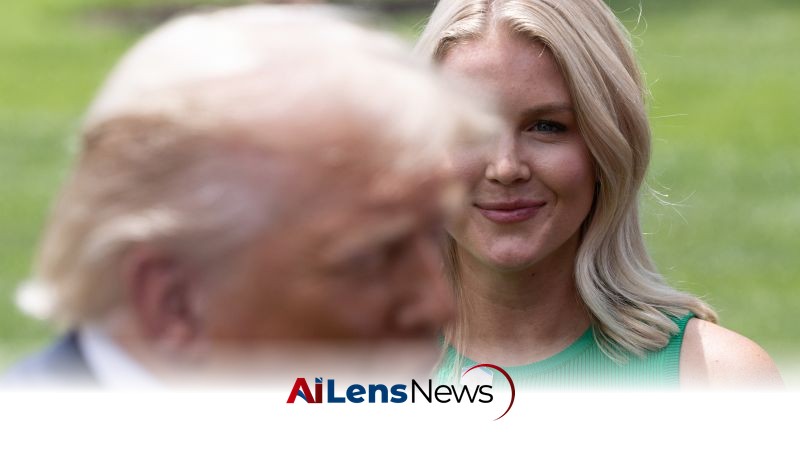


Karoline Leavitt's exit as press secretary highlights her vital role in shaping Trump's communication and the challenges of replacing her.
Washington DC, United States Aug 13, 2026 ALN: Donald Trump hardly needs anyone else to serve as his mouthpiece. The most clamorous president in modern history always gets his message out — in a daily riot of online posts, interviews, and rancor with reporters. His communication style, characterized by its unpredictability and often incendiary nature, has reshaped the landscape of American political discourse. The departure of a press secretary, therefore, might seem like a trifle to the messenger in chief. But the exit of Karoline Leavitt, announced Wednesday, represents a significant personal and political loss. The vacuum she’ll leave will emphasize her role as a vital member of the president’s brain trust.
Leavitt's contributions to the Trump administration extend far beyond the traditional responsibilities of a press secretary. She has consistently demonstrated a deep understanding of the Trump id, the instinctual desires and impulses that drive the former president's behavior and rhetoric. Her role has included leading the charge against Washington institutions of accountability, particularly the Beltway press, which has often been at odds with Trump's administration. Just like her boss, she broke the mold of her position, embodying a new style of communication that is more combative and less deferential than what has been typical in previous administrations. With her relentless trolling of reporters, she has exposed the fractures of traditional journalism in the social media age, where sensationalism often trumps substance.
On social media, Leavitt expressed that since the birth of her second child, a daughter, on May 1, she had come to realize that she couldn’t be the mother her kids deserve while devoting the "constant time, energy, and attention" her job requires. Trump, perhaps softening the blow to himself over the departure of a 28-year-old he praised as one of his "most trusted aides," announced that Leavitt will continue to serve as an outside adviser. This arrangement suggests that while she may be stepping back from day-to-day responsibilities, her influence within the administration will not be entirely severed.
Being Trump’s press secretary is no easy ride. The term "message discipline" is an oxymoron in this administration. No one, including himself, knows what the president will say from one minute to the next. He changes policy on a dime, contradicting his top officials and himself with alarming frequency. This unpredictability creates a challenging environment for anyone tasked with managing the administration's communications.
Moreover, Trump is a master media manipulator. He has demonized, flattered, and played reporters for decades, relishing the role of a New York tabloid villain as he built his brand as a real estate tycoon and celebrity. His keen understanding of the media landscape allows him to exploit its weaknesses, using reporters' cravings for constantly evolving headlines as a distraction from his controversies. His zeal for conflict, disdain for etiquette, and willingness to say outrageous things have forged a unique relationship with the media, one that is both adversarial and symbiotic.
Trump's political ascent coincided with the explosion of social media, which he has used to inject his volcanic personality into the nation’s political bloodstream. Unlike his predecessors, who relied on traditional media as a conduit for their messages, Trump has often bypassed these channels entirely, communicating directly with his supporters through platforms like Twitter and Facebook. This strategy has fundamentally altered the dynamics of political communication in the United States.
While it may seem that Trump doesn’t need another press secretary, the reality is that Leavitt's combination of skills will be difficult to replace. She speaks MAGA more fluently on camera than anyone but the president himself. Her briefings were less attempts to explain policy or to deliver coded messages to foreign leaders than demonstrations of Trumpian defiance. Her ability to engage with the media in a manner that resonates with Trump’s base has been a significant asset for the administration.
The president’s supporters have shown great affection for Leavitt, whose confrontational style and sharp critiques of prominent journalists echo the rebellious spirit of Trump’s first campaign. She rarely answered questions directly, instead opting to attack the motives or mindsets of reporters, who often found themselves cast as extras in the Trump show. This approach has endeared her to many in the MAGA community, who view her as a champion of their values against a perceived liberal media bias.
Last month, Leavitt sat by the president’s side at the White House Correspondents’ Association Dinner, an event rescheduled following a security scare. That evening, which Trump spent insulting journalists in vicious and personal terms, will now serve as a valedictory metaphor for her tenure. It encapsulates the combative relationship between the Trump administration and the press, a dynamic that has only intensified over the years.
It is also fitting that Leavitt announced her resignation amid a storm over whether the White House used reporters on Air Force One as a decoy during the president’s secret flight from Turkey during a security scare last month. This incident highlights the ongoing tensions between the Trump administration and the media, as well as the challenges faced by those in the press corps who seek to hold the administration accountable.
Leavitt’s tenure will be remembered as devastating to the quaint notion that the press has a vital role in holding presidents to account. Her operation took over control of the pool system long administered by the independent correspondents’ association, determining who gained access to presidential events and who flew on Air Force One. She introduced streaming services, local conservative radio hosts, podcasters, and MAGA personalities into the permanent press corps, which critics have viewed as an attempt to dilute the traditional media landscape.
Many observers have expressed concern that this shift represents an effort to introduce propagandists who would go soft on Trump. Conversely, his supporters have cheered what they see as an overdue dilution of what they regard as the liberal elite media. The administration's approach to media relations has led to significant debates about press freedoms and the role of journalism in a democratic society.
One notable controversy underscoring the administration's contempt for regular media occurred when Leavitt, under Trump’s direction, banned the Associated Press from certain White House press events. An AP reporter was also excluded from Air Force One after the agency refused to alter its style guide to align with Trump’s executive order renaming the Gulf of Mexico to the “Gulf of America.” Such actions have raised grave questions about press freedoms and the ability of journalists to perform their duties in a free society.
Leavitt's briefings soon made the “alternative facts” pioneered by Trump’s first-term media team appear tame by comparison. She opened briefings with highly torqued monologues hyperbolically lauding Trump’s achievements. Her performances were reminiscent of prime-time shows on conservative television, a world in which she would likely find a lucrative future once her children grow up.
Tensions between every administration and the media are not new. Relations between President George W. Bush’s team and reporters were often brittle, and acrimony between reporters and President Barack Obama’s aides belied conservative notions that journalists were in the tank. The Biden administration has also experienced its share of challenges with the press. However, Trump has threatened the constitutional role of the press in the republic as never before, creating a unique and troubling environment for journalists.
Democratic Rep. James Walkinshaw commented on CNN’s “The Arena” regarding Leavitt's departure, expressing skepticism about the sincerity of her stated family reasons. He remarked, “It’s a tough job. It’s a job where, to be Donald Trump’s spokesman, you have to willfully deny reality on a daily basis.” Walkinshaw added, “I think her legacy will be one of further degrading the relationship between the White House and the press.” This sentiment reflects a broader concern among critics that the erosion of trust between the media and the government could have lasting implications for American democracy.
To learn more about the latest developments in Political Controversies, stay updated with our exclusive reports and analyses on AiLensNews.

