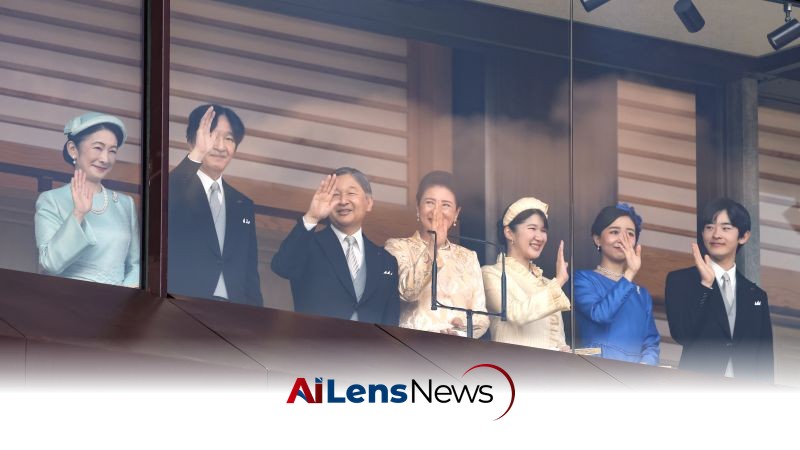


Japan's royal family is grappling with a succession crisis as the government resists allowing women to ascend the throne, despite a dwindling number of heirs.
Washington DC, United States Jul 14, 2026 ALN: Japan's monarchy, known for its rich history and cultural significance, is currently grappling with a succession crisis that has been exacerbated by longstanding gender restrictions. While the nation may soon see its first female prime minister, the chances of a woman ascending to the imperial throne appear increasingly remote due to entrenched patriarchal traditions that have governed the monarchy for centuries.
The current situation is dire, with only three eligible heirs to the Chrysanthemum throne, two of whom are over the age of 60. This demographic reality poses a significant challenge for the future of the imperial family. Japan's historical preference for male-only succession has deep roots in a society that has long been characterized by male dominance in various sectors, including business and politics. The implications of this crisis extend beyond the royal family, raising questions about gender equality and women's roles in leadership within Japanese society.
In recent decades, the imperial family has seen a notable increase in the number of daughters born, which has led to a dwindling number of male heirs. This demographic shift has prompted government ministers to propose a controversial solution: reinstating former branches of the royal family to expand the pool of male successors. These proposals are currently awaiting parliamentary approval, but they have ignited a debate among scholars, opposition politicians, and citizens regarding the exclusion of women from the line of succession.
Professor Makoto Okawa, an expert on imperial lineage at Chuo University in Tokyo, has voiced concerns over the lack of a rational basis for the exclusion of women from the throne. Historically, Japan has had eight empresses, primarily when male heirs were too young to assume power. However, the enactment of the Imperial House Law in 1889 during the Meiji era formally prohibited female emperors, a decision that has persisted for over a century.
Despite this legal framework, Okawa emphasizes that the Japanese constitution does not explicitly bar women from ascending to the throne. He argues that the exclusion of women should not be viewed as a cultural norm or tradition but rather as a manifestation of misogyny that undermines the potential for female leadership. Public sentiment appears to align with Okawa's views, as various polls indicate that a majority of Japanese citizens are open to the idea of female emperors, reflecting a shift in societal attitudes toward gender roles.
One resident, Kana Sakakura, has pointed out the stark contrast between Japan and other nations, such as the United Kingdom, which have embraced female monarchs as part of their historical narrative. She notes that Japan still exhibits an atmosphere that discourages women from taking on leadership roles, which further complicates the discussion around female succession in the imperial family.
Despite growing public support for female succession, the ruling Liberal Democratic Party (LDP), led by Prime Minister Sanae Takaichi, remains firmly opposed to any changes that would allow women to ascend to the throne. During a recent parliamentary discussion, Takaichi reiterated her stance, stating that it is "appropriate to limit eligibility to male descendants of the imperial lineage." This unwavering position underscores the challenges faced by advocates of gender equality within the context of Japan's monarchy.
The proposed amendments to the Imperial House Law, which are expected to pass into law soon, do not include any provisions that would enable a princess to ascend to the throne. Furthermore, the current rules dictate that if a female member of the royal family marries a commoner, her children are also excluded from the line of succession. This stipulation has significant implications for the future of the imperial family, particularly as the number of eligible heirs continues to dwindle.
Despite its largely ceremonial role, the imperial family holds immense symbolic value in Japan, serving as a unifying force for the nation of approximately 123 million people. The historical significance of the monarchy is such that General Douglas MacArthur, who oversaw Japan's post-World War II reconstruction, famously described the emperor as "a symbol which unites all Japanese." His warning that the destruction of the emperor would lead to national disintegration highlights the delicate balance between tradition and modernity that the imperial family must navigate.
The challenges of succession are compounded by the historical context of the imperial family. In pre-war Japan, the imperial family was considerably larger, with multiple collateral branches, known as Oke, that provided a wider pool of potential successors. However, following World War II and the subsequent economic turmoil, the Imperial House Law was amended in 1947 to downsize the imperial family and reduce royal expenditures. This amendment drastically limited the membership of the imperial family to the immediate relatives of Emperor Hirohito, effectively eliminating 11 collateral branches and setting the stage for the current succession crisis.
The original royal household, which consisted of 67 members, has now dwindled to just 16, a contraction that has been further exacerbated by the requirement that female members leave the imperial family upon marrying a commoner. This policy has significantly restricted the pool of potential heirs and has contributed to the ongoing crisis.
In an effort to address these challenges, the latest government proposal suggests allowing the imperial family to "adopt" members from the former collateral branches. Under this proposal, individuals aged 15 and older who are unmarried and childless could be adopted into the imperial family, thereby expanding the line of succession. The children of these adopted members would also be eligible for the throne, potentially alleviating the immediate crisis.
Currently, Emperor Naruhito, who is 66 years old, has a daughter, Princess Aiko, who is widely regarded as popular among the Japanese public. However, under the current laws, she is legally barred from inheriting the throne. At 24 years old, she does not have any children, and even if she were to have a son, he would also be ineligible to ascend to the throne due to the gender restrictions in place.
The two other eligible successors are Hitachi, Emperor Naruhito's 90-year-old uncle, and his younger brother Akishino, who is 60. The third eligible successor, and the most likely candidate, is Akishino's 19-year-old son, Hisahito, who is notable for being the first male royal to reach adulthood in four decades. This concentration of potential successors within a limited age range raises further concerns about the future stability of the monarchy.
As Japan navigates this complex landscape of tradition, gender, and modernity, the question remains: will the monarchy adapt to the changing societal norms that increasingly favor gender equality, or will it continue to cling to its historical precedents at the risk of its own survival? The outcome of this ongoing discussion will have profound implications not only for the imperial family but for the broader discourse on gender roles and leadership in Japan.
To learn more about the latest developments in Political Controversies, stay updated with our exclusive reports and analyses on AiLensNews.

