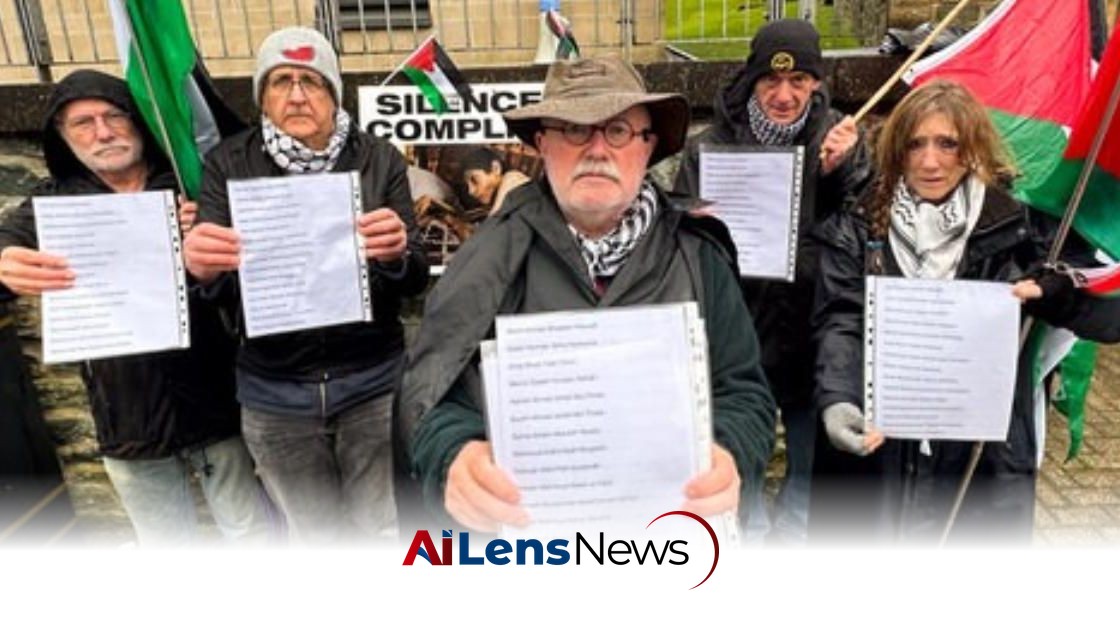


Bill Williamson, a Scottish pro-Palestine activist, faces charges after reading a poem about children killed in Gaza during a vigil in Dunoon.
London, United Kingdom Jul 18, 2026 ALN: A SCOTTISH pro-Palestine activist is facing charges for “threatening and abusive behaviour” after reading a poem about children killed by Israel. Bill Williamson, 74, who lives in Ardentinny, said he had been at a weekly Palestine vigil outside Dunoon Burgh Hall on July 4 when he was approached by a pair of police officers while he was reading out Don’t Mention The Children by the Jewish writer Michael Rosen through a megaphone.
Williamson's arrest has sparked significant debate surrounding freedom of speech, the right to protest, and the implications of police intervention in peaceful demonstrations. The incident raises questions about the boundaries of acceptable public discourse, particularly in relation to sensitive and politically charged topics such as the Israeli-Palestinian conflict.
He said: “I was midway reading the poem [which takes about 90 seconds], and I hear, ‘Excuse me, sir, excuse me, sir’, so I thought, well, I'm almost finished, so I'll just carry on – but then this police constable started trying to snatch the poem.” This moment encapsulates the tension that often exists between law enforcement and activists, particularly those advocating for marginalized voices or controversial issues. The police's intervention in Williamson's peaceful demonstration has raised concerns among activists and civil liberties advocates about the potential chilling effect on free speech.
Williamson said that after he finished, the police officers told him repeatedly that he had been “causing fear and alarm” by reading out the poem, something he said he had done twice at a vigil every Saturday for the past two-and-a-half years. The idea that reciting a poem could incite fear challenges the very notion of what constitutes a threat in public discourse. Williamson's assertion that he had been reading the poem regularly without incident underscores the complexities of policing public expression, especially when it pertains to contentious political issues.
“He kept repeating that I was causing fear and alarm, people could be placed in a state of fear and alarm because I was reading out this poem about dead babies, dead children,” the activist went on. This highlights the potential disconnect between law enforcement's interpretation of public safety and the activist's assertion of his right to express a viewpoint. In a democratic society, the challenge lies in balancing the need for public order with the protection of individual rights to free expression.
“He said if you do that again, you'll be arrested. I said, well, hang about till 1.30 because it'll be getting read out again.” Williamson's defiance reflects a broader sentiment among activists who feel that their rights are being infringed upon. This incident not only highlights individual cases of police intervention but also points to a larger trend where activists may feel increasingly vulnerable while voicing dissenting opinions.
Williamson and other activists then got into a back-and-forth with officers which led to his arrest. “They slapped handcuffs on me and took me to a police van and put me in the back of it and demanded my details, and I said, well, you're not getting them, and I was there for an hour [before being ‘de-arrested’],” he said. This sequence of events raises further questions regarding the appropriateness of police responses to non-violent protests and the potential for escalation in confrontations between activists and law enforcement.
“The first thing I did was I went back up and I got the poem out.” This act of reclaiming his voice after the arrest symbolizes the resilience of activists who continue to fight for their causes despite facing legal repercussions. Williamson's determination to continue reading the poem reflects a belief in the importance of raising awareness about the plight of children affected by conflict, a theme prevalent in many human rights discussions.
As he had been told he was being de-arrested, Williamson said he believed that was the end of the matter. However, three days later, on July 7, three officers turned up at his house and told his wife that he had been “reported to the courts.” This unexpected follow-up from law enforcement has left Williamson feeling targeted and confused about the legal ramifications of his actions. “Now, if they wanted my details, how did they know where I lived?” Williamson asked, expressing frustration over the perceived lack of transparency in police actions.
“It was a game they were playing.” This sentiment of being subjected to arbitrary enforcement resonates with many activists who feel that their rights are not being respected. Williamson's experience is indicative of a broader concern regarding the treatment of individuals who seek to draw attention to social justice issues, particularly those related to international conflicts.
He added: “Initially I thought, just let this die a death. But then I thought, people are not hearing about this gradual erosion of our civil liberties.” This reflection highlights a critical aspect of activism: the need to raise awareness about the potential encroachments on civil liberties that can occur when individuals attempt to express dissenting opinions. The implications of such actions extend beyond individual cases and speak to the health of democratic societies and their commitment to protecting free speech.
“I thought, this is intimidation. The more people that know about it, I think the better.” This call to action underscores the importance of solidarity among activists and the need for collective awareness regarding the challenges faced by those who advocate for marginalized communities. Williamson's experience serves as a reminder of the ongoing struggles for civil rights and the necessity of vigilance in protecting freedoms that many take for granted.
A Police Scotland spokesperson said: “A man was arrested in the Argyll Street area of Dunoon on Saturday, 4 July, 2026, in connection with threatening and abusive behaviour and failing to provide his details when required by police.” This official statement reflects the law enforcement perspective on the incident, but it also raises questions about the criteria used to determine what constitutes threatening behavior in the context of peaceful protests.
“Due to an ongoing incident nearby, the man was de-arrested. A report has been submitted to the Procurator Fiscal in connection with these offences.” The mention of an ongoing incident adds another layer of complexity to the situation, suggesting that external factors may have influenced the police's actions during Williamson's arrest. This context is crucial for understanding the dynamics at play during protests and the potential for police discretion to impact individual cases.
Rosen’s poem was written in response to a 2014 decision by the Israeli Broadcasting Authority to ban a radio advert from human rights group B’Tselem which listed the names of children killed in Gaza. The historical context of the poem adds depth to Williamson's actions, as it reflects ongoing debates about the representation of suffering and the impact of conflict on vulnerable populations, particularly children. The poem serves as a powerful reminder of the human cost of war and the importance of remembering those who are often overlooked in political discourse.
Rosen’s poem ends: “The people would not be safe if they knew/ the names of the children./ Don’t name the dead children./ Don’t remember the dead children./ Don’t think of the dead children./ Don’t say: ‘dead children’.” These poignant lines encapsulate the struggle to bring attention to the plight of children affected by conflict, emphasizing the need for empathy and awareness in discussions surrounding war and its consequences.
Last month, a UN inquiry concluded that Israel had deliberately targeted Palestinian children as part of a genocide, and that more than 20,000 Palestinian children have been killed and more than 44,000 injured since October 2023. This alarming statistic underscores the urgency of the issues Williamson sought to highlight through his recitation of the poem. The findings of the UN inquiry further complicate the discourse surrounding the Israeli-Palestinian conflict, as they challenge narratives that minimize the impact of military actions on civilian populations, particularly children.
To learn more about the latest developments in Political Controversies, stay updated with our exclusive reports and analyses on AiLensNews.

