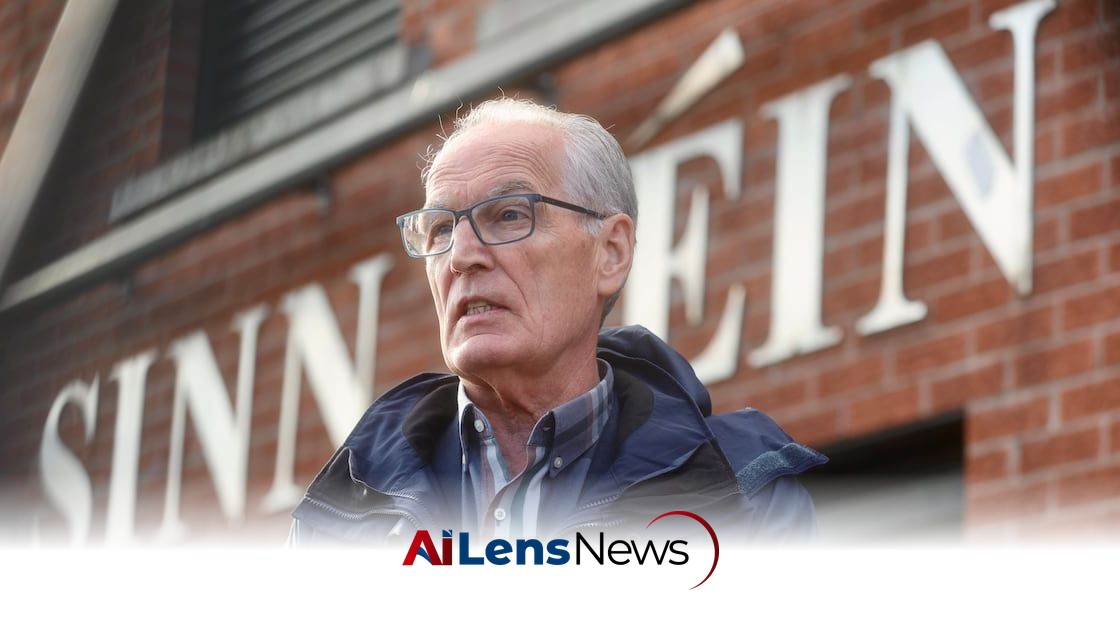


Veteran republican Gerry Kelly, MLA for North Belfast, will not contest the next Stormont election, marking the end of a three-decade political career.
London, United Kingdom Jul 22, 2026 ALN: Veteran republican Gerry Kelly has revealed that he won’t stand in next year’s Stormont election, marking the end of a significant chapter in Northern Ireland's political landscape. Mr. Kelly, a prominent figure in Sinn Féin, made the announcement in an interview with The Irish News, expressing his intention to remain involved in activism, albeit in a less intensive capacity, stating he would be “just not a 24/7 activist.” His retirement from the Assembly will bring the curtain down on a political career spanning three decades, a period that has seen immense change in Northern Ireland.
At 73 years old, Kelly is a North Belfast MLA and a former IRA prisoner whose political journey began with his participation in the Northern Ireland Forum in 1996. This forum was a precursor to the more formal legislative assembly established under the Good Friday Agreement in 1998, which was pivotal in the peace process that aimed to end decades of conflict known as The Troubles. Kelly's election to the Assembly marked a significant milestone in his life, transitioning from a history of paramilitary involvement to a role in democratic governance.
While not the eldest member of the Assembly, Kelly is one of its longest-serving representatives, alongside figures such as speaker Edwin Poots. His tenure includes a period of service as an Executive junior minister from 2007 to 2011, during which he was involved in various policy initiatives and governance strategies aimed at fostering peace and reconciliation in Northern Ireland. As he steps back from his official role, he expressed a desire for personal time, particularly to reconnect with his family, acknowledging that his political commitments often kept him away during his children’s formative years.
In his reflections on his political career, Mr. Kelly highlighted the promising future of Sinn Féin, noting that he believes he is leaving the party in a healthy state with new talent emerging. He expressed confidence in the younger generation of politicians, stating, “I honestly think we’ve great younger people coming through. They are much better educated with a great depth of knowledge.” This observation underscores a broader trend within many political organizations where new leaders are emerging with fresh perspectives and skills, particularly in a rapidly changing political environment.
Assessing the current state of Stormont, Kelly was critical of the Democratic Unionist Party (DUP), suggesting that their tactics were ineffective and that they often seemed preoccupied with their position relative to other unionist factions. He remarked on the irony that those who are meant to champion the stability of the Assembly are, in fact, contributing to its dysfunction. This critique reflects ongoing tensions within Northern Ireland’s political framework, where inter-party dynamics can significantly influence governance and public policy.
Mr. Kelly's reflections on aging in politics were both humorous and poignant. He noted that he first felt the passage of time when he found himself sharing platforms with senior police officers, observing that the chief constables he addressed were consistently younger than him. This anecdote serves as a reminder of the generational shifts occurring in both politics and law enforcement, and how these changes are reflective of broader societal transformations in Northern Ireland.
Before entering the political arena, Gerry Kelly had a tumultuous past as an active member of the Irish Republican Army (IRA). Born in west Belfast, he joined Fianna Éireann in his teens, which was a youth organization associated with the republican movement. His political activism took a drastic turn when he was arrested in 1971, leading to a series of events that would shape his future. During his imprisonment in Dublin’s Mountjoy prison, he escaped and returned to Belfast, showcasing a commitment to the republican cause that would define much of his early life.
Kelly’s involvement in the IRA escalated in the early 1970s, particularly with a series of car bombings in London, including near the Old Bailey, which led to his conviction at the age of 19 for causing explosions and conspiracy to cause explosions. He received two life sentences, a reflection of the severity of his actions during a tumultuous period in Irish history. His time in prison was marked by significant events, including a hunger strike that lasted 60 days, during which he was force-fed, illustrating the extreme measures taken by prisoners to protest their conditions and treatment.
Following his hunger strike, Kelly was transferred to the Maze Prison, a facility notorious for housing paramilitary prisoners. His time there was punctuated by multiple escape attempts, culminating in 1983 when he led a massive prison break that resulted in the death of a prison officer. This incident underscored the violent and chaotic backdrop of the Troubles, a conflict characterized by deep-seated divisions and violent confrontations.
After going on the run, Kelly continued to be involved in the IRA’s operations, including attacks in Europe. His eventual arrest in Amsterdam in 1986 alongside fellow republican Brendan ‘Bik’ McFarlane led to his extradition back to the UK. He was released three years later under conditions agreed upon with Dutch authorities, highlighting the complexities of international law and extradition in the context of political conflict.
Gerry Kelly's retirement from politics comes at a time when Northern Ireland continues to grapple with the legacy of the Troubles and the ongoing challenges of governance in a post-conflict society. His departure from the Assembly raises questions about the future direction of Sinn Féin and the broader political landscape in Northern Ireland, particularly as younger leaders step into roles that will shape the region’s future. The evolution of political leadership, especially in a context marked by historical divisions, will be critical as Northern Ireland seeks to navigate its path forward amidst ongoing challenges and opportunities.
To learn more about the latest developments in Elections, stay updated with our exclusive reports and analyses on AiLensNews.

