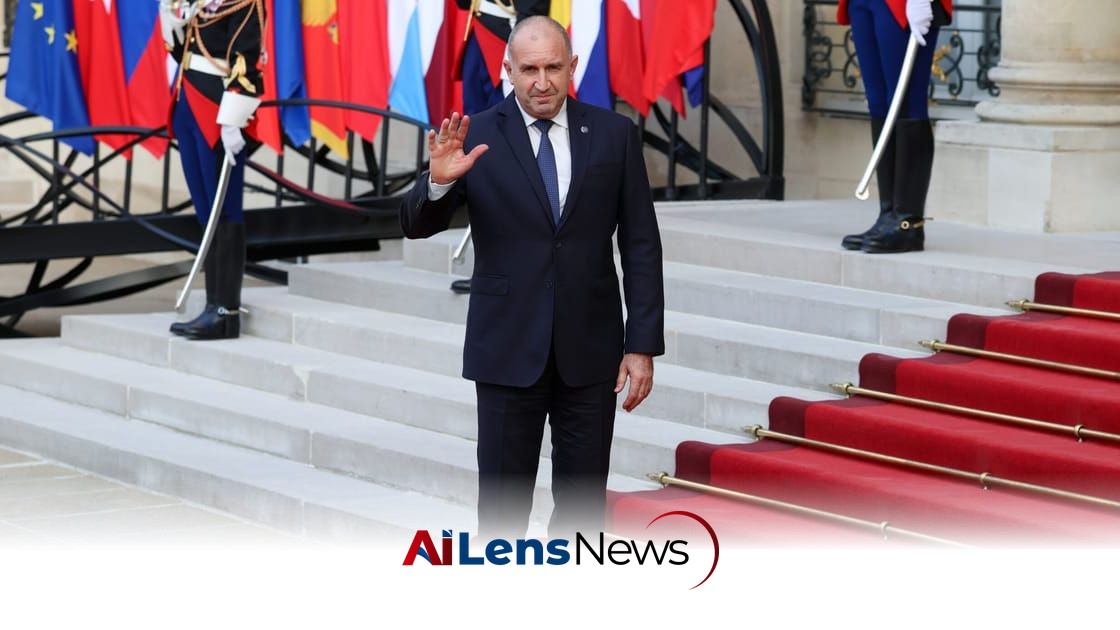


Prime Minister Rumen Radev asserts Bulgaria's stance against military support for Ukraine, emphasizing diplomacy over prolonged conflict.
London, United Kingdom Jul 14, 2026 ALN: Bulgaria's Prime Minister Rumen Radev recently made headlines by declaring that his country does not belong to the so-called Coalition of the Willing, which comprises various European nations committed to supporting Ukraine amid its ongoing conflict with Russia. This statement was made during his attendance at the Bastille Day celebrations in Paris, where Bulgarian ceremonial Guards participated alongside other European armed forces. Radev's remarks have sparked discussions about Bulgaria's foreign policy stance, its relationship with NATO and the EU, and the broader implications for regional security in Eastern Europe.
During a press briefing in Paris, Radev, a politician known for his alignment with Russia, emphasized that despite being invited by French President Emmanuel Macron to engage further with the Coalition of the Willing, he firmly believes that it is not in Bulgaria's interest to be part of such an alliance. "We are not part of a coalition that insists on continued financial and military assistance to Ukraine," he stated, highlighting his administration's reluctance to directly support Ukraine through military means. Instead, Radev underscored the importance of diplomatic solutions, arguing that prolonging the conflict through military engagement is not a viable path forward. This perspective reflects a significant divergence from the views held by many Western leaders who advocate for ongoing military support to Ukraine.
Radev's skepticism towards military involvement is not a new development; it aligns with his broader foreign policy approach since taking office. He has consistently maintained that the war in Ukraine cannot be resolved on the battlefield and has even characterized the Ukrainian cause as "doomed." Such statements raise questions about Bulgaria's role in the larger European security framework, especially given the heightened tensions in the region following Russia's annexation of Crimea in 2014 and the ongoing conflict in Eastern Ukraine. The annexation of Crimea marked a turning point in European security policy and has since led to a reevaluation of defense strategies across the continent.
In a demonstration of Bulgaria's complex relationship with Ukraine, Defense Minister Dimitar Stoyanov announced on June 9 that Bulgaria would cease the donation of weapons to Ukraine, a decision that was later clarified to indicate that commercial arms sales would continue. This nuanced position suggests that while Bulgaria is cautious about direct military support, it is not entirely disengaged from the arms trade involving Ukraine. This duality reflects the challenges faced by Bulgaria as it navigates its national interests while being part of NATO and the European Union, both of which have been supportive of Ukraine in its conflict with Russia. The arms trade is a sensitive issue, as it often reflects a nation’s stance on international conflicts and can lead to tensions within alliances.
Radev's administration has also shown a willingness to assert Bulgaria's national interests within the EU framework. He defended Sofia's threat to veto the EU's latest sanctions package, particularly concerning the inclusion of individuals such as Russian Orthodox Patriarch Kirill. Radev's assertion that "there's nothing wrong with a country defending its national interest within a collective framework" indicates a pushback against what some Bulgarian leaders may perceive as overreach by EU institutions in matters of national sovereignty. This stance highlights the tension between national interests and collective European policies, especially in a context where EU member states are expected to act in unison against external threats.
The Coalition of the Willing, which Radev has distanced Bulgaria from, is led by France and the United Kingdom and includes over 30 countries that are looking to establish long-term security guarantees for Ukraine in the event of a ceasefire. This coalition represents a significant shift in European defense strategy, aiming to provide Ukraine with the necessary support to ensure its sovereignty and territorial integrity in the face of Russian aggression. The absence of Bulgaria from this coalition raises questions about the unity and cohesion of EU member states in their response to the crisis in Ukraine. It also reflects the varying levels of commitment among EU nations regarding military engagement and support for Ukraine, which could impact the overall effectiveness of the coalition's efforts.
The backdrop of Radev's statements is critical to understanding Bulgaria's position. Historically, Bulgaria has had close ties with Russia, stemming from cultural, historical, and religious connections. This relationship has influenced Bulgaria's foreign policy decisions, particularly in the context of NATO and EU relations. While Bulgaria joined NATO in 2004 and the EU in 2007, the legacy of its Soviet past continues to shape public opinion and political discourse regarding military alliances and foreign military engagements. The historical context is essential, as it informs the contemporary debates around national identity and foreign policy choices in Bulgaria.
Radev's administration has faced criticism from various quarters for its cautious stance on military involvement in Ukraine. Some analysts argue that Bulgaria's reluctance to fully support Ukraine could undermine its credibility within NATO and the EU, especially as these organizations seek to present a united front against Russian aggression. Critics contend that such a position may embolden Russia and could have long-term implications for Bulgaria's security. Conversely, Radev's supporters contend that his approach reflects a pragmatic recognition of Bulgaria's historical ties to Russia and a desire to avoid entanglement in a protracted conflict that could have severe repercussions for Bulgaria's security and economic stability. This internal debate highlights the complexity of national security considerations in the face of external pressures.
The implications of Bulgaria's non-involvement in the Coalition of the Willing extend beyond immediate military considerations. They touch upon broader themes of national identity, regional security dynamics, and the future of EU-Russian relations. As the conflict in Ukraine continues, Bulgaria's position may influence how other nations in the region approach their foreign policies, particularly those with similar historical ties to Russia. The responses of neighboring countries to Bulgaria's stance could either lead to a fragmentation of Eastern European unity or encourage a more nuanced approach to regional security.
In conclusion, Prime Minister Rumen Radev's declaration of Bulgaria's non-involvement in the Coalition of the Willing reflects a complex interplay of historical ties, national interests, and the evolving landscape of European security. As Bulgaria navigates its role in NATO and the EU, the decisions made by Radev's administration will be closely watched by both allies and adversaries alike, as they will have significant implications for the future of security and diplomacy in Eastern Europe. The ongoing developments in Ukraine and the responses from various international actors will continue to shape the discourse surrounding Bulgaria's foreign policy, making it a pivotal player in the broader geopolitical context.
To learn more about the latest developments in Political Controversies, stay updated with our exclusive reports and analyses on AiLensNews.

