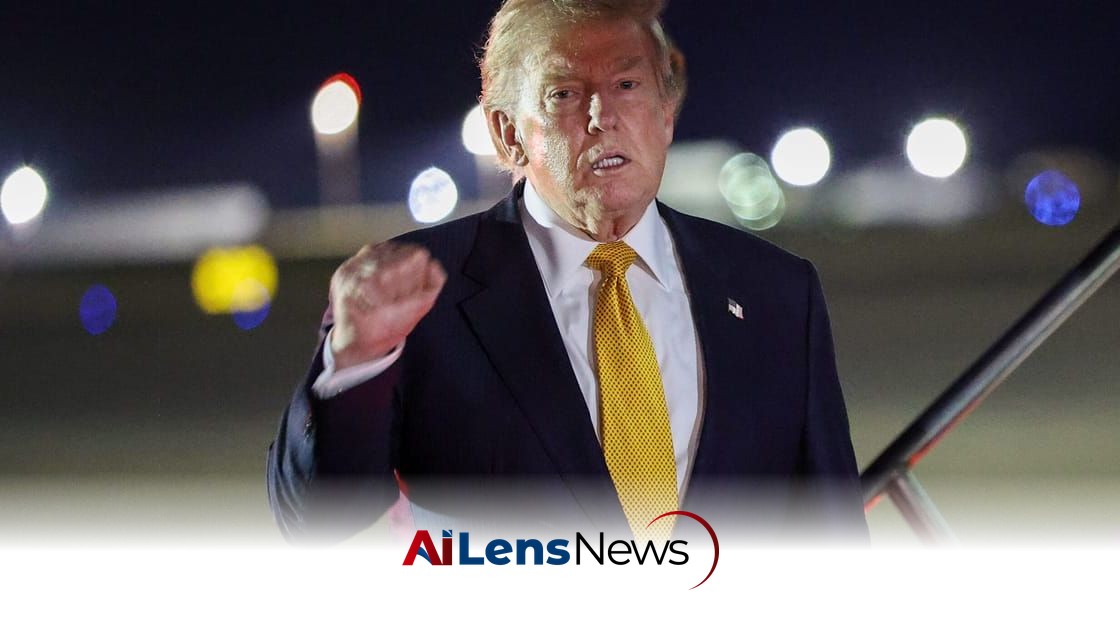


In a recent post, President Trump declared the U.S. military ready to 'decimate' Iran amid assassination threats against him.
London, United Kingdom Jul 11, 2026 ALN: U.S. President Donald Trump's recent statements regarding Iran have drawn significant attention and concern, particularly in the context of escalating tensions between the two nations. In a post on Truth Social, Trump declared that the American military stands ready to "completely decimate and destroy all areas of Iran" in response to alleged threats against his life. This statement not only reflects the heightened state of geopolitical tensions but also underscores the volatile nature of U.S.-Iran relations.
Trump's remarks were reportedly influenced by intelligence briefings he received from Israeli officials. These briefings suggested that the Iranian regime was contemplating an assassination plot against him. Such claims, if substantiated, would represent a severe escalation in hostilities and could have far-reaching implications for U.S. foreign policy and military engagement in the region. The history of U.S.-Iran relations is fraught with suspicion and hostility, dating back to the 1979 Iranian Revolution, which resulted in the overthrow of the U.S.-backed Shah and the establishment of the Islamic Republic of Iran. Since then, the two countries have often found themselves at odds, with numerous incidents contributing to a climate of distrust.
In his post, Trump emphasized a military readiness that included "1000 Missiles are Locked and Loaded and aimed at the Islamic Republic of Iran". This type of rhetoric is not unprecedented for Trump, who has often employed strong language when discussing Iran, especially since he took office in 2017. The suggestion of a military strike, however, raises questions about the potential for conflict and the ramifications of such an action on international relations and regional stability. The Iranian military, known as the Islamic Revolutionary Guard Corps (IRGC), has a reputation for being highly organized and capable, which adds to the complexity of any potential military engagement.
The backdrop to these recent threats is a significant breakdown in the ceasefire agreement that was established between Iran and the U.S. in June. The ceasefire was a critical attempt to de-escalate tensions following years of hostile exchanges, sanctions, and military confrontations. However, the recent U.S. strikes on Iranian positions, particularly in response to attacks on shipping in the strategically vital Strait of Hormuz, indicate that the situation is deteriorating rapidly. The Strait of Hormuz is a crucial maritime chokepoint through which a significant portion of the world's oil supply is transported. Any military action in this area could not only disrupt global oil markets but also draw in other nations into a conflict, further complicating an already tense situation. The U.S. has historically maintained a strong naval presence in the region to ensure the safety of shipping lanes and to counter Iranian influence.
In his comments to reporters, Trump elaborated on the intelligence he received, stating, "They want to take out the U.S. leader — me. I’m on every list. I saw this morning, I’m on every single one of their lists. And so far, I guess I’ve been a little bit lucky, but that maybe doesn’t last very long." This admission highlights the perceived threat to his safety and the broader implications of such threats against a sitting U.S. president. The notion of being on a target list is a serious concern, not only for Trump personally but also for national security, as it underscores the potential for state-sponsored violence against U.S. leaders.
Despite the aggressive posturing and rhetoric, reports suggest that discussions between Washington and Tehran are still ongoing. This indicates that, despite the public declarations of military readiness and threats, there may still be avenues for diplomacy and negotiation. The complexity of U.S.-Iran relations cannot be overstated; both nations have a long history of conflict and cooperation, often marked by periods of intense hostility followed by attempts at dialogue. The Joint Comprehensive Plan of Action (JCPOA), commonly known as the Iran nuclear deal, was one such attempt at diplomacy, although the U.S. withdrawal from the agreement in 2018 under Trump's administration has led to increased tensions and a breakdown of trust.
Trump's unexpected conclusion to his post, "PRAISE BE TO ALLAH!", has sparked numerous interpretations and discussions among political analysts and commentators. This phrase, often associated with Islamic faith, may have been intended to convey a sense of defiance or irony, given the context of his comments. However, it also raises questions about the appropriateness of such statements from a sitting president, particularly in relation to a country that is predominantly Muslim and with which the U.S. has a contentious relationship. The use of religious phrases in political discourse can be a double-edged sword, as it may resonate with some audiences while alienating others, particularly in a charged geopolitical climate.
The implications of Trump's statements extend beyond immediate military concerns. They reflect a broader strategy that has characterized his administration's approach to foreign policy—one that often relies on strong rhetoric and a willingness to use military force as a means of asserting U.S. power. This approach has been met with both support and criticism, with some arguing that it could lead to unnecessary conflict, while others believe it is necessary to deter adversaries. The balancing act of maintaining a strong military posture while also pursuing diplomatic channels is a challenge that has faced many U.S. administrations, but the current rhetoric suggests a preference for the former.
The potential for military action against Iran raises significant ethical and legal questions as well. The U.S. has faced scrutiny over its military interventions in the Middle East, with many arguing that such actions have often led to prolonged conflict and instability rather than resolution. The prospect of a direct confrontation with Iran, a nation with a powerful military and a complex network of regional alliances, poses a significant risk not only to U.S. forces but also to civilians in the region. The humanitarian implications of military action cannot be overlooked, especially in a country that has already faced significant challenges due to sanctions, economic hardship, and previous military engagements.
As the situation unfolds, the international community will be watching closely. Allies and adversaries alike are likely to assess their positions in light of Trump's statements and the U.S. military's readiness to act. The potential for escalation is a concern, and many are calling for a return to diplomatic channels to prevent further deterioration of relations. The role of international organizations, such as the United Nations, may become increasingly important in mediating tensions and facilitating dialogue between the U.S. and Iran.
In conclusion, Trump's recent declarations regarding Iran serve as a stark reminder of the fragile state of international relations and the potential for conflict. As tensions rise, the need for careful diplomacy and strategic communication becomes increasingly critical to avoid miscalculations that could lead to military engagement. The world will be closely observing how both the U.S. and Iran navigate this precarious situation in the coming days and weeks. The stakes are high, not only for the two nations involved but for global stability as well, as the repercussions of military action could reverberate far beyond the Middle East.
To learn more about the latest developments in Leaders & Politicians, stay updated with our exclusive reports and analyses on AiLensNews.

