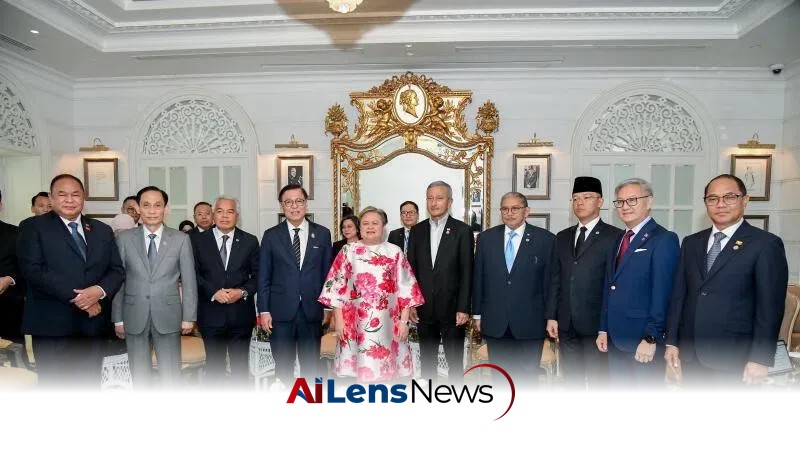


ASEAN foreign ministers emphasize the need for Myanmar to demonstrate progress on the Five-Point Consensus peace plan during a recent meeting in Bangkok.
Singapore, Singapore Jul 12, 2026 ALN: BANGKOK – ASEAN is urging Myanmar to show tangible progress on the Five-Point Consensus (5PC) peace plan, particularly regarding the release of political detainees, including Aung San Suu Kyi, Singapore's Foreign Minister Vivian Balakrishnan stated on July 12. The Five-Point Consensus was initially agreed upon in April 2021 in response to the military coup that ousted the democratically-elected government led by Aung San Suu Kyi and her party, the National League for Democracy (NLD). The consensus aims to address the escalating violence and humanitarian crisis in Myanmar, focusing on the cessation of hostilities, constructive dialogue among all parties, and the provision of humanitarian assistance.
“The most important point was that we all reaffirmed the central importance of the Five Point Consensus – it was and it remains valid. The next point is that all of us want to see demonstrable progress,” he told the Singapore media after an informal meeting between ASEAN foreign ministers and their Myanmar counterpart in Bangkok. This meeting marked the first in-person engagement between ASEAN foreign ministers and Myanmar’s top diplomat since the 2021 coup, which has led to widespread unrest, violence, and a deteriorating humanitarian situation across the country.
Balakrishnan also emphasized the need for a permanent end to violence in Myanmar and for ASEAN to be able to deliver humanitarian aid across the country, even in areas not controlled by the Myanmar regime, as outlined in the peace plan. The ongoing conflict has created a dire humanitarian crisis, with millions in need of assistance due to displacement, violence, and economic instability. “Let’s hope that we will see some response and some progress in the next few months,” he added, reflecting the cautious optimism that ASEAN hopes to instill regarding the situation in Myanmar.
In a statement on July 12, Singapore’s Ministry of Foreign Affairs reiterated that “Myanmar remains an integral part of ASEAN, and Singapore hopes to see a peaceful, stable and prosperous Myanmar.” This sentiment underscores the regional bloc's commitment to maintaining unity and stability within its member states, despite the challenges posed by the ongoing crisis in Myanmar. “Singapore is disappointed with the limited progress made in the implementation of the ASEAN Five-Point Consensus and stressed the importance of constructive dialogue among all of Myanmar’s key stakeholders to achieve a peaceful and durable resolution of the crisis.”
During a joint press conference, the Thai and Philippine foreign ministers also stressed that Myanmar needs to show progress on the peace plan before ASEAN would consider further engagement. Philippine Foreign Secretary Ma. Theresa Lazaro stated that the detained state counsellor remains in “good health” and has access to healthcare, referring to comments from Myanmar Foreign Minister Tin Maung Swe. Calls for the release of the 81-year-old Suu Kyi have intensified, but these requests have been largely ignored, including a recent appeal from ASEAN member states to meet her.
The July 12 meeting was described as an initial step in engaging with Myanmar. Thailand's Foreign Minister Sihasak Phuangketkeow noted, “In the end, we have to engage, we have to have dialogue and we are not abandoning our position.” This reflects a broader approach within ASEAN to maintain diplomatic channels while addressing the pressing issues at hand. Since the coup, at least 100,000 people have died, according to the Armed Conflict Location & Event Data project, while approximately 22,400 Myanmar civilians remain detained, highlighting the urgent need for a resolution to the ongoing conflict.
Lazaro, who is also ASEAN's special envoy to Myanmar, plans to lead a humanitarian mission to the country later this year. The mission aims to provide much-needed assistance to affected populations while navigating the complex political landscape created by the military's control. All ASEAN member ministers attended the meeting except for Malaysia, which was represented by a senior official, and Cambodia, which did not send any representatives.
In April, junta chief Min Aung Hlaing became Myanmar’s president after a carefully managed election widely regarded as fraudulent. He later appointed Tin Maung Swe as foreign minister, further consolidating military control over the political landscape. The legitimacy of this government has been challenged both domestically and internationally, raising questions about the effectiveness of ASEAN's engagement with a regime that lacks broad-based support.
Analysts have expressed concerns that ASEAN has compromised its credibility by allowing Tin Maung Swe to attend the meeting. “ASEAN has made its own position more difficult by offering symbolic access before obtaining meaningful compliance,” said Phyo Win Latt, an independent Myanmar analyst. This sentiment reflects a growing concern that ASEAN's approach may inadvertently legitimize the military junta at the expense of democratic movements within Myanmar.
“Once recognition begins to flow without concessions, ASEAN’s leverage diminishes. The regime may conclude that time is working in its favor and that regional fatigue will eventually secure its full return,” he added, emphasizing the risks associated with a lack of concrete outcomes from ASEAN's engagement. ASEAN has not set any deadlines for Myanmar to demonstrate positive progress in addressing the political crisis. However, the foreign ministers are expected to follow up on the discussions when they meet again formally in Manila from July 20 to 24.
Members of Parliament in Myanmar have rejected the peace plan entirely, labeling it irrelevant. Zin Mar Aung, foreign minister of Myanmar’s National Unity Government, expressed skepticism about the July 12 meeting producing any meaningful breakthroughs. “If ASEAN or individual member states continue engaging stakeholders separately and without equal political weight, they risk reinforcing the junta’s divide-and-rule strategy rather than creating the conditions for an inclusive solution,” she stated. This highlights the complexities of the political landscape in Myanmar, where multiple factions and interests complicate any potential resolution.
“If the consensus collapses without a credible alternative, it will pave the way for a ‘might makes right’ environment in the region,” warned Naing Min Khant, a researcher at the Institute for Strategy and Policy – Myanmar. The implications of a failed consensus could extend beyond Myanmar’s borders, potentially destabilizing the region and undermining ASEAN's role as a facilitator of peace and stability.
Other observers believe that the inclusion of the Myanmar foreign minister indicates ASEAN's capitulation and has significantly weakened its leverage over Myanmar. “ASEAN is signaling that its political bans are flexible and its red lines are porous,” said Yuyun Wahyuningrum, an ASEAN policy expert. This perception poses a challenge for ASEAN’s credibility as a regional organization committed to democratic principles and human rights.
“It reinforces the critique that ASEAN prioritizes institutional optics over the actual protection of human rights and civilian lives,” she added, emphasizing the need for a more robust and principled approach to the crisis in Myanmar. As ASEAN navigates this complex situation, the balance between diplomatic engagement and the promotion of human rights remains a critical challenge for the organization and its member states.
To learn more about the latest developments in Political Controversies, stay updated with our exclusive reports and analyses on AiLensNews.

