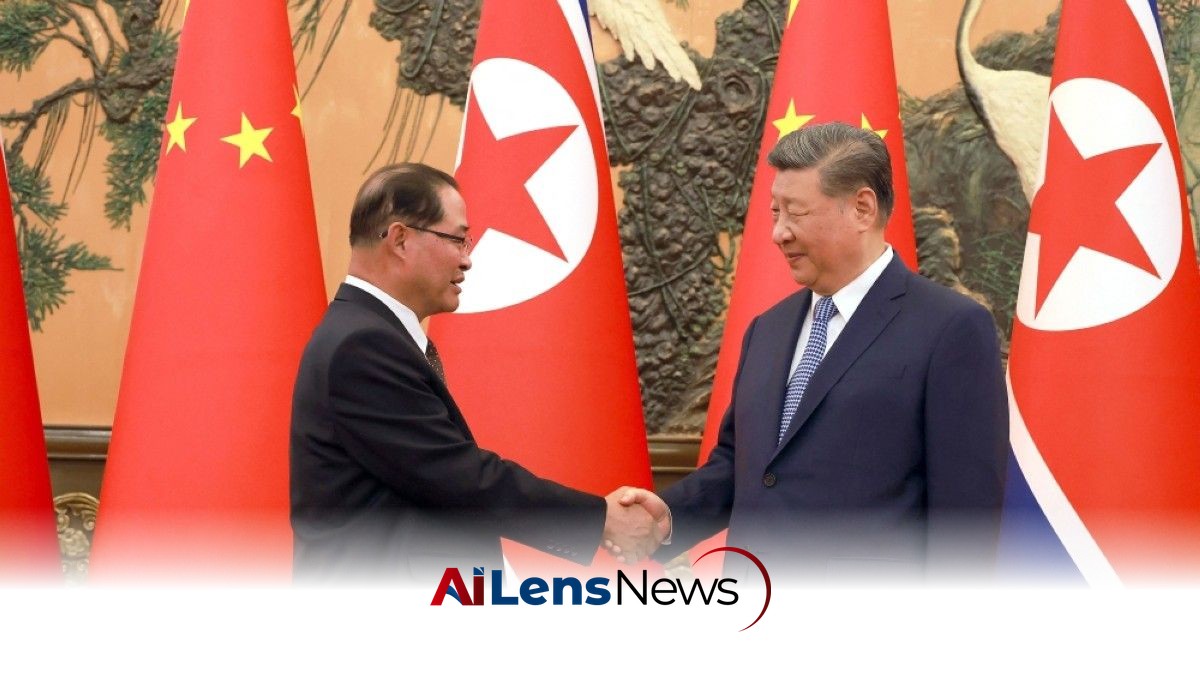


Chinese President Xi Jinping reaffirmed China's unwavering friendship with North Korea, emphasizing continued support amidst evolving international dynamics.
Kuwait City, Kuwait Jul 12, 2026 ALN: Chinese President Xi Jinping stated that China’s commitment to its traditional friendship with North Korea remains steadfast, regardless of changes in the international landscape. This declaration was made through letters exchanged with North Korean leader Kim Jong Un, which were published by North Korean state media KCNA on Saturday. Kim, in his correspondence, noted that the bilateral friendship and cooperation have reached a "new strategic level," according to KCNA.
North Korea’s Premier Pak Thae Song arrived in Beijing on Friday for a three-day visit to commemorate the 65th anniversary of the friendship treaty between the two nations. Xi had visited Pyongyang last month, marking his first trip to North Korea in seven years, where he and Kim agreed to enhance cooperation across various sectors, including politics, economy, and culture.
The Treaty of Friendship, Cooperation and Mutual Assistance, signed on July 11, 1961, is China’s only active mutual defense pact. Xi emphasized that, irrespective of international developments, the Chinese Communist Party and the Chinese government will continue to prioritize the traditional friendship with North Korea. He reiterated support for North Korea’s socialist agenda under Kim Jong Un’s leadership, affirming a commitment to safeguard the common interests of both nations and maintain a favorable strategic environment.
This commitment comes at a time when global politics are increasingly complex and fraught with tensions, particularly in the Asia-Pacific region. The relationship between China and North Korea is historically significant; it has been shaped by shared ideological foundations and mutual interests, particularly in countering U.S. influence in the region. The ongoing cooperation is seen as a strategic necessity for both nations, as they navigate their respective challenges on the global stage.
In a related development, North Korea condemned the United States and its allies for allegedly strengthening military alliances and accelerating arms buildups following a NATO summit earlier this week. Pyongyang accused NATO leaders of depicting North Korea’s legitimate sovereign rights as a threat, as stated by the foreign ministry in a KCNA report. The ministry criticized the alliance for demonstrating a stronger commitment to confrontational bloc dynamics through increased military spending and closer military ties with allies in the Asia-Pacific region.
During the NATO summit held in Turkey on Tuesday, officials announced over $50 billion in military procurement and industrial agreements, as European allies faced ongoing pressure from U.S. President Donald Trump to contribute more to the alliance’s defense efforts. President Lee Jae Myung of South Korea, North Korea’s rival, expressed hopes for enhanced cooperation with NATO allies in research and development, particularly in advanced technologies and weapon systems production. This context is critical, as the South Korean government’s alignment with NATO reflects a broader strategy to counter perceived threats from the North.
The increasing military cooperation among NATO members has raised alarms in Pyongyang, which views these developments as a direct threat to its national security. North Korea characterized the NATO summit as indicative of an organization geared towards war and confrontation, pursuing what it termed exclusive geopolitical interests at the expense of peace and security in Europe and the Asia-Pacific region. This perspective underscores the deep-seated mistrust that exists between North Korea and the U.S.-led military alliances.
In light of these tensions, Pyongyang has taken a hardline stance regarding its nuclear program. North Korea asserts that Western demands for it to abandon nuclear weapons have been irreversibly rejected, believing that denuclearization efforts should first address the nuclear ambitions of South Korea and Japan under U.S. protection, as well as the nuclear aspirations of NATO members involved in nuclear-sharing arrangements. The North Korean ministry stated that it would protect its sovereignty and security interests, alongside regional peace, through the responsible exercise of its sovereign rights.
The implications of this stance are significant. As North Korea continues to develop its nuclear capabilities, the region faces heightened risks of military escalation. The international community remains concerned about North Korea's missile tests and nuclear advancements, which are perceived as provocations that could destabilize the region further. The commitment from China to support North Korea adds another layer of complexity to the geopolitical landscape, as it reinforces the notion that Pyongyang has a powerful ally in its corner.
KCNA reported on Friday that North Korea has decided to implement measures to enhance its nuclear capabilities both quantitatively and qualitatively, as leader Kim Jong Un calls for military modernization. This move is indicative of North Korea's strategy to bolster its defense mechanisms in the face of perceived external threats, particularly from the U.S. and its allies.
Additionally, the ongoing military modernization efforts in North Korea are likely to provoke responses from neighboring countries, particularly South Korea and Japan, which may feel compelled to enhance their own military capabilities in response. This could lead to an arms race in the region, further complicating diplomatic efforts aimed at achieving stability and peace.
In conclusion, the reaffirmation of the China-North Korea alliance amid shifting international dynamics highlights the enduring nature of their relationship. As both nations navigate the challenges posed by external pressures, their cooperation is likely to continue to evolve, potentially reshaping the security landscape in the Asia-Pacific region. The implications of this partnership, coupled with North Korea’s military ambitions, will be closely monitored by the international community, as they could have far-reaching consequences for regional and global security.
To learn more about the latest developments in Leaders & Politicians, stay updated with our exclusive reports and analyses on AiLensNews.

