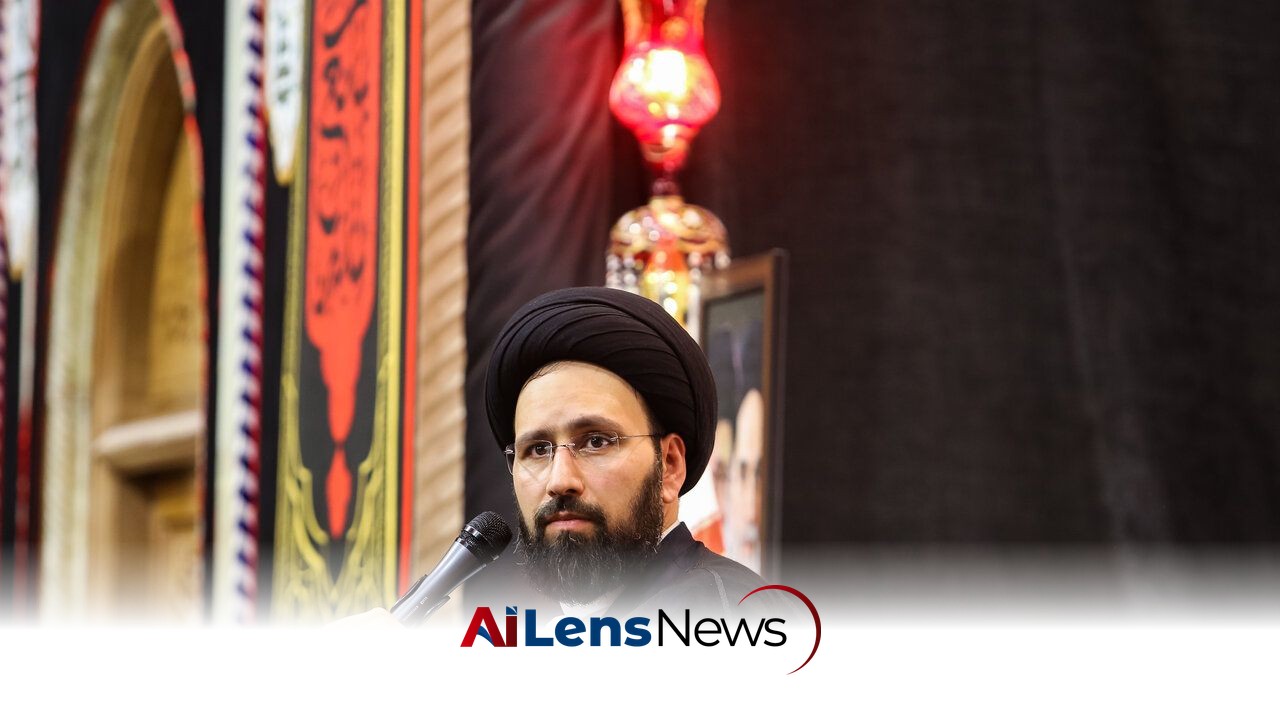


TEHRAN — Seyed Ali Khomeini demands accountability for the death of Iran's martyred Leader, Ayatollah Seyyed Ali Khamenei, during a national mourning period.
Tehran, Iran Jul 11, 2026 ALN: TEHRAN — Seyed Ali Khomeini, the grandson of the founder of the Islamic Republic, has called for “justice and retribution for the death of Iran's martyred Leader, Ayatollah Seyyed Ali Khamenei,” urging officials to remain committed to pursuing those responsible. This call for justice comes against the backdrop of a significant national tragedy that has reverberated throughout Iran, leading to widespread mourning and public demonstrations of grief.
Speaking at a memorial ceremony in the shrine city of Qom on Friday evening, Khomeini stated that any official who failed to seek accountability for the Leader's death should "question his conscience," emphasizing that this matter is a national responsibility. His strong words reflect a deep sense of urgency and collective responsibility felt among the Iranian populace, as they grapple with the implications of the assassination of a prominent leader.
His remarks came as mourning ceremonies continued across Iran, with large crowds gathering in mosques, religious centers, public squares, and streets in cities and towns nationwide to commemorate the late Leader. Memorial services, recitations of the Quran, elegies, and public processions were held in numerous provinces, reflecting what organizers described as a nationwide display of grief and solidarity following the assassination of the Leader in a U.S.-Israeli airstrike on February 28, during the early moments of the illegal war on Iran. This incident has not only intensified the emotional landscape of the nation but has also reignited discussions about national sovereignty and the impacts of foreign intervention in Iranian affairs.
Referring to the recent conflict, Khomeini remarked that Iran's adversaries had expected the Islamic Republic to collapse within days, but the situation instead demonstrated the resilience of the Iranian ruling system and its people. He asserted that the United States, Israel, and their political, military, and media capabilities had failed to achieve their objectives. In light of these developments, Khomeini's comments serve to bolster national morale and unity, framing the situation as a struggle against external aggression.
"No credible scholar or research center" could conclude that Washington emerged victorious from the confrontation, he added. This assertion speaks to a broader narrative within Iranian discourse that positions the country as a resilient entity capable of withstanding external pressures and adversities. Khomeini's emphasis on scholarly consensus also suggests a desire to ground political rhetoric in perceived objective analysis, reinforcing the legitimacy of Iran's stance against foreign intervention.
Khomeini also criticized anti-revolution groups abroad, stating that they had relied on foreign intervention and military action by the United States and Israel to bring about political change in Iran. The failure of those efforts, he commented, deprived the opposition of its remaining political credibility. This reflection on the opposition’s failure underscores the complexities of Iran's internal political landscape, where external influences are often viewed with suspicion and resentment.
Noting that “the fear of war is more dangerous than war itself,” he emphasized that Iran neither initiated the conflict nor seeks war, but would not retreat in the face of aggression. This statement encapsulates the tension within Iranian society regarding the balance between advocating for peace and demonstrating strength in the face of perceived threats. Khomeini's rhetoric seeks to reassure the public that the leadership is committed to national security while also fostering a sense of resilience.
Pointing to diplomacy within the framework of the memorandum of understanding (MOU) mediated by Pakistan, Khomeini stated that any future negotiations with the United States should not be interpreted as “reconciliation,” arguing that such negotiations represent "another arena of confrontation" rather than a departure from the Islamic Republic's principles. This perspective highlights the intricate and often contentious nature of international relations, especially as they pertain to Iran's dealings with Western powers.
The recent events have deepened hostility between Iran and the United States, he remarked, adding that Iranians would not forget the crimes committed against their country. This sentiment resonates with a historical narrative that frames U.S. actions as part of a broader pattern of intervention in Iranian affairs, thereby solidifying a collective memory that influences contemporary political sentiment.
The memorial ceremony in Qom was one of dozens of events held across Iran as the country continued observing a period of national mourning for its late Leader, with religious scholars, government officials, and the public paying tribute and renewing pledges to uphold his legacy. The significance of these gatherings cannot be overstated; they serve not only as a means of honoring the deceased but also as a platform for reinforcing communal bonds and shared values within Iranian society.
People in cities such as Rey, Mashhad, Tehran, Qom, Isfahan, Shiraz, Tabriz, and others gathered in Friday prayer halls (Mosallas) to mourn and demand revenge for the assassination of the Leader. The participation of diverse demographics in these events reflects the widespread impact of the Leader's death on the Iranian populace, transcending regional and social divides. The communal aspect of mourning rituals plays a vital role in fostering a sense of unity and collective identity, especially during times of national crisis.
The Policymaking Council of Friday Prayer Imams announced that Friday prayers, beginning on July 10, would be dedicated to commemorating the martyred Leader and other martyrs of the Resistance Front, renewing calls for accountability, and demanding justice for those responsible for their assassinations. This institutionalized approach to mourning underscores the intertwining of religious observance and political activism in Iran, as leaders seek to channel public grief into a call for justice and accountability.
Friday prayers across the country were held under the title "Friday of Revenge," with worshippers chanting slogans of revenge. The choice of language and framing in these gatherings is indicative of the powerful emotions at play and the desire for retribution felt by many Iranians. Such slogans serve to galvanize public sentiment and create a sense of urgency around the pursuit of justice, reinforcing the collective identity of the mourners.
A large crowd gathered in Imam Hussein (AS) Square in downtown Tehran to mourn. In Mashhad, citizens observed Sham-e-Ghariban (the Night of the Oppressed) to commemorate the memory of the Leader and his family members. The observance of specific cultural and religious rituals during this period of mourning highlights the deep-rooted significance of the Leader's legacy in Iranian society, as well as the intertwining of personal grief with broader historical narratives.
The gatherings followed the massive turnout witnessed during the funeral processions and burial ceremonies for the Leader and his kin, who were assassinated alongside him. The scale of these public demonstrations serves as a testament to the profound impact of the Leader's life and death on the Iranian people, as they navigate the complexities of grief, loss, and national identity in the wake of such a significant event.
To learn more about the latest developments in Political Controversies, stay updated with our exclusive reports and analyses on AiLensNews.

