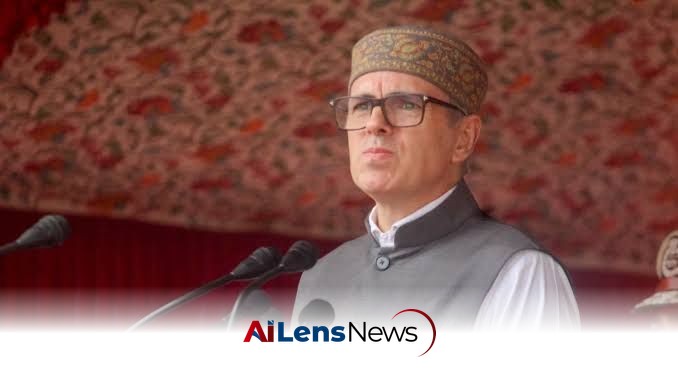


Jammu and Kashmir's Chief Minister Omar Abdullah defends the invitation to Mirwaiz Umar Farooq for a protest demanding statehood, amidst BJP's accusations of soft separatism.
New Delhi, India Jul 12, 2026 ALN: Jammu and Kashmir Chief Minister Omar Abdullah on Sunday strongly defended the National Conference’s (NC) decision to invite Kashmir’s chief Muslim cleric and Muttahida Majlis-e-Ulama (MMU) chairman, Mirwaiz Muhammad Umar Farooq, to the proposed July 20 protest at Jantar Mantar in New Delhi. This protest is being organized in the context of ongoing demands for the restoration of statehood to Jammu and Kashmir, a topic that has garnered significant attention and debate since the region was reorganized into a Union Territory in 2019.
Abdullah dismissed the criticism generated by the invitation to Mirwaiz, alleging that the Bharatiya Janata Party (BJP) was deliberately creating a controversy to divert attention from the core issue of the agitation—the restoration of J&K’s statehood. The Chief Minister maintained that the demonstration is not intended to serve as a platform for political confrontation but rather as a broad-based democratic movement seeking the fulfillment of repeated assurances regarding the restoration of statehood to J&K. This assertion underscores the NC's position that the demand for statehood is a matter of fundamental rights and democratic representation for the people of the region.
The National Conference has been vocal in its stance that the disenfranchisement of the people of Jammu and Kashmir following the abrogation of its special status has led to widespread feelings of alienation and discontent. Abdullah emphasized that the NC had embarked on an extensive outreach campaign, extending invitations across the political and social spectrum, including political parties, religious leaders, civil society representatives, trade bodies, and other stakeholders. This effort aims to build the widest possible consensus around the demand for statehood, reflecting a desire for unity among diverse groups in J&K.
In response to objections specifically concerning the invitation extended to Mirwaiz Umar, Abdullah argued that there should be no controversy in inviting a prominent religious leader who represents a significant section of society in J&K. He described the outreach as part of an inclusive strategy, asserting that the movement aims to unite different sections of society behind a common constitutional and democratic objective. According to Abdullah, the restoration of statehood is an issue that transcends political affiliations and ideological divisions and concerns every resident of J&K.
Accusing the BJP of manufacturing a controversy, the Chief Minister contended that the debate should focus on the Union Government’s commitment to restoring statehood rather than on who has been invited to participate in the protest. He argued that attempts to shift public discourse towards the Mirwaiz invitation were intended to distract from the larger political question that has remained unresolved since J&K was reorganized into a Union Territory in 2019. This reorganization has been a point of contention, with many in the region feeling that their voices and rights have been marginalized.
The NC has invited nearly all major political formations in J&K, including the BJP, Congress, Peoples Democratic Party (PDP), Apni Party, and Peoples Conference, while also reaching out to national and regional parties across the country irrespective of their political alignments. Invitations have additionally been extended to religious organizations, trade associations, and civil society groups. Abdullah highlighted a recent three-hour consultation meeting attended by around 170 representatives from diverse sectors, stating that there was unanimous support for the immediate restoration of statehood. This broad-based support is indicative of a collective desire for political representation and governance that reflects the unique needs of J&K's populace.
However, the BJP reacted sharply to the NC’s decision to invite Mirwaiz Umar, accusing the party of indulging in political theatrics and displaying what it described as a continued tendency towards “soft separatism.” BJP leaders argued that by inviting a leader associated with the Hurriyat Conference’s political legacy, the NC had exposed its willingness to accommodate separatist sentiments under the guise of a mainstream political campaign. The party portrayed the move as an anti-national compromise and questioned the NC’s political intentions behind giving a prominent role to the Mirwaiz in a public mobilization effort. This criticism reflects the BJP's broader narrative that seeks to frame any engagement with separatist figures as detrimental to national integrity and security.
Leader of the Opposition in the J&K Assembly, Sunil Sharma, and other BJP leaders rejected the invitation outright and announced a complete boycott of the proposed protest. They asserted that the restoration of statehood is a matter that can only be decided by Parliament and not through what they termed “eyewash” demonstrations at Jantar Mantar. The BJP maintained that the NC was attempting to create unnecessary drama despite repeated assurances from the Centre regarding the eventual restoration of statehood. This position underscores the BJP's commitment to a centralized approach to governance in J&K, contrasting sharply with the NC's advocacy for regional autonomy.
Adding another layer to the evolving political debate, Mirwaiz Umar himself has indicated that the movement should not be confined to the demand for statehood alone. He has argued that any meaningful political resolution for J&K should also include the restoration of Articles 370 and 35A, along with other constitutional safeguards that were revoked following the August 2019 changes. His remarks have further sharpened political divisions, with critics claiming they reveal a broader agenda behind the mobilization, while supporters argue that they reflect long-standing political aspirations in the region. This call for the restoration of specific articles of the Constitution highlights the complexities of the political landscape in J&K, where issues of identity, autonomy, and governance intersect.
The July 20 protest, scheduled to coincide with the Monsoon Session of Parliament, is expected to be the NC’s most significant political mobilization on the statehood issue. Through its nationwide outreach campaign, the party is seeking to build a broad coalition comprising regional parties, national political leaders, civil society groups, trade organizations, and religious representatives from across the country. This coalition-building effort is crucial, as it aims to amplify the voices of those advocating for the restoration of statehood and create a unified front that can effectively challenge the central government's stance.
The NC has insisted that the demonstration is intended to intensify pressure on the Union Government to honor its commitments and restore J&K’s statehood, while the BJP continues to accuse the party of reviving old political narratives and legitimizing elements linked to separatist politics. As the date approaches, the protest is increasingly shaping up as a political showdown over both the future status of J&K and the competing narratives surrounding its post-2019 political landscape. The outcome of this protest and the responses it elicits from both the government and the public will likely have significant implications for the political dynamics in J&K, potentially influencing future policy decisions and the relationship between the region and the central government.
To learn more about the latest developments in Political Controversies, stay updated with our exclusive reports and analyses on AiLensNews.

