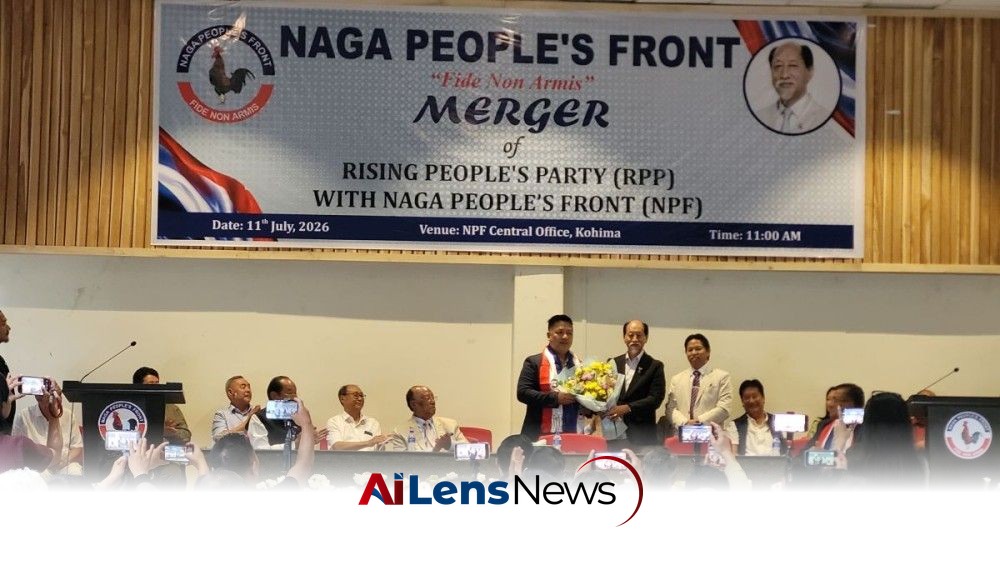


Chief Minister Neiphiu Rio invites all Nagas to join the Naga People's Front, emphasizing unity and the importance of addressing the Naga political issue ahead of upcoming elections.
Kohima, India Jul 11, 2026 ALN: Our Correspondent
Kohima | July 11
Chief Minister and Naga People's Front (NPF) president Dr Neiphiu Rio on July 11 said the party's doors were open to all those who believed in unity, peace, and the greater good of the Naga people, while making a special appeal to Nagas in Manipur to join the regional party ahead of the state's Assembly elections. This statement comes at a crucial time as the NPF seeks to consolidate its influence and broaden its base among the Naga community, particularly in the wake of ongoing political changes and challenges in the region.
Addressing a programme marking the merger of the Rising People's Party (RPP) with the NPF in Kohima, Rio said, "The NPF belongs to you too. This is your platform. Come forward. Participate. Strengthen the movement for Naga unity and oneness." The merger of RPP with NPF is seen as a strategic move to enhance the party's presence and effectiveness in representing the interests of the Naga people across various states. The call for inclusivity is significant, especially considering the historical context of division among the Naga tribes, which has often been exacerbated by political and administrative boundaries.
Rio emphasized the need for a common political platform that sincerely articulated the aspirations of the people, stating that politics should not merely focus on differences but also on building bridges, promoting reconciliation, and creating hope for future generations. This vision aligns with the broader goals of fostering peace and stability in a region that has been marred by conflict and division for decades. The NPF's approach aims to transcend these historical divides and create a unified front that can effectively address the pressing issues facing the Naga community.
Referring to the opposition-less government, Rio noted that all elected members of the Legislative Assembly had agreed to work together in a spirit of unity and oneness for the larger cause of resolving the Naga political issue. The concept of an opposition-less government, while not common in many democratic systems, reflects a unique political arrangement in , aimed at fostering collaboration among various political factions to address shared challenges, particularly the longstanding Naga political issue. "This is not merely a political arrangement. It carries a deeper message. It is a message that, on the most important issue concerning the future and destiny of the Naga people, we must stand together," he said.
Rio reiterated that the Naga political issue remained at the top of the agenda for both the NPF and the People's Democratic Alliance (PDA) government and urged all sections of Naga society to unite. The Naga political issue has been a complex and multifaceted struggle for autonomy and recognition, with various factions and groups advocating for different solutions. Rio's call for unity is a recognition of the need for a cohesive approach to address these challenges effectively.
"Our message of unity must be sent out loud and clear to every section of our society, to every Naga community, to all negotiating parties, to the Government of India, and to the world," he said. This appeal underscores the NPF's commitment to not only internal unity but also to presenting a united front in negotiations with external stakeholders, particularly the Indian government, which plays a pivotal role in the resolution of the Naga political issue.
Observing that Nagas had historically remained divided by opinions, organisations, and geographical boundaries, Rio pointed out that artificial administrative divisions had placed members of the same family, village, and tribe under different states and even different countries. This observation highlights the complexities of Naga identity, which transcends political boundaries and is deeply rooted in shared history and culture. Rio noted that Nagas now lived across Manipur, Arunachal Pradesh, and Assam, while nearly one-third of the Naga population lived in Myanmar, further complicating the issue of unity and representation.
"These are man-made boundaries. They cannot erase our history. They cannot change our identity. They cannot remove the bonds of blood, culture, tradition, and belonging that make us one people," he said. This assertion reinforces the idea that despite the political divisions, the cultural and social ties that bind the Naga people remain strong and enduring. Rio's emphasis on emotional integration, even if physical integration is not immediately achievable, reflects a pragmatic approach to addressing the aspirations of the Naga people.
He said the aspiration for the integration of all Naga-inhabited areas remained alive, although immediate physical integration might not be possible under the prevailing circumstances. "If physical integration cannot be immediately achieved, then we must constantly and tirelessly work towards emotional integration. We must bring our people closer. We must build bridges between Naga communities and strengthen people-to-people relationships," he said. This focus on emotional integration speaks to the importance of fostering a sense of belonging and community among Nagas, regardless of their geographic location.
Rio also called for creating platforms where youth, women, elders, intellectuals, civil society organisations, and political leaders could interact and work together to realise the aspirations of future generations. This inclusive approach is essential for ensuring that the voices of all segments of society are heard and represented in the political discourse, particularly in a region where traditional power structures have often marginalized certain groups.
NPF Committed to Building a More Prosperous Future
Stating that the NPF remained one of the most important political platforms for Nagas across their contiguous homeland, Rio asserted that the party's vision could not be confined by political or administrative boundaries. The NPF's commitment to a broader vision of Naga identity and representation is crucial in a context where regional parties often face challenges in articulating their goals within the framework of national politics.
He said the NPF was currently part of the governments in Manipur and was prepared to strengthen and expand its presence in other states and areas inhabited by Nagas. This readiness to expand its influence reflects the NPF's strategic approach to regional politics, aiming to ensure that the interests of the Naga people are represented at various levels of government.
Emphasizing that peace and development must go hand in hand, Rio stated that the party remained committed to building a stronger and more prosperous future through improved roads, connectivity, infrastructure, digital access, quality education, healthcare, and employment opportunities. This holistic approach to development is vital for addressing the socioeconomic challenges faced by the Naga community and ensuring that the benefits of progress are equitably distributed.
He noted that the government was working to attract investment, promote industries, encourage entrepreneurship, and improve livelihoods through sustainable agriculture, while ensuring that women and youth became equal partners in the state's development. This focus on inclusivity in development initiatives is essential for empowering marginalized groups and fostering a sense of ownership among the community.
Referring to the party's alliance with the Bharatiya Janata Party (BJP), Rio stated that the NPF remained committed to the partnership, which was guided by the shared objective of securing an early solution to the Naga political issue and accelerating development in the state. The alliance with a national party like the BJP provides the NPF with greater leverage in negotiations with the central government, which is crucial for advancing the Naga political agenda.
At the same time, he emphasized that the party would continue to safeguard Naga identity, traditions, and values. This commitment to cultural preservation is significant in a rapidly changing world where globalization and modernization often threaten traditional ways of life.
‘We Shall Not Compromise Christian Values’
Rio also stressed the importance of preserving the Christian heritage of the Naga people, stating that Christianity had brought education, literacy, healthcare, and social transformation to the state. The role of Christianity in shaping Naga society cannot be understated, as it has been a unifying force and a source of strength for many communities. "Our faith remains central to our lives, and we shall not compromise the Christian values that have shaped our society and inspired generations of Nagas," he said, while affirming respect for the constitutional guarantee of freedom of religion.
Describing the NPF as "a regional party with a national outlook and global alignments," Rio stated that its cooperation with the Centre and national political parties reflected its commitment to peace, stability, and development. This positioning of the NPF as a regional party with a broader vision is essential for navigating the complexities of Indian politics, where regional aspirations often intersect with national interests.
He concluded by affirming that the NPF, as a constituent of the National Democratic Alliance (NDA), remained committed to contributing to India's nation-building process while protecting the interests and aspirations of the Naga people. This dual commitment to regional identity and national unity is a delicate balance that the NPF seeks to maintain as it navigates the challenges of contemporary politics in India.
To learn more about the latest developments in Political Parties, stay updated with our exclusive reports and analyses on AiLensNews.

