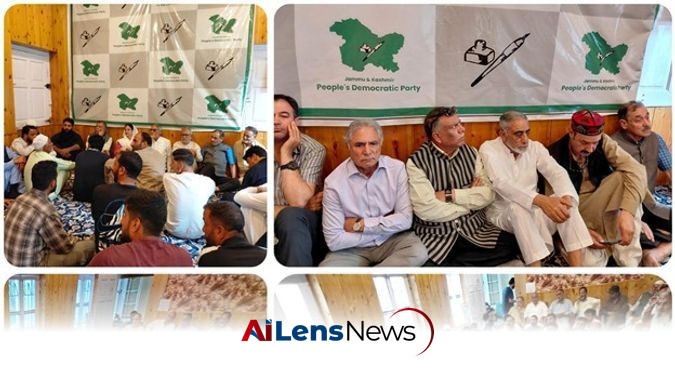


The Jammu and Kashmir Peoples Democratic Party (PDP) held meetings in Baramulla and Bandipora to enhance grassroots outreach and strengthen party structure.
Leh, India Jul 11, 2026 ALN: The Jammu and Kashmir Peoples Democratic Party (PDP) convened separate organisational meetings for the Baramulla and Bandipora districts at its headquarters in Srinagar on Friday. This initiative aimed to review the operational effectiveness of the party units in these districts and to discuss strategic measures for strengthening the organisational framework of the PDP. The PDP, established in 1999, has historically served as a significant political force in Jammu and Kashmir, advocating for the rights and aspirations of the local populace amidst a complex socio-political landscape.
The meetings were presided over by Ghulam Nabi Lone Hanjura, the General Secretary (Organisation) of the PDP. He was joined by notable senior party leaders, including General Secretary Mohammad Khursheed Aalam, former ministers Naeem Akhtar and Basarat Bukhari, and the President of the Women’s Wing, Anjum Fazili, along with other key office bearers. The presence of these senior leaders underscored the importance of the meetings, reflecting the party's focus on grassroots engagement and organisational integrity. The PDP's leadership structure is designed to ensure that local voices are heard, and that the party remains responsive to the needs of its constituents.
During the course of the meetings, the leadership undertook a thorough review of the organisational structure in both districts. This evaluation included discussions centered on enhancing public outreach initiatives, revitalising district and zonal committees, and fostering improved coordination among party workers. The emphasis on maintaining regular engagement with the local populace was particularly highlighted, as it is crucial for sustaining the party's relevance and effectiveness in the region. This approach aligns with the PDP's historical commitment to a bottom-up political model, which prioritises local issues and community engagement.
The Baramulla meeting saw participation from District President Mohammad Rafique Rather, alongside constituency in-charges and various district office bearers. This gathering allowed for a comprehensive assessment of the local party dynamics and the challenges faced by the party at the district level. Similarly, the Bandipora meeting included contributions from District President Syed Sajad Hussain, zonal presidents, district committee members, and other influential leaders, facilitating a robust exchange of ideas and strategies. Such interactions are vital for understanding the unique political and social challenges that each district faces, and for crafting tailored responses that resonate with local constituents.
In their addresses, PDP leaders urged the party workers to maintain unity, discipline, and a steadfast commitment to fortifying the party's presence at the grassroots level. This call to action is particularly significant in the context of Jammu and Kashmir's complex political landscape, where the PDP has historically positioned itself as a party advocating for the rights and aspirations of the local populace. The party's narrative has often focused on issues such as autonomy, development, and social justice, which are critical in a region that has experienced prolonged conflict and instability.
The PDP has long championed the cause of safeguarding the constitutional rights, dignity, identity, and democratic aspirations of the people of Jammu and Kashmir. This commitment was reiterated during the meetings, as leaders emphasized the need for the party to remain a vocal advocate for the rights of the people in the region. The party's historical context is essential to understanding its current positioning; founded in 1999, the PDP has sought to provide an alternative political narrative in a region often marked by conflict and political instability. The PDP's emphasis on dialogue and reconciliation has been a cornerstone of its approach, setting it apart from other political entities in the region.
In recent years, the PDP has faced significant challenges, including shifts in political alliances and changes in the broader political environment following the abrogation of Article 370 in August 2019. This constitutional change altered the special status of Jammu and Kashmir and has had profound implications for local governance and political representation. The PDP's response to these changes has been critical, as it seeks to redefine its role in a landscape where traditional political paradigms have been disrupted. As a result, the PDP's efforts to strengthen its organisational setup come at a crucial time, as it seeks to re-establish its influence and reconnect with its base amidst a rapidly evolving political landscape.
The concluding remarks of the meetings reflected a collective resolve among party leaders to intensify organisational activities and expand the party's outreach across Baramulla, Bandipora, and other areas in North Kashmir. This strategic focus on outreach is essential for the PDP as it aims to rebuild its support base and engage effectively with the electorate. The importance of grassroots mobilization cannot be overstated, especially in a political environment where voter sentiments can shift rapidly based on local issues and national narratives.
The implications of these meetings extend beyond mere organisational restructuring. They signal the PDP's intent to reassert its presence in a region where political dynamics are continually shifting. By prioritising grassroots engagement and reinforcing the party's foundational principles, the PDP is attempting to navigate the complexities of local politics while addressing the concerns and aspirations of the people it represents. The party's ability to adapt to changing political circumstances while maintaining its core values will be crucial in determining its future relevance.
Moreover, the emphasis on unity and discipline among party workers is indicative of the PDP's understanding of the need for a cohesive front in the face of challenges. The party's ability to mobilise its workers and present a united stance will be critical as it prepares for future electoral contests and seeks to regain its foothold in Jammu and Kashmir's political arena. The call for unity is particularly pertinent given the fragmentation of political alliances in the region, which has often led to a dilution of voter support for parties perceived as divided or ineffective.
In conclusion, the organisational meetings held by the PDP in Baramulla and Bandipora reflect a strategic effort to strengthen the party's structure and enhance its engagement with the local populace. As Jammu and Kashmir continues to navigate its unique political landscape, the PDP's focus on grassroots outreach, unity, and advocacy for the rights of its people will play a pivotal role in shaping its future trajectory in the region. The outcomes of these meetings may also set the tone for the party's future strategies as it seeks to address the evolving needs of its constituents and re-establish its position as a key player in Jammu and Kashmir's political discourse.
To learn more about the latest developments in Political Parties, stay updated with our exclusive reports and analyses on AiLensNews.

