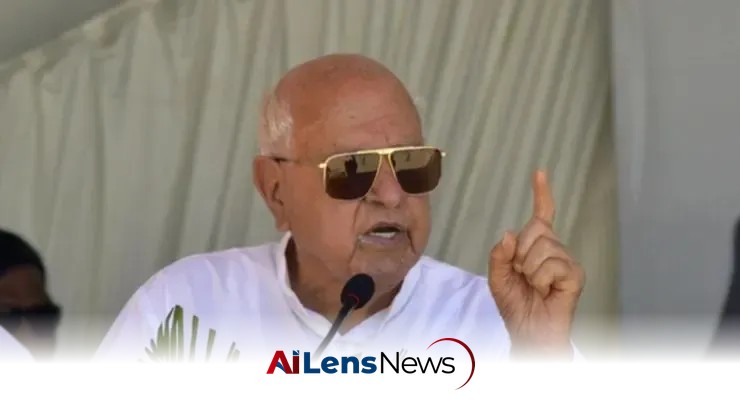


Dr. Farooq Abdullah emphasizes the need for dignity and respect for the people of Jammu and Kashmir, asserting the National Conference's commitment to their constitutional rights.
New Delhi, India Jul 12, 2026 ALN: Srinagar: Jammu and Kashmir National Conference President Dr. Farooq Abdullah on Saturday stated that nations inevitably face hardships and trials, but such challenges are tests of faith, resilience, and perseverance. He urged the people not to lose hope, adding that difficulties are temporary and eventually give way to better times.
Addressing a grand National Conference convention held at Naseem Bagh to mark the 26th death anniversary of Madar-e-Meherban Begum Akbar Jehan, Dr. Farooq said that the National Conference has consistently appealed to every government at the Centre to ensure justice for the people of Jammu and Kashmir. However, whenever the Centre had the opportunity, it weakened Article 370 instead of honouring the constitutional relationship with the region.
Article 370, which was abrogated in August 2019, granted special status to Jammu and Kashmir, allowing it to have its own constitution and a certain degree of autonomy. The abrogation has been a contentious issue, leading to widespread debate about the implications for the region's political structure, identity, and the rights of its citizens. Dr. Abdullah's remarks reflect a deep-seated concern among many residents of Jammu and Kashmir regarding the loss of autonomy and the subsequent governance challenges that have arisen.
Referring to former Prime Minister P.V. Narasimha Rao, Dr. Abdullah recalled that PM Rao had publicly assured the world that the shortcomings relating to Article 370 would be addressed and had famously declared that, within the framework of the Constitution of India, “Sky is the Limit” in granting greater autonomy to Jammu and Kashmir. He further said that during a meeting with the Prime Minister in 2021, he had candidly remarked that there was a trust deficit between New Delhi and the people of Jammu and Kashmir. Although assurances were given that the distance between Delhi and Kashmir would be bridged, no meaningful progress has been made in that direction to this day.
This sentiment of a trust deficit is echoed by many in the region who feel alienated from the central government. The perception that the central government has not adequately addressed local concerns has fueled ongoing unrest and dissatisfaction among the populace. Dr. Abdullah's comments serve to highlight the ongoing disconnect between the aspirations of the people and the policies implemented by the central government.
Dr. Abdullah asserted that Jammu and Kashmir is the crown of India and its people deserve dignity and respect. He stated that successive promises made to the people were repeatedly broken. “We are not asking for anything outside the Constitution of India. We are only demanding the restoration of our dignity, constitutional safeguards, and democratic rights,” he said. This assertion underscores the National Conference's long-standing position that the rights of the people of Jammu and Kashmir must be respected within the framework of the Indian Constitution.
The National Conference President reiterated that his party has never surrendered in the face of adversity and remains steadfast in its struggle for the rights of the people. He described the National Conference as a party of the poor, the marginalized, and the common people, committed to protecting their interests at every stage. This framing of the National Conference as a champion of the underprivileged resonates with many constituents who have felt left behind in the political landscape of Jammu and Kashmir.
Addressing political leaders whom he accused of acting at the behest of New Delhi, Dr. Abdullah said that if they truly cared for the people of Kashmir, they should abandon the politics of subservience, warning that a day would come when they would no longer be accepted by the people of this land. This statement reflects the ongoing political tensions in the region, where loyalty to the central government is often viewed with skepticism by the local populace.
Praising the performance of the present National Conference government, Dr. Abdullah said that despite severe constraints, limited powers, and numerous obstacles, the government has delivered exemplary public service and introduced a new direction in governance across various sectors. He noted that National Conference legislators are working tirelessly to address public grievances, even though political opponents refuse to acknowledge these achievements. This assertion of effective governance is crucial for the National Conference as it seeks to position itself as a viable alternative to the ruling parties.
Dr. Abdullah also alleged that attempts were once again being made to weaken the National Conference through political horse-trading. Recalling the events of 1984, he said that those who participated in the politics of defections disappeared from the political landscape within two years and are remembered by no one today. This historical reference serves to remind party members and supporters of the potential pitfalls of political opportunism and the importance of loyalty and integrity in politics.
Reaffirming the party’s commitment, Dr. Farooq Abdullah vowed that the National Conference would continue its struggle to alleviate the hardships of the people and work tirelessly for the restoration of Jammu and Kashmir’s constitutional, democratic, and political rights. This commitment is likely to resonate with the party's base, which has historically viewed the National Conference as a protector of their rights and interests.
Earlier, special prayers, Quran Khawani, Fateha Khawani, and floral tributes were offered at the mausoleums of Sher-e-Kashmir Sheikh Mohammad Abdullah and Madar-e-Meherban Begum Akbar Jehan. The prayers were led by noted Islamic scholar Dr. Prof. Mohammad Tayyub Kamili, Imam of Alamdar-e-Kashmir. A separate commemorative function was held at Sher-e-Kashmir Bhavan, where party leaders paid rich tributes to Madar-e-Meharban and recalled her historic contributions. This act of remembrance underscores the importance of the legacy of past leaders in shaping the narrative of the National Conference and its ongoing relevance in contemporary politics.
Similar commemorative programmes were organized across Jammu and Kashmir, including Leh, Kargil, Doda, Kishtwar, Poonch, Rajouri, Gool, Ramban, Zanskar, and several other places. These events highlight the widespread support for the National Conference and its historical figures, as well as the party's efforts to maintain its presence and relevance across the diverse regions of Jammu and Kashmir. The engagement of party members and supporters in these commemorations reflects a collective memory that the National Conference seeks to cultivate in its quest for political legitimacy and authority in the region.
To learn more about the latest developments in Regional Politics, stay updated with our exclusive reports and analyses on AiLensNews.

