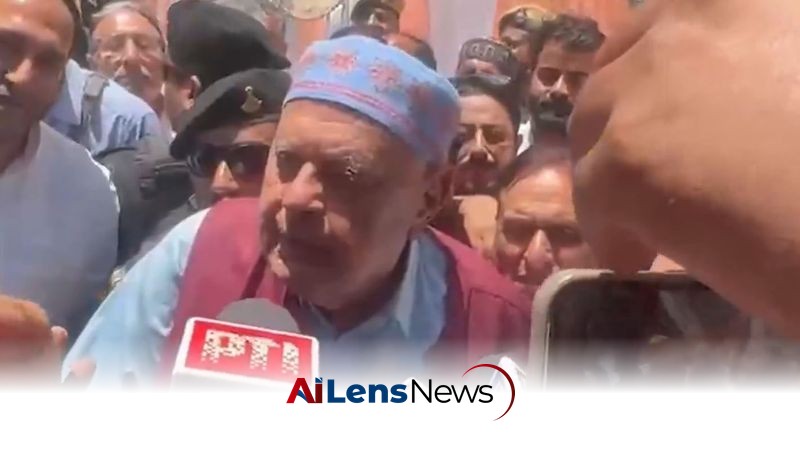


Farooq Abdullah, president of the National Conference, stated that Prime Minister Modi assured him and Chief Minister Omar Abdullah about restoring statehood.
Srinagar, India Jun 10, 2026 ALN: Prime Minister Narendra Modi has assured Chief Minister Omar Abdullah that he will fulfill his promise regarding the restoration of statehood, according to National Conference president Farooq Abdullah. Abdullah made this statement during a press conference in Anantnag district, emphasizing that they are awaiting the Centre to act on this commitment.
“The Prime Minister has recently told Omar that he will fulfill his promise regarding the restoration of statehood,” Abdullah stated, highlighting the importance of this assurance. He further addressed concerns regarding the delay in the approval of business rules for the local government, asserting that his party seeks not only the business rules but also the restoration of statehood.
“Statehood is their promise before the world. We are waiting for it,” he added, indicating the urgency of the matter. In light of these developments, the National Conference has announced plans to hold a protest in Delhi on the first day of the monsoon session of Parliament to advocate for the restoration of statehood. This decision was made during a meeting of the ruling party legislators chaired by Omar Abdullah on June 3. The National Conference is determined to keep the pressure on the government to fulfill its commitments regarding statehood.
The issue of statehood for and has been a contentious topic since the region was reorganized in August 2019. At that time, the Indian government abrogated Article 370 of the Constitution, which granted special status to and , and bifurcated the state into two Union Territories: and , and Ladakh. This move was met with widespread protests and political upheaval, as many viewed it as an infringement on the region's autonomy and rights.
Since the reorganization, there has been a significant push from various political parties, including the National Conference, for the restoration of statehood. The demand is rooted in the belief that statehood would provide greater political representation and administrative autonomy to the people of and , allowing them to have a more significant say in their governance and development. The National Conference, which has historically been one of the dominant political parties in the region, has positioned itself as a key player in advocating for the restoration of statehood. Farooq Abdullah, who has served as the Chief Minister of and in the past, has been vocal about the need for the central government to honor its commitments to the people of the region. His recent statements reflect a broader sentiment among the local populace, who feel that their voices have been marginalized since the 2019 changes.
In addition to the demand for statehood, the National Conference has also raised concerns regarding the governance structure in the Union Territory. The delay in the approval of business rules for the local government has been a point of contention, as it hampers the functioning of the local administration. Abdullah's comments highlight the urgency of resolving these bureaucratic issues to ensure effective governance. The lack of business rules has created a vacuum in governance, leading to a situation where local leaders are unable to implement policies effectively or respond to the needs of their constituents.
The planned protest in Delhi is indicative of the party's strategy to garner national attention to their demands. By mobilizing support in the capital, the National Conference aims to pressure the central government to take concrete steps towards restoring statehood. This approach reflects a broader trend among regional parties in India, which often seek to leverage national platforms to advocate for local issues. The protest is expected to draw participation not only from party members but also from local activists and citizens who share the sentiment for restoring statehood.
The implications of restoring statehood to and are significant. It would not only restore local governance but also potentially lead to greater economic development and stability in the region. Many believe that statehood can empower local leaders to address the unique challenges faced by the people of and , including issues related to security, development, and social welfare. The re-establishment of a legislative assembly could facilitate more localized decision-making, allowing for policies that are tailored to the specific needs of the diverse communities within the region.
Furthermore, the restoration of statehood could also have a positive impact on the political climate in the region. It may foster a sense of trust and cooperation between the local populace and the central government, which has been strained in recent years. By fulfilling its promise of statehood, the government could signal its commitment to democratic principles and local empowerment. This could also serve to mitigate some of the tensions that have historically characterized the relationship between and and the Indian state.
However, the path to restoring statehood is fraught with challenges. The central government must navigate complex political dynamics, including concerns about security and governance in the region. Additionally, there are differing opinions among various political factions regarding the best approach to addressing the aspirations of the people of and . Some factions argue for a more gradual approach to restoring statehood, citing security concerns, while others advocate for immediate action to restore democratic processes.
As the National Conference continues to advocate for statehood, the situation remains fluid. The upcoming monsoon session of Parliament will be a critical time for the party to press its demands and seek a resolution to the ongoing issues surrounding governance in and . The outcome of these efforts will likely have lasting implications for the political landscape of the region and its relationship with the central government.
In conclusion, the assurance given by Prime Minister Modi to Chief Minister Omar Abdullah regarding the restoration of statehood is a pivotal moment in the ongoing dialogue between the central government and the political leadership of and . The National Conference's commitment to advocating for this cause reflects the broader aspirations of the people in the region, who seek a return to a state of governance that allows for greater autonomy and representation. As developments unfold, the eyes of the nation will remain on and , as the quest for statehood continues to shape the political narrative of this historically significant region. The restoration of statehood not only represents a political objective but also symbolizes a hope for a more equitable and participatory governance structure that can effectively address the aspirations of its people.
To learn more about the latest developments in Leaders & Politicians, stay updated with our exclusive reports and analyses on AiLensNews.

