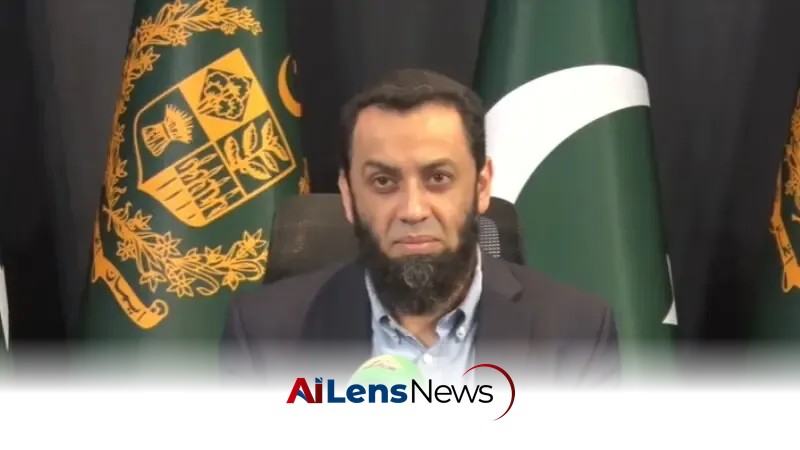


Information Minister Attaullah Tarar announced the arrest of a digital marketer accused of disseminating anti-state content on social media in exchange for Indian funding.
Islamabad, Pakistan Jul 26, 2026 ALN: In a significant development, Information Minister Attaullah Tarar announced on Sunday the arrest of an individual allegedly involved in disseminating anti-state content on social media, purportedly funded by India. This arrest has raised questions about the influence of external actors in Pakistan's internal affairs and the ongoing tensions between Pakistan and India, particularly concerning narratives surrounding Kashmir and national security.
During a televised address broadcast on state media, Minister Tarar explained that security forces had apprehended a man engaged in digital marketing services, whose business activities were reportedly linked to India. This case is emblematic of broader concerns regarding the use of social media as a tool for misinformation and manipulation, particularly in politically sensitive regions.
The minister accused the arrested individual of receiving payments from Indian sources in return for orchestrating a "network of misinformation" within Pakistan. This claim highlights the increasing scrutiny of digital platforms and their potential role in exacerbating divisions within society, particularly in a country where political and sectarian tensions are already heightened.
According to Tarar, the digital marketing professional utilized bot farms to disseminate and amplify anti-state messages across social media platforms. These messages reportedly targeted various institutions, including the government, military, and even the army chief, raising serious concerns about the potential for social unrest and destabilization in Pakistan.
In his address, the information minister presented what he described as evidence of the misinformation campaign, including screenshots of financial transactions and social media posts that promoted sectarian violence, unrest in Azad Jammu and Kashmir, and anti-state sentiments. Such claims underscore the complexities of information warfare in the digital age, where the lines between genuine discourse and orchestrated propaganda can often become blurred.
Tarar elaborated on the nature of the communications between the arrested individual and his alleged Indian operator, describing a WhatsApp exchange that included discussions about the number of views on specific posts, as well as financial transactions. He indicated that the payments were deliberately kept small to evade detection by financial monitoring authorities, an assertion that points to the sophisticated methods employed to fund and facilitate these operations.
Moreover, the minister revealed that the arrested individual had confessed to receiving content primarily concerning the Joint Awami Action Committee (JAAC), a group that the government has recently designated as a proscribed organization due to its calls for widespread protests. This connection raises critical questions about the intersection of local political movements and external influence, particularly in a region as contentious as Kashmir.
In his remarks, Tarar drew a direct link between the JAAC and the alleged anti-state activities, claiming that the group aims to undermine Pakistan’s position on the Kashmir issue and weaken its ties with the region. This assertion reflects a broader narrative within Pakistan that views Indian influence as a threat to national unity and territorial integrity.
The backdrop of this arrest involves ongoing tensions in Azad Jammu and Kashmir, where the JAAC has been at odds with regional authorities over a range of issues, most notably its demand to abolish twelve seats in the region's Legislative Assembly. This demand has sparked protests, signaling a growing discontent among certain segments of the population, which the government is keen to manage carefully.
In a rhetorical flourish, Tarar questioned the commitment of the JAAC to the Kashmir cause, suggesting that if the group were genuinely invested in the welfare of the region, it would participate in the electoral process instead of resorting to protests and disinformation campaigns. This line of reasoning reflects a common tactic employed by political leaders to delegitimize opposition movements by framing them as unrepresentative of the broader populace's interests.
Furthermore, Tarar asserted that the digital marketing campaign in question serves India's interests rather than those of the Kashmiri people, a claim that underscores the pervasive narrative in Pakistan that external adversaries seek to exploit local grievances for their own strategic ends. He emphasized that evidence of financial transactions linked to India substantiates these claims, thereby reinforcing the government’s stance on the need for vigilance against foreign interference.
In closing, the information minister stated that the JAAC and similar groups must be held accountable for their actions, which he characterized as treasonous given their alleged connections to foreign funding and anti-state activities. He called on the group to explain its actions to the Pakistani populace, framing their behavior as a betrayal of national interests.
Tarar also pointed to the political landscape in Azad Jammu and Kashmir, noting that other political parties are preparing for upcoming elections with substantial public support. This observation was intended to illustrate that the Kashmiri populace is increasingly rejecting the JAAC's narratives and tactics, thereby affirming the resilience of Pakistan's relationship with Kashmir despite the challenges posed by dissenting groups.
In a broader context, the information minister linked the recent diplomatic successes of Pakistan on the global stage and the country's military achievements against India to the emergence of groups like the JAAC. He suggested that these developments are difficult for adversaries to accept, which may explain the rise of disinformation campaigns aimed at destabilizing the current government and undermining Pakistan's strategic objectives.
This incident serves as a reminder of the intricate dynamics at play in South Asia, where historical grievances, territorial disputes, and the rise of digital communication intersect. As Pakistan continues to navigate its complex relationship with India, the implications of such arrests could extend beyond immediate political ramifications, potentially influencing public discourse and the perception of national security issues in the region.
To learn more about the latest developments in Political Controversies, stay updated with our exclusive reports and analyses on AiLensNews.

