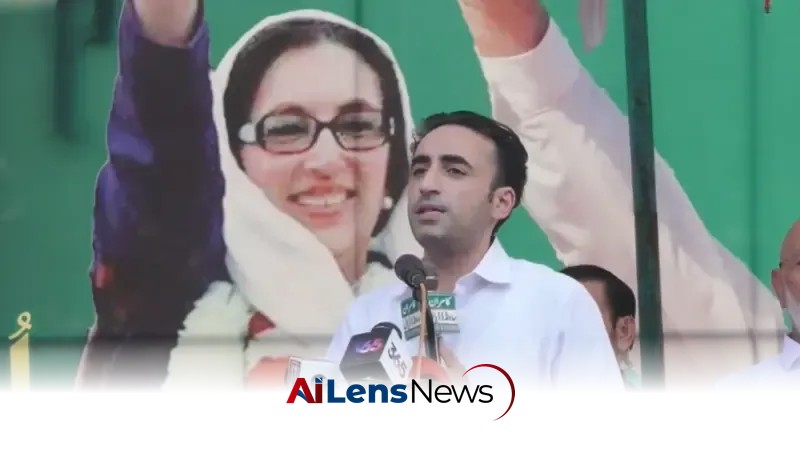


Bilawal Bhutto-Zardari promises to be the voice of Azad Jammu and Kashmir (AJK) in the Centre, addressing key issues and proposing a truth and reconciliation commission.
Islamabad, Pakistan Jul 17, 2026 ALN: Bilawal Bhutto-Zardari, the Chairman of the Pakistan Peoples Party (PPP), has officially launched his election campaign in Azad Jammu and Kashmir (AJK), a region that has been a focal point of political discourse in Pakistan for decades. His commitment to represent the voices of the people of AJK both at the federal level and on international platforms underscores the importance of this region in Pakistan's political landscape.
In his inaugural rally, Bilawal articulated a strong message about the current state of affairs in AJK, stating, "We have seen both good and bad times in AJK, but I have not witnessed the conditions that I am seeing today." This statement reflects the growing concerns among residents regarding governance, economic stability, and the overall welfare of the population. The PPP chairman framed the prevailing circumstances as a significant challenge not only for the AJK government but also for the state of Pakistan as a whole, as well as for all political parties involved.
Bilawal's assertion that it is the fundamental duty of politicians to act as a bridge between the people of AJK and the Centre is particularly poignant. He criticized the current political leadership for failing to fulfill this responsibility, indicating a disconnect between the government and the populace. His comments resonate with sentiments expressed by many citizens who feel marginalized and unheard in the political process.
Moreover, Bilawal contextualized the challenges faced by AJK within a broader national framework, asserting that regions such as Sindh, Khyber Pakhtunkhwa, Balochistan, and Gilgit-Baltistan are similarly experiencing neglect. This perspective highlights a prevalent issue in Pakistan's political discourse—regional disparities and the need for equitable representation and resource allocation across the country.
During the rally, Bilawal made a compelling promise: "If the people of AJK give me the mandate, I promise that I will be your voice in Islamabad and globally." This pledge emphasizes his commitment to advocating for the rights and needs of AJK residents, particularly in the context of ongoing political and social struggles. His assertion that "there is no issue that cannot be resolved politically and peacefully" reflects a belief in dialogue and negotiation as essential tools for conflict resolution.
One of the most notable proposals Bilawal put forth was the formation of a truth and reconciliation commission aimed at addressing the longstanding issues in AJK. This proposal, if accepted, could serve as a mechanism for healing and addressing grievances that have persisted over time. Bilawal's call for both the government and protesters to consider this approach suggests a desire for collaborative solutions rather than continued confrontation.
However, he expressed frustration at the lack of response from both sides regarding his proposal. His statement, "If this is not the way, I ask the government and protesters to tell me what the alternative is," reflects a growing impatience with the status quo and a yearning for constructive dialogue. Bilawal's acknowledgment of the right to protest, coupled with his concerns about the negative impact of disruptive demonstrations on ordinary citizens, illustrates the complex dynamics of political activism in AJK.
Bilawal's critique of the government's response to protests is noteworthy. He pointed out that while the government has a duty to maintain order, its current actions seem to disproportionately affect the general population rather than targeting those responsible for civil unrest. His statement, "The government is not punishing the protesters; it is punishing all Kashmiris," underscores the need for a more nuanced approach to governance that takes into account the diverse needs of the populace.
In a broader context, Bilawal's remarks about the potential for Pakistan to mediate peace between nations, such as the United States and Iran, juxtaposed with the ongoing struggles in Kashmir, highlight the paradox of Pakistan's foreign policy ambitions against its domestic challenges. His demand for the government to open up Kashmir for dialogue and development reflects a desire for progress that transcends political divisions.
Looking ahead to the upcoming elections in AJK, Bilawal characterized them as the "most important election in the history of AJK." This statement underscores the significance of this electoral process in shaping the future of the region. He emphasized the need for self-ownership, self-government, and employment opportunities, which are integral components of the PPP's manifesto. The mention of these rights resonates with the aspirations of many in AJK who seek greater autonomy and economic development.
Bilawal's comments regarding the underdevelopment of AJK and Gilgit-Baltistan (GB) further highlight the urgent need for targeted policies that address the unique challenges faced by these regions. He pointed out that both areas have been waiting for generations to fully integrate into Pakistan's socio-economic framework, suggesting that the PPP is committed to advocating for their rights without compromising the broader Kashmir cause.
In a forward-looking statement, Bilawal announced plans to convene constitutional conventions post-elections, providing a platform for citizens to voice their proposals for reforms. This approach signifies a commitment to participatory governance, where the voices of the people are prioritized in the decision-making process. His assertion that "only Kashmir can decide for Kashmir" encapsulates the essence of self-determination that many in the region seek.
Additionally, Bilawal's promise to ensure representation for the people of Kashmir in legislative forums, whether through observer status or provisional measures, reflects a recognition of the need for inclusive governance. His opposition to a centralized Ministry of Kashmir and Gilgit-Baltistan in favor of complete empowerment aligns with the aspirations of many who advocate for regional autonomy and self-governance.
As the AJK Election Commission prepares for the general elections scheduled for July 27, the political landscape is becoming increasingly dynamic. The PPP's decision to field candidates for 35 of the 45 seats in the AJK Legislative Assembly, while also forming an alliance with the Jamiat Ulema-i-Islam (Fazl) (JUI-F), indicates a strategic approach to consolidate political power in the region. This alliance could potentially reshape the electoral outcomes and influence the future governance of AJK.
In conclusion, Bilawal Bhutto-Zardari's campaign launch in AJK encapsulates the complexities of regional politics in Pakistan. His commitment to being a voice for the people, coupled with proposals for dialogue and reform, reflects a broader aspiration for a more inclusive and equitable political landscape in AJK and beyond. As the elections approach, the implications of his promises and the response from the electorate will be pivotal in determining the future trajectory of governance and representation in this critical region.
To learn more about the latest developments in Elections, stay updated with our exclusive reports and analyses on AiLensNews.

