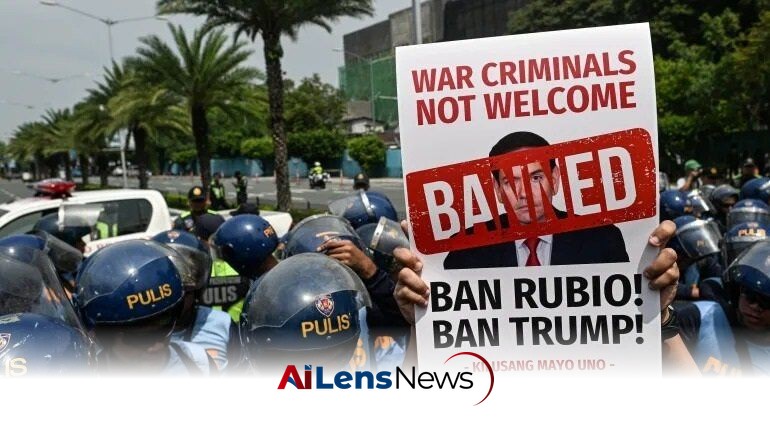


Public anger erupted in Manila as demonstrators protested Secretary of State Marco Rubio's presence at the ASEAN Foreign Ministers’ Meeting, denouncing US military operations against Iran.
Tehran, Iran Jul 22, 2026 ALN: Public anger over Washington’s aggressive foreign policy erupted on the streets of Manila on Wednesday, as anti-war demonstrators rallied outside the venue of the Association of Southeast Asian Nations (ASEAN) Foreign Ministers’ Meeting to protest the presence of Secretary of State Marco Rubio and denounce US military operations against Iran.
Carrying placards reading “War criminals not welcome” and “Ban Trump! Ban Rubio!”, activists gathered in the Philippine capital to voice sharp opposition to Washington's military actions in the Middle East and its expanding strategic footprint in the Indo-Pacific. The protests not only highlighted the discontent with US foreign policy but also reflected a broader sentiment against perceived imperialism and interventionism that has characterized US actions in various parts of the globe.
Rubio arrived in Manila to participate in bilateral and multilateral sessions with regional counterparts, attempting to justify the US military posture and reinforce defense commitments with local allies. However, the American delegation was met by crowds demanding an immediate end to US warfare abroad and an end to foreign military entanglements. This juxtaposition of diplomatic engagement and public dissent underscores the complexities faced by US officials when navigating international relations, particularly in a region that has historically been sensitive to foreign intervention.
Human rights advocate Cristina Palabay condemned Washington's global military actions during the rally, pointing to a long pattern of interventionism. Her statements resonate with a growing number of activists and scholars who argue that the US has frequently prioritized its geopolitical interests over the welfare of local populations. The implications of such actions often lead to significant humanitarian crises, destabilization of regions, and long-term repercussions for international relations.
“The US, especially under Trump, has been the world’s foremost war criminal,” Palabay told Al Jazeera. “The US government has been known to bomb and kill people in Palestine, in Iran, in the Philippines, and in many other places where their permanent presence exists and where military basing continues.”
The sentiment expressed by Palabay is not an isolated viewpoint but part of a larger narrative that has gained traction in recent years. Many critics of US foreign policy argue that military interventions have often resulted in unintended consequences, including the rise of extremist groups, prolonged conflicts, and the erosion of trust between nations. These factors contribute to a cycle of violence that can destabilize entire regions, as seen in the Middle East, where US actions have been linked to ongoing conflicts in countries like Iraq, Syria, and Yemen.
Protesters also targeted the host government’s alignment with Washington’s geopolitical agenda. Activist Mong Palatino urged the administration of President Ferdinand Marcos Jr. to cut ties with top US officials, warning that deeper military cooperation serves American imperial interests at the expense of national sovereignty. The Philippines has a complicated history with the US, having been a colony in the early 20th century and enduring a tumultuous relationship marked by periods of cooperation and conflict.
“His visit will lead to more US military bases in the Philippines,” Palatino said. “His visit will lead to the further plunder of our natural resources. So we are here to condemn the Marcos government for colluding with the US.”
The concerns raised by Palatino reflect broader apprehensions about the implications of foreign military presence in the Philippines. The country has been a strategic ally of the US, especially in the context of regional security dynamics involving China. However, this alliance has often been met with resistance from segments of the Filipino population who view it as a compromise of their sovereignty and an infringement on their rights. The presence of US military bases has historically been a contentious issue, with many advocating for a reevaluation of the terms of such agreements.
The demonstrations in Manila reflect growing international blowback against American unilateralism, as civil society groups across Asia join global calls demanding a halt to US military aggression against Iran and an end to Western intervention in regional affairs. This rising tide of activism is indicative of a shift in public opinion, particularly among younger generations who are increasingly vocal about issues of social justice, human rights, and anti-imperialism.
Moreover, the protests in Manila are part of a larger trend observed in various countries where citizens are questioning the role of their governments in international conflicts. In recent years, there has been a noticeable increase in anti-war movements, particularly as information about the consequences of military interventions becomes more accessible through social media and independent news outlets. This has encouraged a more informed and engaged citizenry, capable of mobilizing against policies they view as unjust or harmful.
As the international community grapples with the complexities of modern warfare and foreign policy, the protests in Manila serve as a reminder of the need for accountability and transparency in government actions. The voices of activists like Palabay and Palatino highlight the importance of considering the humanitarian impact of military engagements and the necessity of prioritizing diplomacy over conflict.
The implications of such protests extend beyond the borders of the Philippines, as they resonate with global movements advocating for peace and justice. The intersection of local and international activism underscores the interconnectedness of struggles against imperialism, militarism, and human rights violations. As more citizens around the world become engaged in these issues, the potential for significant change in the discourse surrounding foreign policy and military intervention increases.
In conclusion, the protests in Manila against US military actions reflect a growing dissent against interventionist policies and a call for a reevaluation of alliances that may undermine national sovereignty. As activists continue to raise their voices, the challenge for governments will be to address these concerns while navigating the complexities of international relations in an increasingly multipolar world.
To learn more about the latest developments in Political Controversies, stay updated with our exclusive reports and analyses on AiLensNews.

