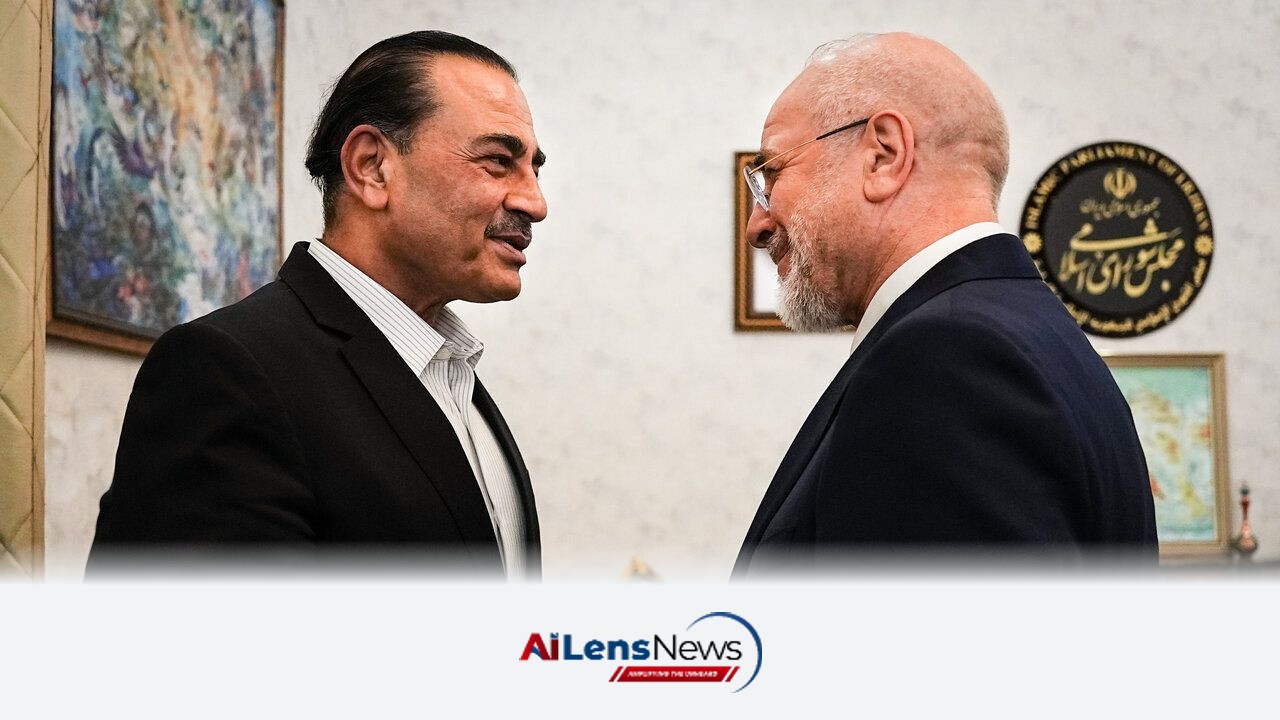



In Tehran, Pakistan's Chief of Defense Forces, Field Marshal Syed Asim Munir, discussed regional stability with Iranian officials, highlighting US failures in commitments.
Tehran, Iran Aug 26, 2026 ALN: Pakistan’s Chief of Defense Forces (CDF), Field Marshal Syed Asim Munir, held talks with senior Iranian officials, including Parliament Speaker Mohammad Baqer Qalibaf, in Tehran on Monday. This meeting highlights the ongoing diplomatic engagement between Iran and Pakistan, two neighboring countries that share a long and complex history. Their relationship has often been influenced by regional dynamics, including the role of external powers such as the United States.
During the meeting, Qalibaf pointed to the US failure to honor its commitments under the memorandum of understanding (MoU) that President Donald Trump signed with Iran on June 17. The MoU was intended to establish a framework for reducing tensions and promoting dialogue between the two nations. However, Qalibaf's remarks underscore a broader sentiment in Iran regarding the reliability of US commitments in international agreements. He stated, “The commitments made by both sides under the memorandum of understanding are clear. It was the United States’ failure to honor its commitments that undermined regional stability and gave us yet another reason not to trust Washington.”
This statement reflects Iran's longstanding grievances with US foreign policy, particularly following the unilateral withdrawal of the United States from the Joint Comprehensive Plan of Action (JCPOA) in 2018. The JCPOA was a landmark agreement aimed at curbing Iran's nuclear program in exchange for sanctions relief. The US withdrawal, coupled with the re-imposition of stringent sanctions, has significantly strained relations between Iran and the West, leading to increased tensions in the region.
Field Marshal Munir, for his part, emphasized his commitment to fostering regional peace. His visit to Iran comes at a time when Pakistan is also navigating its own complex relationships with neighboring countries, including India and Afghanistan. The strategic location of Pakistan and Iran, both bordering Afghanistan, makes their cooperation essential for addressing security challenges in the region. Munir's arrival in Iran signals a desire for collaboration on security issues, especially in light of the evolving geopolitical landscape.
The mediated MoU established framework terms to cease hostilities. While subsequent US aerial strikes and naval blockades disrupted the agreement, Pakistan had already demonstrated its diplomatic role by helping facilitate the April 8 ceasefire that paused the 39-day war that the US and Israel launched on Iran on February 28. This involvement highlights Pakistan’s diplomatic engagement and its willingness to act as a mediator in regional conflicts, a role that has historically been significant given its relationships with both Iran and the United States.
Tehran has repeatedly expressed its gratitude to Pakistan for its diplomatic support and conflict-resolution efforts during critical moments of crisis. Such acknowledgments are crucial as they reinforce the importance of bilateral ties between the two nations. Beyond defense cooperation, economic partnership remains central to their bilateral relationship. Under comprehensive joint agreements, Tehran and Islamabad are actively expanding cross-border infrastructure, trade market access, and energy links. These initiatives aim to scale bilateral trade volume from over $3 billion to a targeted $10 billion, reflecting a mutual commitment to leveraging shared geography for long-term economic integration and regional peace.
The economic ties between Iran and Pakistan are not only vital for their respective economies but also serve as a counterbalance to external pressures, particularly from the US. By enhancing trade and investment, both countries aim to create a more resilient economic framework that can withstand geopolitical tensions. Additionally, energy cooperation, particularly in the form of gas pipelines and electricity exchanges, is a key area of focus. The Iran-Pakistan gas pipeline project, which has faced numerous delays and challenges, remains a symbol of potential collaboration that could significantly benefit both nations.
Furthermore, the strategic partnership between Iran and Pakistan is also shaped by their shared interests in combating terrorism and ensuring stability in the region. Both countries have faced threats from extremist groups and have a vested interest in promoting security along their borders. Collaborative security measures can enhance their ability to address these challenges while fostering trust and cooperation.
As both nations navigate the complexities of their relationship, the implications of their discussions extend beyond bilateral concerns. The evolving dynamics in the Middle East and South Asia, including the US's strategic interests and its relationships with other regional players, will continue to influence Iran-Pakistan relations. The ongoing dialogue between Qalibaf and Munir reflects a broader effort to strengthen ties amid a backdrop of uncertainty and change in the geopolitical landscape.
In conclusion, the meeting between Iran's Qalibaf and Pakistan's Munir signifies not only a commitment to enhancing bilateral relations but also a recognition of the importance of regional stability in the face of external pressures. As both countries seek to navigate their respective challenges, their collaboration on security, economic, and diplomatic fronts will be crucial for fostering a peaceful and prosperous future in the region.
To learn more about the latest developments in Political Controversies, stay updated with our exclusive reports and analyses on AILensNews.

