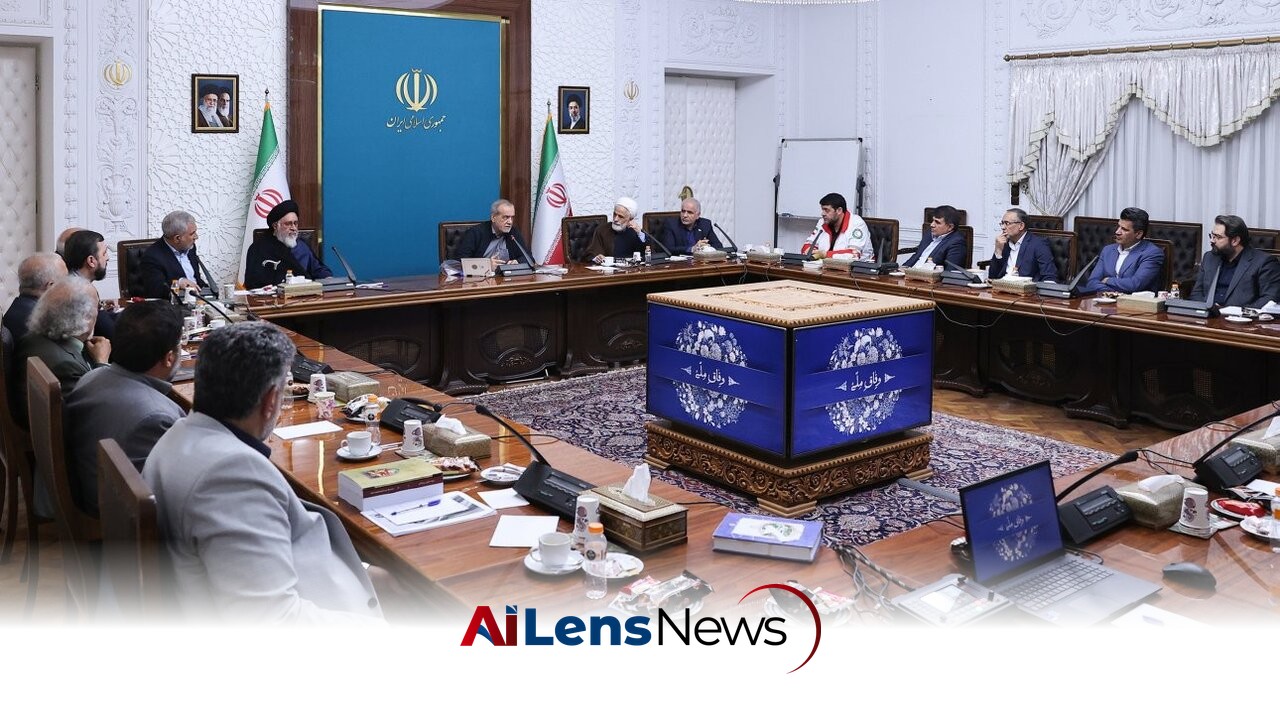


President Masoud Pezeshkian emphasizes the need for a systematic legal approach to counter Israeli and US military actions against Iran, aiming to establish international deterrence.
Tehran, Iran Jul 19, 2026 ALN: TEHRAN - President Masoud Pezeshkian has described a systematic examination of the legal and judicial dimensions of the Israeli and US military aggression against Iran as an undeniable necessity to establish international deterrence. This statement comes amid heightened tensions in the region, where military confrontations have raised questions about international law and the rights of sovereign nations.
"Systematically addressing the legal and judicial dimensions of the recent wars is an undeniable necessity—not only for raising public awareness and vigilance, but also for laying the foundation for Iran to build legal influence and deterrence in international forums," Pezeshkian said on Saturday morning. His remarks underscore a growing recognition within Iran of the importance of legal frameworks in the face of military aggression.
Pezeshkian made the comments while chairing a specialized high-level meeting convened to develop a comprehensive strategy for pursuing legal action in domestic, international, and foreign jurisdictions over crimes committed against Iran. The session was attended by the justice minister, senior officials from the executive branch, and leading legal and judicial experts. This gathering reflects a concerted effort by the Iranian government to mobilize its legal resources in response to perceived violations of its sovereignty.
The legal initiative directly addresses two separate waves of unprovoked, unilateral military aggression launched against Iran by the US and Israel. The first conflict, known as the 12-Day War, occurred between June 13 and June 24 last year. It began with a series of hostile, surprise airstrikes targeting sovereign Iranian military command centers, civil infrastructure, and defensive facilities. The criminal operation resulted in the martyrdom of dozens of senior military commanders and civil personnel, alongside widespread damage to non-military installations. This conflict marked a significant escalation in hostilities and served as a catalyst for Iran's current legal strategy.
The second major aggression, widely referred to as the Ramadan War, was initiated on February 28 this year under a joint US-Israeli operation. The opening wave of the strikes hit the heart of Iran’s leadership and defensive sectors. The criminal nature of the campaign was heavily condemned internationally after a US missile struck a school adjacent to a public area in the southern city of Minab, massacring approximately 170 people, many of them innocent schoolchildren. This incident not only heightened domestic outrage but also drew international condemnation, further complicating the geopolitical landscape.
These military actions have caused significant upheaval within Iran, leading to increased calls for accountability and justice from both the Iranian government and its citizens. The Iranian leadership has consistently characterized these actions as violations of international law and human rights, arguing that they undermine Iran's sovereignty and threaten regional stability. This narrative is crucial for the Iranian government as it seeks to consolidate public support and legitimize its response to external threats.
In the wake of these conflicts, President Pezeshkian's administration has sought to galvanize support for a robust legal framework that not only addresses past aggressions but also aims to deter future military interventions. This approach reflects a broader strategy by Iran to assert its rights on the international stage and challenge what it views as unlawful acts by foreign powers. The emphasis on legal recourse is indicative of a shift in Iran's strategy, moving from purely military responses to a more multifaceted approach that includes legal and diplomatic avenues.
The call for enhanced legal deterrence also comes at a time when Iran is navigating a complex geopolitical landscape. The country's relations with the US and Israel have been strained for decades, marked by sanctions, military posturing, and diplomatic standoffs. The recent military actions have exacerbated these tensions and have led to heightened security concerns within Iran. The Iranian government is aware that any legal initiative must be bolstered by a strong narrative that resonates both domestically and internationally.
In this context, the Iranian government is likely to engage with international legal bodies, including the International Court of Justice and the United Nations, to present its case against the alleged aggressions. However, the effectiveness of such legal actions remains uncertain, as geopolitical dynamics often influence the outcomes of international legal proceedings. The Iranian leadership may face challenges in garnering support from the international community, particularly from nations that have historically aligned with the US and Israel.
Moreover, the Iranian leadership's focus on legal recourse may serve multiple purposes. It aims to bolster domestic support by demonstrating a commitment to justice and accountability, while also seeking to rally international opinion against military aggressions. By framing these conflicts in legal terms, Iran may hope to shift the narrative from a purely military confrontation to one that emphasizes international law and human rights. This strategy could potentially enhance Iran's standing in international forums and create a more favorable environment for its legal pursuits.
Critics of the Iranian government, however, argue that the focus on legal avenues may not address the immediate security concerns posed by ongoing tensions with the US and Israel. They suggest that a more comprehensive approach, including diplomatic engagement and dialogue, may be necessary to resolve the underlying issues fueling these conflicts. The debate over the efficacy of legal versus diplomatic strategies reflects broader discussions within Iran about the best path forward in a challenging geopolitical environment.
As the situation evolves, the implications of President Pezeshkian's legal initiative will be closely monitored. The effectiveness of Iran's legal strategy in deterring future aggressions will depend not only on the strength of its legal arguments but also on the political will of the international community to support its claims. The coming months will likely reveal whether Iran's approach to legal deterrence can achieve its desired outcomes or if it will lead to further escalation in the region.
In conclusion, President Pezeshkian's advocacy for enhanced legal deterrence highlights a pivotal moment for Iran as it seeks to navigate a fraught geopolitical landscape. The outcomes of these legal initiatives may not only impact Iran's national security but also influence broader regional dynamics and the international legal framework regarding state sovereignty and military intervention. As the Iranian government continues to develop its legal strategy, it remains to be seen how effectively it can leverage international law to protect its interests and assert its rights in the face of ongoing aggression.
To learn more about the latest developments in Political Controversies, stay updated with our exclusive reports and analyses on AiLensNews.

