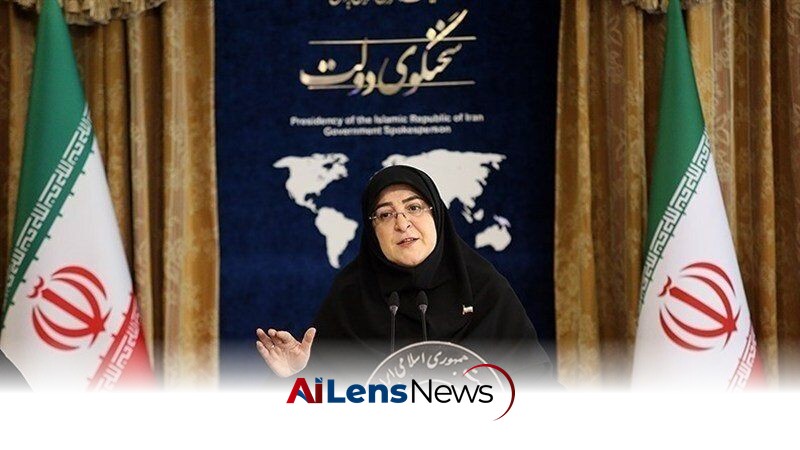


The Iranian government has confirmed that more than 30 civilians were killed in recent US airstrikes in southern Iran, prompting widespread condemnation and calls for accountability.
Tehran, Iran Jul 15, 2026 ALN: Iranian government spokesperson Fatemeh Mohajerani stated on Wednesday that more than 30 civilians have lost their lives in recent US strikes targeting southern Iran. In a statement published on the social media platform X, Mohajerani expressed her deepest condolences to the victims' families and pledged full government support for the affected communities in the region.
The United States has carried out several waves of intense airstrikes on Iran's southern regions in recent days. While Washington maintains that these operations are strictly aimed at "degrading Iran's ability to threaten commercial shipping" in the vital Strait of Hormuz, the rising civilian death toll directly contradicts these claims. The Strait of Hormuz is a critical chokepoint for global oil supplies, and tensions in the region have long been a focal point of geopolitical strife, particularly between the US and Iran.
The renewed US bombardment represents a flagrant violation of the memorandum of understanding (MoU) signed electronically on June 17 by Iranian President Masoud Pezeshkian and US President Donald Trump. The Islamabad MoU explicitly demanded a permanent end to hostilities on all fronts and committed both sides to final peace negotiations within a 60-day window. US forces launched these bombings after Trump abruptly declared that the June agreement was "over." This abrupt shift has raised questions about the reliability of international agreements and the broader implications for diplomatic relations in the region.
The June MoU was originally engineered to preserve the April 8 ceasefire, which temporarily paused the joint US and Israeli war on Iran that erupted on February 28. According to official data, nearly 3,500 people have been killed in Iran since the outbreak of the war, roughly half of whom are confirmed to be civilians. The staggering human cost of this conflict has led to widespread calls for accountability and a reevaluation of military strategies employed by the US in the region.
The catastrophic human cost of Washington's military campaign was set on the very first day of the war, marked by a tragic US missile strike on an elementary school in the southern city of Minab. The attack killed 168 people, the vast majority of them school children. While US media outlets later acknowledged that an American Tomahawk cruise missile was responsible for obliterating the school, Washington has faced severe international criticism for failing to ensure accountability or alter its targeting parameters to protect innocent lives. Critics argue that the Minab school disaster, paired with the recent deaths of 30 more civilians in the south, underscores a reckless disregard for international humanitarian law and exposes the empty nature of Washington's "precision striking" rhetoric.
The situation in Iran is further complicated by the historical context of US-Iran relations, which have been fraught with tension since the 1979 Iranian Revolution. The US has imposed a series of sanctions on Iran, aimed at curtailing its nuclear program and curbing its influence in the region. These sanctions have had a profound impact on the Iranian economy and have contributed to widespread discontent among the population. In response to perceived threats from the US and its allies, Iran has often engaged in regional proxy conflicts, further escalating tensions.
The Iranian government has consistently framed US military actions as acts of aggression that violate its sovereignty and threaten its national security. The Iranian military has vowed to retaliate against what it perceives as unjustified attacks. This creates a precarious situation where further escalation could lead to a broader conflict, drawing in regional powers and potentially destabilizing the entire Middle East.
The implications of these airstrikes extend beyond immediate civilian casualties. They could hinder any potential diplomatic efforts aimed at resolving the ongoing conflict. The international community has been closely monitoring the situation, with various countries calling for restraint and urging both sides to return to the negotiating table. However, the ongoing violence and loss of life may complicate these efforts, as trust between the parties continues to erode.
Moreover, the humanitarian crisis in Iran is deepening as a result of the conflict. The influx of casualties from airstrikes and ground fighting has placed immense pressure on medical facilities, many of which are already struggling due to sanctions and resource shortages. Hospitals and clinics are often overwhelmed by the number of injured civilians, and the lack of essential medical supplies exacerbates the suffering of those caught in the crossfire. The international humanitarian community faces challenges in delivering aid, with access often restricted by ongoing hostilities and the complex political landscape.
As the situation evolves, the global community is left grappling with the ramifications of US military actions in Iran. The loss of civilian lives raises ethical questions about military intervention and the responsibilities of nations under international law. The principle of proportionality in armed conflict, which seeks to limit civilian casualties, is increasingly being questioned in light of these recent events. The concept requires that military actions must not cause excessive civilian harm in relation to the anticipated military advantage gained.
In the aftermath of these airstrikes, numerous human rights organizations have condemned the US actions, calling for independent investigations into the civilian casualties. They argue that accountability is essential for preventing future violations of international law and for restoring some measure of trust in the international system. The calls for accountability are echoed by various governments and international bodies that emphasize the need for all parties to adhere to humanitarian standards during armed conflict.
In conclusion, the recent US airstrikes in southern Iran have resulted in significant civilian casualties, raising alarms about the humanitarian impact of military operations in the region. The violation of the June MoU further complicates the already tense relationship between the US and Iran, with potential implications for future diplomatic efforts. As the conflict continues, the international community must navigate a complex landscape, balancing the need for security with the imperative to protect civilian lives and uphold international humanitarian standards. The ongoing violence not only threatens to escalate into a wider conflict but also poses profound challenges for humanitarian efforts and the protection of civilians caught in the crossfire.
To learn more about the latest developments in Political Controversies, stay updated with our exclusive reports and analyses on AiLensNews.

