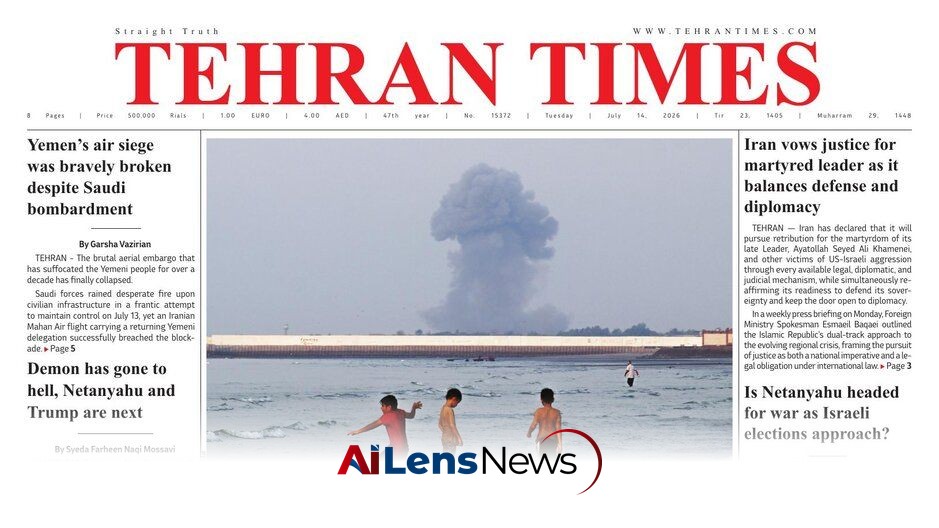


Iran emphasizes its control over the Hormuz Strait, rejecting foreign claims amid escalating regional tensions and military maneuvers.
Tehran, Iran Jul 14, 2026 ALN: The Islamic Republic of Iran has reiterated its stance on the sovereignty of the Hormuz Strait, asserting that it belongs exclusively to Iran and not to foreign powers. This declaration comes in the context of heightened military activities in the region, particularly involving the United States and its allies. The Hormuz Strait is not only a critical chokepoint for maritime traffic but also a symbol of national pride and territorial integrity for Iran, making it a focal point of both strategic and political significance.
Iran's assertion is rooted in its long-standing position regarding the strategic waterway, which is crucial for global oil transportation. The Strait of Hormuz connects the Persian Gulf with the Gulf of Oman and is a vital passage for a significant portion of the world's oil supply. According to estimates, approximately 20% of the world's oil passes through this narrow strait, highlighting its importance not just to Iran but to the global economy. The geopolitical significance of the Strait of Hormuz has made it a point of contention among various nations, particularly in the context of U.S.-Iran relations, which have been fraught with tension since the Islamic Revolution of 1979.
The strategic importance of the Strait of Hormuz cannot be overstated. It serves as a conduit for oil tankers traveling to and from the oil-rich Gulf states, including Saudi Arabia, Iraq, and the United Arab Emirates. The reliance of global economies on this narrow passage has led to increased military and political maneuvers by various nations seeking to assert control or influence over the region. Iran's insistence on its sovereignty is both a defensive posture and a means of projecting power in a region where it has historically sought to maintain influence.
In recent months, there has been an increase in military presence from the U.S. and allied nations in the region, aimed at ensuring the security of maritime routes. The U.S. has conducted naval exercises and has deployed additional naval assets to the Persian Gulf, citing the need to protect shipping lanes against threats, including those posed by Iranian naval forces. Iran views these actions as provocative and a direct challenge to its sovereignty, prompting a series of warnings from Iranian officials regarding the potential consequences of foreign military presence in the Strait.
The military maneuvers have included joint exercises between the U.S. and Gulf Cooperation Council (GCC) partners, which encompass nations like Saudi Arabia, the United Arab Emirates, and Bahrain. These exercises are often portrayed by the U.S. as necessary steps to ensure freedom of navigation and to deter any hostile actions from Iran, particularly in light of previous incidents involving the seizure of oil tankers and attacks on commercial vessels attributed to Iranian forces or their proxies. Such incidents have heightened tensions and raised concerns about the potential for direct confrontation.
Moreover, the U.S. has accused Iran of engaging in aggressive tactics to intimidate shipping vessels, including the use of fast attack boats and the deployment of naval mines. In response, Iranian officials have characterized these military preparations as a form of psychological warfare aimed at undermining Iran's position in the region. The ongoing military activities have created a precarious situation, where miscalculations on either side could lead to an escalation of hostilities.
In response to foreign military activities, Iranian officials have vowed to protect their territorial waters and maintain a robust defense posture. The Iranian military has conducted various exercises to demonstrate its readiness to respond to any perceived threats, including missile tests and naval drills in the Persian Gulf. These exercises are intended to showcase Iran's military capabilities and resolve in defending its claims over the Strait of Hormuz.
Furthermore, Iran has employed a strategy of asymmetric warfare, leveraging its regional influence through proxy groups in Iraq, Syria, Lebanon, and Yemen, which can disrupt maritime traffic should tensions escalate. Iran's leadership has repeatedly emphasized that any attempt to challenge its sovereignty over the Strait would be met with a strong military response, raising the stakes in an already volatile region. This strategy allows Iran to project power and influence beyond its borders while maintaining plausible deniability regarding direct military engagement.
The international community remains divided on the issue, with some nations supporting Iran's claims while others back the U.S. stance on maintaining freedom of navigation in international waters. Countries such as Russia and China have expressed support for Iran's position, criticizing U.S. military presence as destabilizing. Conversely, Western allies of the U.S. have generally endorsed the need for a secure maritime environment and have participated in patrols aimed at ensuring the safety of shipping lanes.
This division has further complicated diplomatic relations in the region. The European Union has attempted to mediate tensions but has faced challenges in balancing its economic interests with the need for security in the Gulf. The ongoing negotiations surrounding Iran's nuclear program, which also involve the U.S. and other world powers, add another layer of complexity to the situation. Any escalation in military tensions could jeopardize these diplomatic efforts and lead to a broader conflict.
In addition, the response from regional players has also been notable. Countries in the GCC have been increasingly vocal about their security concerns, leading to a collective security framework aimed at countering Iranian influence. This has included increased defense spending and the acquisition of advanced military technology, further complicating the security landscape in the Gulf.
The situation in the Strait of Hormuz is emblematic of the broader geopolitical struggle for influence in the Middle East. The region has been characterized by a series of conflicts, proxy wars, and shifting alliances, all of which contribute to an environment of instability. Iran's insistence on its sovereignty over the Strait is not merely a matter of national pride but also a strategic imperative that shapes its foreign policy and military strategy.
Moreover, the implications of this tension extend beyond the immediate region. Disruptions in oil supply routes through the Strait of Hormuz could have significant repercussions for global energy markets, leading to increased oil prices and economic uncertainty worldwide. Countries heavily reliant on oil imports from the Gulf region, particularly in Asia and Europe, could face economic challenges if military confrontations lead to blockades or escalations. Such disruptions could also trigger a ripple effect across global markets, affecting everything from transportation costs to inflation rates.
As tensions continue to rise, the situation in the Strait of Hormuz remains a focal point of geopolitical interest. Iran's firm stance on its sovereignty underscores the complexities of regional security and the ongoing struggle for influence in the Middle East. The potential for miscalculation or unintended confrontations remains high, necessitating careful diplomatic engagement to prevent escalation into a broader conflict. The international community's response will be crucial in shaping the future dynamics of the region and ensuring that maritime routes remain secure and open for global trade.
In conclusion, the assertion of sovereignty by Iran over the Hormuz Strait is a reflection of larger geopolitical currents that define the Middle East today. The interplay of military posturing, regional alliances, and international diplomacy will continue to shape the landscape, making the Strait a critical flashpoint for future conflicts or resolutions. As nations navigate these turbulent waters, the stakes are high for regional stability and global economic well-being.
To learn more about the latest developments in Elections, stay updated with our exclusive reports and analyses on AiLensNews.

