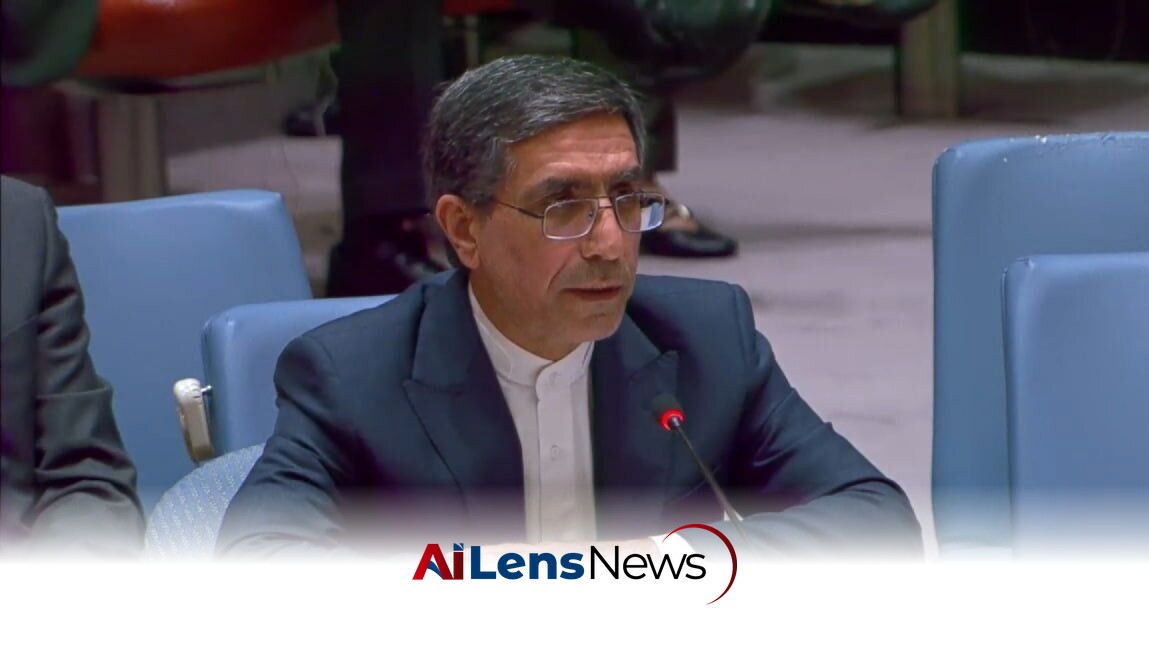


In a recent UNSC debate, Iran's representative emphasized that military actions taken by the Islamic Republic are defensive and aligned with international law, urging the council to address US aggression.
Tehran, Iran Jul 24, 2026 ALN: Addressing an open debate of the United Nations Security Council, Iran’s diplomatic mission reaffirmed that all military measures taken by the Islamic Republic are strictly defensive, necessary, and fully aligned with international law in response to continuous American acts of aggression.
Speaking at the session, Gholamhossein Darzi, Iran's deputy permanent representative to the United Nations, highlighted Washington's systematic breaches of international obligations and warned that Iran will continue exercising its inherent right to self-defense to safeguard its sovereign territory, national security, and civilian population. This assertion is rooted in a long-standing narrative within Iranian foreign policy that frames its military actions as responses to perceived threats, particularly from the United States and its allies.
Darzi stated that Iranian missile and drone strikes against US-operated military installations across the region over the past two weeks were launched as a direct response to unprovoked American strikes against Iranian territory. This claim reflects a broader context of escalating tensions between Iran and the United States, particularly following the US withdrawal from the Joint Comprehensive Plan of Action (JCPOA) in 2018, which had aimed to curb Iran's nuclear program in exchange for sanctions relief. The withdrawal led to a significant deterioration in relations and a series of confrontations in the region.
He emphasized that under Article 51 of the United Nations Charter, Iran maintains the absolute legal authority to defend its sovereignty and vital national interests against external aggression. This legal framework is often invoked by nations to justify military actions in response to perceived threats, and Iran's interpretation of this article underscores its stance that its military responses are not only justified but legally mandated. He noted that questioning Iran's defensive retaliations is invalid while foreign forces continue using regional positions to strike civilian and military infrastructure inside Iran.
In his statement, the Iranian diplomat detailed how Tehran consistently prioritized dialogue and diplomatic channels, pointing to negotiations initiated in 2025 in good faith despite Washington's history of violating the 2015 nuclear agreement (JCPOA) and UN Security Council Resolution 2231. This mention of diplomatic efforts highlights Iran's attempt to portray itself as a responsible actor on the international stage, seeking peaceful resolutions while being met with aggression. He criticized the United States for twice "betraying diplomacy" by launching military offensives while negotiations remained active, specifically referencing the June 2025 aggression and subsequent operations since February 2026, which targeted vital civilian infrastructure, national assets, and senior military leaders. This narrative plays into a broader theme of Iranian victimhood in the face of what it perceives as imperialistic policies from the US.
Highlighting regional peace efforts, the envoy noted that Pakistani-mediated talks produced the Islamabad memorandum of understanding (MoU) on June 17, establishing a structured framework for de-escalation, mutual respect for territorial integrity, and the peaceful resolution of disputes. This agreement, which aims to foster dialogue and cooperation among regional powers, is significant in the context of Iran's efforts to engage with its neighbors and reduce tensions in a historically volatile region. While Iran faithfully implemented all commitments under the accord, Washington routinely violated the agreement through daily strikes, maritime blockades, and attempts to impose a parallel naval regime in the Strait of Hormuz. The Strait of Hormuz is a critical chokepoint for global oil shipments, and any military disruptions there can have significant economic ramifications worldwide, further complicating the geopolitical landscape.
Darzi urged the UN Security Council to abandon its silence and discharge its legal responsibilities under the UN Charter by enacting immediate measures to stop ongoing US aggression. This call to action reflects Iran's ongoing frustration with what it perceives as a lack of accountability for US actions on the international stage. He stressed that failure to hold Washington accountable severely threatens regional stability, maritime navigation in the Persian Gulf, and the overall credibility of international law. The implications of such a stance are profound, as they not only affect Iran's relations with the US but also influence its interactions with other nations in the region, many of whom are wary of US military presence and its implications for their own security.
The ongoing tensions between Iran and the United States have significant implications for global security and regional dynamics in the Middle East. The US has maintained a military presence in the region, citing the need to counter Iranian influence and protect its allies, particularly Israel and Saudi Arabia. This presence has often been met with hostility from Iran, which views it as an encroachment on its sovereignty and a direct threat to its national security.
Moreover, the conflict has broader implications for international relations, as countries around the world grapple with the consequences of US foreign policy and its impact on global stability. The situation is further complicated by the involvement of other major powers, including Russia and China, both of whom have expressed support for Iran in various forms, whether through economic partnerships or diplomatic backing. This multipolar dynamic adds an additional layer of complexity to the already fraught situation.
In conclusion, the statements made by Iran at the UN Security Council reflect a deep-seated belief in its right to self-defense, framed within the context of historical grievances against US actions in the region. As tensions continue to rise, the international community faces the challenge of navigating these complex dynamics while seeking pathways to de-escalation and stability in a region that has long been a focal point of geopolitical conflict.
To learn more about the latest developments in Elections, stay updated with our exclusive reports and analyses on AiLensNews.

