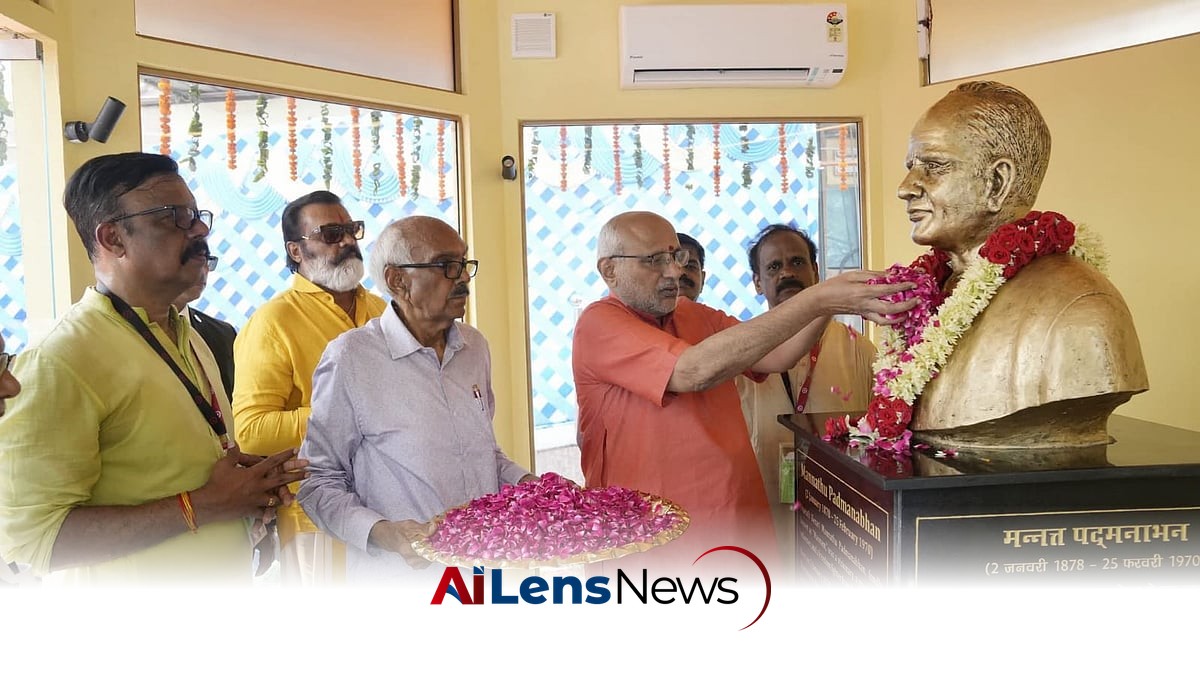


Vice President CP Radhakrishnan inaugurates a statue of Mannathu Padmanabhan in Delhi, six months after being denied access to pay tributes at his resting place in Kerala.
New Delhi, India Jul 14, 2026 ALN: On July 12, Vice President CP Radhakrishnan inaugurated a statue of Mannathu Padmanabhan in New Delhi, an event that has stirred considerable controversy and raised questions about access and recognition within the Nair Service Society (NSS). This inauguration comes six months after Radhakrishnan was reportedly denied permission to pay respects at the Mannam Samadhi, Mannathu Padmanabhan's final resting place located in Kerala.
The statue has been installed at the Mannam International Centre, which serves as a hub for the Nair community in Delhi. This facility operates independently from the NSS in Kerala, which is a prominent caste organization representing the Nair community and is headquartered in Changanassery. The NSS, founded by Mannathu Padmanabhan Pillai in 1914, has played a significant role in the socio-economic upliftment of the Nair community, establishing a vast network of local units known as karayogams and managing over a hundred schools along with several higher education institutions. This historical context is essential in understanding the significance of Mannathu Padmanabhan's legacy and the ongoing relevance of the NSS in contemporary society.
During his visit to Changanassery in February 2026 for the centenary celebrations of SB College, Radhakrishnan had expressed a desire to pay floral tributes at the Mannam Samadhi. However, the Kerala NSS, led by general secretary G Sukumaran Nair, denied him access, citing security concerns. The organization claimed that the presence of bomb-squad dogs accompanying the Vice President's security detail could compromise the sanctity of the site, which is held in high regard by the community. This incident has raised questions about the NSS's governance and its approach to managing access to important cultural and historical sites.
At the inauguration event in Delhi, Radhakrishnan made remarks that seemed to reference this earlier denial of access. He emphasized the importance of inclusivity within the organization and cautioned against the mindset that prioritizes individual authority over collective recognition. His comments were perceived as a veiled criticism directed at Sukumaran Nair, who has a history of limiting access to the Mannam Samadhi to prevent political figures from leveraging the site for their own gain. This dynamic highlights the tension between political engagement and community leadership within the NSS, illustrating how the organization's internal politics can impact its broader mission.
Union Minister Suresh Gopi, who attended the event, echoed Radhakrishnan's sentiments about moving forward and finding alternatives for the Nair community. His comments suggested a desire for unity and progress despite the challenges faced by the community regarding access to significant cultural and historical sites. The presence of political figures at such events often raises concerns about the potential for political capital to be gained from community initiatives, further complicating the relationship between the NSS and political entities.
MKG Pillai, the president of NSS Delhi, stated that the chapter had long intended to install the statue at the Mannam International Centre, but financial constraints had delayed the project. He emphasized that this new statue represents a space that will be open to all, contrasting it with the perceived exclusivity of the Mannam Samadhi in Kerala. Pillai also clarified that the event was not politically motivated and that the NSS Delhi chapter maintains amicable relations with various communities, distancing themselves from any specific political affiliations. This assertion reflects an ongoing effort to navigate the complex interplay between community identity and political engagement.
In discussing the support for the statue's installation, Pillai mentioned that the foundation stone was laid by former West Bengal Governor CV Anandabose three months prior to the inauguration. The NSS Delhi chapter, established in 1984, claims to represent approximately 25,000 families, indicating a significant presence of the Nair community in the national capital. The establishment of such a statue not only serves as a tribute to Mannathu Padmanabhan but also as a statement of identity for the Nair community in a diverse urban landscape.
The Mannam International Centre, inaugurated by former President Pranab Mukherjee in 2012, serves as a cultural and social gathering place for the Nair community in Delhi. The recent events surrounding the statue's inauguration highlight ongoing tensions within the NSS regarding access to important sites and the management of community affairs. These tensions are symptomatic of broader issues related to caste-based organizations in India, where access and recognition can often become contentious points of debate.
Numerous public figures have come forward with claims of being denied access to the Mannam Samadhi and the NSS office in Perunna, illustrating a broader issue of accessibility and recognition within the organization. For instance, in January 2026, CV Anandabose publicly alleged that he was also refused permission to pay floral tributes at the Samadhi, leading him to propose the installation of a memorial for Mannathu Padmanabhan in Delhi as an alternative. He even pledged one month's salary towards this project, indicating a commitment to honoring the legacy of the NSS founder despite the obstacles presented by the Kerala leadership. This incident underscores the ongoing struggle for recognition and the desire for a more inclusive approach to community heritage and memorialization.
Similarly, Suresh Gopi recounted facing a rebuff from Sukumaran Nair in 2015 while trying to attend the NSS's budget presentation during his campaign for the Bharatiya Janata Party (BJP) in the Aruvikkara bye-election. Such incidents underscore the ongoing friction between political aspirations and community leadership within the NSS, as well as the challenges faced by public figures in navigating these dynamics. The intersection of politics and community identity remains a critical area of concern, particularly in a country as diverse as India.
The inauguration of the Mannathu Padmanabhan statue in Delhi thus serves as a focal point for discussions about community identity, political engagement, and the complexities of caste-based organizations in India. As the NSS continues to evolve, the implications of these events may resonate beyond the immediate context, influencing how the Nair community engages with broader socio-political issues in the country. This event also raises questions about the future direction of the NSS and its ability to adapt to changing societal dynamics while remaining true to its foundational mission.
In conclusion, the statue's unveiling marks a significant moment for the Nair community in Delhi, symbolizing both a tribute to their founder and a challenge to the existing leadership within the NSS in Kerala. The ongoing dialogue about access, recognition, and the role of political figures within community organizations will likely shape the future dynamics of the NSS and its members. As the Nair community navigates these challenges, the outcomes of such discussions may not only impact their internal structure but also influence their engagement with the broader socio-political landscape in India, highlighting the need for a more inclusive and representative approach to community leadership.
To learn more about the latest developments in Political Controversies, stay updated with our exclusive reports and analyses on AiLensNews.

