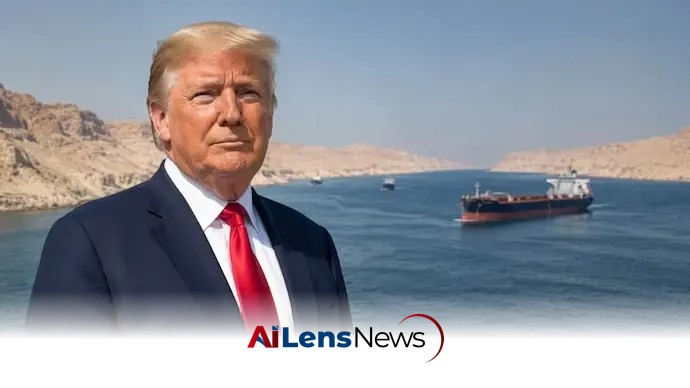


In a bold statement, Donald Trump announced that the US will charge 20% on all cargo passing through the Hormuz Strait, asserting its role as the guardian of this strategic waterway.
New Delhi, India Jul 13, 2026 ALN: New York: Donald Trump on Monday declared that the United States will be the ‘Guardian of the Hormuz Strait’.
Announcing the reinstatement of the ‘Iranian blockade’, the US President stated that Washington will charge 20 percent on all cargo shipped through the narrow but strategic waterway as reimbursement for providing security.
“The Hormuz Strait is OPEN, and will remain OPEN, with or without Iran. We are reinstating the Iranian blockade. All other countries will have fair and open use of the Strait. The U.S.A. will be, from this point forward, known as ‘THE GUARDIAN OF THE HORMUZ STRAIT,’ but as such, and as a matter of fairness, will be reimbursed, at the rate of 20% on all cargo shipped, for any and all costs necessary to do the job of providing safety and security to this very volatile section of the world,” Trump wrote in his latest post on Truth Social.
Hours earlier, Trump made similar comments in a Fox News interview.
“We’re going to keep the strait, and we’ll probably run it. We’ll become the guardian of the strait. Maybe we’ll call it the guardian angel of the strait. And we should be reimbursed for that,” Trump had said.
Iran says they continue to control Strait
A spokesperson for Iran’s Islamic Revolutionary Guard Corps (IRGC) stated in a video message that Tehran “under no circumstances will allow the United States to interfere in the management” of the strait, insisting Tehran continued to exercise authority over Hormuz.
“We continue to assert our authority and control over the Strait of Hormuz with strength and power, and we will force foreign powers and their allies to surrender to the will of the Iranian people,” the spokesperson said.
He also warned Gulf countries that cooperating with the US over the waterway will be treated as “an act of war.”
The Strait of Hormuz is a critical chokepoint in global oil transportation, with a significant percentage of the world’s petroleum passing through this narrow passageway. The strait connects the Persian Gulf with the Gulf of Oman and the Arabian Sea, making it a vital route for oil tankers and other commercial vessels. Any disruption in this area could have serious implications for global energy markets and international trade.
Trump's declaration comes amidst heightened tensions between the United States and Iran, particularly following the U.S. withdrawal from the Joint Comprehensive Plan of Action (JCPOA) in 2018, which was designed to limit Iran's nuclear capabilities. The re-imposition of sanctions on Iran has led to a significant deterioration in relations, with both sides engaging in hostile rhetoric and military posturing.
The idea of the U.S. charging a fee for security in the Strait raises questions about international maritime law and the principle of freedom of navigation. The United Nations Convention on the Law of the Sea (UNCLOS) provides for the right of ships to pass through straits used for international navigation. Any attempt by a single nation to impose fees or control over such waterways could be viewed as an infringement on these rights and could provoke backlash from the international community.
Furthermore, the notion of the U.S. acting as a 'guardian' of the Strait may be perceived as an aggressive stance by Tehran and could escalate military tensions in the region. Iran has previously threatened to block the Strait in response to U.S. sanctions and military actions, indicating that any perceived encroachment on its territorial waters or authority could lead to significant confrontations.
The response from Gulf nations will also be critical in shaping the future dynamics of the Strait. Countries like Saudi Arabia, the United Arab Emirates, and others have historically relied on the U.S. for military support and protection against Iranian threats. However, they must also balance their relationships with Iran, which is a significant regional power. Cooperation with the U.S. in the strait, as warned by the IRGC, could alienate these Gulf states from Iran, potentially leading to increased regional instability.
In addition, the economic implications of Trump's announcement cannot be overlooked. A 20 percent fee on cargo could lead to increased costs for shipping companies and, ultimately, consumers around the world. This could have a ripple effect on global oil prices and other commodities, depending on how such a policy is implemented and enforced.
As the situation develops, international observers will be watching closely to see how both the U.S. and Iran navigate this challenge. The potential for conflict in the Strait of Hormuz has long been a concern for global security, and any escalation could have dire consequences not only for the region but for the entire world economy.
In conclusion, Trump's declaration positions the U.S. in a contentious role in the Strait of Hormuz, asserting control while simultaneously risking confrontation with Iran. The implications of this move extend far beyond the immediate geopolitical landscape, touching on issues of international law, economic stability, and regional security. Both the U.S. and Iran will need to tread carefully as they navigate this complex and potentially volatile situation.
The Strait of Hormuz has been a focal point of geopolitical tensions for decades, with its strategic importance underscored by the fact that approximately 20% of the world’s oil supply passes through it. Historically, the strait has been the site of various military confrontations and has been at the center of U.S.-Iran relations, particularly since the Islamic Revolution in 1979. The U.S. has maintained a military presence in the region, often citing the need to ensure freedom of navigation and protect its allies.
In recent years, incidents involving Iranian naval forces and U.S. military vessels have heightened fears of a direct confrontation. The U.S. has accused Iran of harassing commercial shipping and has responded with military deployments aimed at deterring such actions. Conversely, Iran has accused the U.S. of imperialistic behavior and has vowed to defend its territorial waters against foreign intervention.
Moreover, the economic ramifications of Trump's proposed cargo fee could lead to broader implications for international trade. Should shipping companies pass on the costs of the fee to consumers, it could lead to increased prices for oil and other goods, thereby impacting economies worldwide. The potential for increased shipping costs may also encourage countries to seek alternative routes or methods of transporting oil and other commodities, which could reshape global trade patterns.
Analysts suggest that Trump's declaration may also be a strategic maneuver aimed at rallying support domestically and internationally. By positioning the U.S. as a protector of global trade routes, Trump may be attempting to bolster his administration's image as tough on Iran while appealing to voters concerned about energy security and economic stability. However, this approach risks alienating allies who may view the U.S. as overstepping its bounds in international waters.
As the international community reacts to these developments, it is crucial for diplomatic channels to remain open. Escalating tensions in the Strait of Hormuz could lead to unintended consequences, including military clashes or broader regional conflicts. Countries with vested interests in the stability of the region, including European nations and Asian powers that rely on oil imports, may seek to mediate between the U.S. and Iran to prevent further escalation.
In summary, Trump's declaration regarding the Strait of Hormuz raises significant questions about the future of U.S.-Iran relations, the stability of global oil markets, and the principles of international maritime law. As both sides navigate this volatile landscape, the potential for conflict looms large, underscoring the need for careful diplomacy and a commitment to de-escalation in a region that is critical to global trade and security.
To learn more about the latest developments in Political Controversies, stay updated with our exclusive reports and analyses on AiLensNews.

