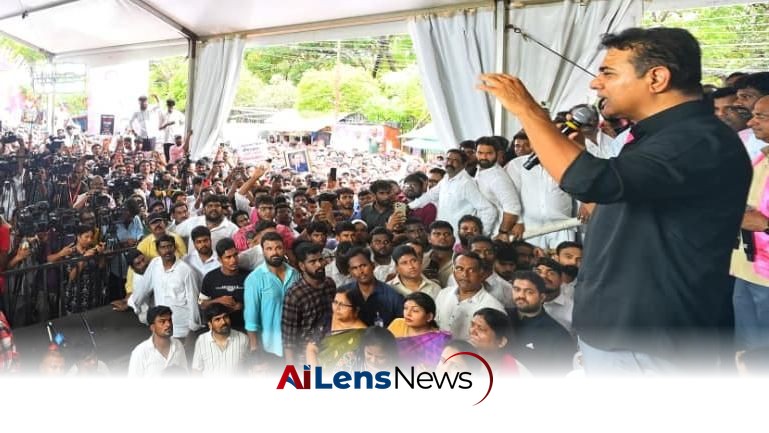


KT Rama Rao condemns the BJP-led government for suppressing youth voices and demands accountability for examination irregularities.
Hyderabad, India Jul 24, 2026 ALN: Hyderabad: BRS working president, KT Rama Rao (KTR) on Friday launched a sharp attack on the BJP-led Central Government alleging that it was suppressing the voices of students and youth. This statement comes in the wake of several incidents that have raised concerns about the treatment of students in India, particularly regarding examination processes and the government's response to protests. The current political climate has seen a growing trend of youth activism, with students increasingly vocal about their rights and the failures of the government to address their concerns.
Addressing a massive gathering of students and youth at Indira Park, KTR said the overwhelming participation reflected growing anger against the Centre’s handling of issues affecting young people, particularly the NEET paper leak and the alleged crackdown on student protests. The National Eligibility cum Entrance Test (NEET) is a critical examination for aspiring medical students in India, and any irregularities surrounding it can have significant implications for students' futures. The recent NEET paper leak incident, which involved allegations of question paper leaks and cheating, has raised serious questions about the integrity of the examination system. Such incidents not only jeopardize the future of individual students but also undermine the credibility of the educational framework in India.
KTR emphasized that the voice of India’s youth could not be silenced through force or intimidation and asserted that every attempt to suppress democratic dissent would only strengthen the movement. His remarks resonate with a broader sentiment among the youth, who feel increasingly disenfranchised by governmental policies that they perceive as neglectful of their needs and aspirations. The socio-political landscape in India has seen a rise in youth activism, especially in recent years, with students taking to the streets to voice their concerns over various issues, including educational reforms, job opportunities, and social justice. This surge in activism signifies a critical awakening among young people who are demanding accountability and transparency from their leaders.
KTR demanded the resignation of Union Education Minister Dharmendra Pradhan, holding him morally accountable for repeated examination irregularities and the Centre’s failure to safeguard the interests of students. This demand for resignation is significant, as it reflects a growing discontent with the leadership within the Ministry of Education. Critics have accused the government of failing to implement adequate measures to ensure the transparency and fairness of examinations, leading to a crisis of confidence among students and their families. The implications of such a crisis can be far-reaching, affecting not only individual students but also the overall perception of the education system in India.
He urged the Central Government to engage in a meaningful dialogue with the agitating students instead of resorting to repression and intimidation. This call for dialogue is particularly important in a democratic society, where the voices of the youth should be heard and considered in policy-making processes. KTR's insistence on dialogue underscores the need for the government to address the concerns of students directly rather than dismissing them or resorting to heavy-handed tactics to quell dissent. The reluctance to engage in constructive dialogue can exacerbate tensions and lead to further unrest among the youth, who are increasingly frustrated with the status quo.
KTR accused the BJP government of betraying the aspirations of millions of students and unemployed youth while refusing to take responsibility for repeated examination irregularities. The issue of unemployment has been a pressing concern in India, with millions of young graduates facing challenges in securing jobs. The government's inability to create sufficient employment opportunities has fueled frustration among the youth, who feel that their potential is being wasted. KTR's comments reflect a broader critique of the government's economic policies and their impact on the younger generation. The disconnect between government promises and the reality faced by young people often leads to disillusionment, which can manifest in various forms of protest and activism.
He said the country was witnessing a dangerous trend in which those demanding accountability were being targeted instead of those responsible for the failures. This assertion points to a growing concern among various segments of society regarding the erosion of democratic norms and the suppression of dissenting voices. The targeting of activists, students, and dissenters raises questions about the state of democracy in India and the government's commitment to upholding the rights of its citizens. The perception of a repressive state apparatus can lead to a chilling effect on free speech and dissent, which are essential components of a healthy democracy.
Calling upon the youth to remain united and democratic in their struggle, KTR said the fight was not merely against paper leaks or repression, but for justice, accountability, and the future of India’s youth. This rallying cry for unity among the youth is crucial as it encourages collective action and solidarity in addressing shared grievances. The emphasis on justice and accountability reflects a desire for systemic change within the educational framework and the broader political landscape. By framing the struggle in terms of justice, KTR is tapping into a deeper narrative that resonates with many young people who feel marginalized and unheard.
The implications of KTR's remarks extend beyond the immediate context of the NEET paper leak and student protests. They highlight the growing discontent among the youth with the current political climate and the perceived failures of the government to address their needs. As young people increasingly mobilize to demand change, it is likely that their voices will play a critical role in shaping the future of Indian politics. The engagement of young people in political processes, whether through protests, social media campaigns, or electoral participation, can significantly influence the direction of policy and governance in the country.
In conclusion, KTR's criticism of the Central Government and his call for the resignation of Union Education Minister Dharmendra Pradhan encapsulate a broader narrative of youth discontent in India. The issues of examination irregularities, unemployment, and the suppression of dissent are interconnected challenges that the government must address to restore trust and confidence among the youth. As the political landscape continues to evolve, the engagement of young people in democratic processes will be crucial in determining the direction of the country. The ability of the government to respond to the concerns of the youth will not only shape the future of education and employment but will also determine the health of democracy in India.
To learn more about the latest developments in Political Controversies, stay updated with our exclusive reports and analyses on AiLensNews.

