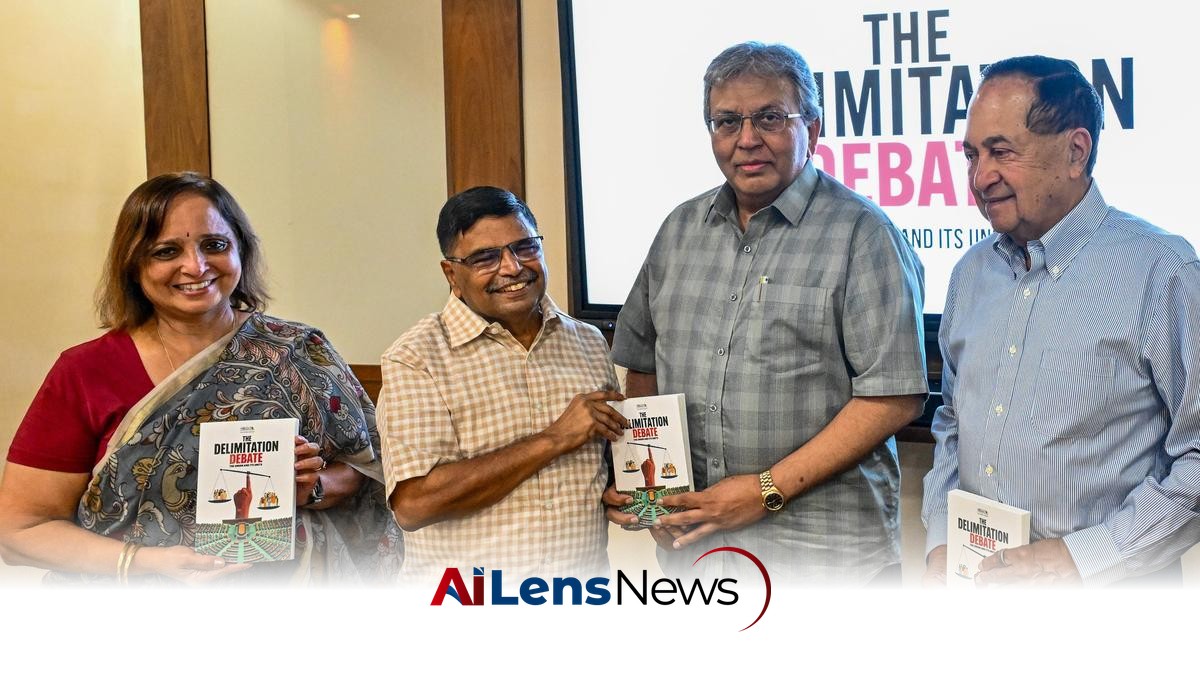


Former Madras High Court judge D. Hariparanthaman emphasizes the need for women's reservation to be implemented independently of delimitation and census adjustments.
Chennai, India Jul 23, 2026 ALN: The call for immediate implementation of women’s reservation in India has gained renewed attention, particularly in light of the statements made by former Madras High Court judge D. Hariparanthaman (retd.) during the release of a significant publication titled The Delimitation Debate: The Union and its Units. This book, published by The Hindu Group, addresses critical issues surrounding delimitation, representation, and the Census, which are fundamental to the functioning of Indian democracy.
Justice Hariparanthaman emphasized that the freeze on the delimitation of parliamentary constituencies should remain in place. He argued that the implementation of women’s reservation should not be contingent upon the completion of delimitation exercises or the Census. This perspective is particularly relevant as India strives to enhance the political representation of women, who have historically been underrepresented in legislative bodies. The push for women's reservation has been a long-standing demand, with various proposals being discussed in Parliament over the years, including the Women's Reservation Bill, which seeks to reserve 33% of seats for women in the Lok Sabha and State Legislative Assemblies.
During the event, Justice Hariparanthaman raised concerns about the potential implications of increasing the number of Lok Sabha seats. He noted that such an increase could hinder meaningful deliberations within the House, suggesting that a larger number of representatives might lead to more fragmented discussions and a dilution of accountability. He highlighted the paradox that if the increase in seats is based on population, southern states, which have effectively implemented the national population policy, could lose representation. This could create a scenario where states that have managed population growth responsibly are penalized, undermining the principle of equitable representation.
Justice Hariparanthaman’s views resonate with broader discussions about representation in Indian democracy. The current structure of the Lok Sabha, with its 543 seats, has been a topic of debate, especially when considering the diverse demographic and geographic landscape of the country. He argued that maintaining the current number of seats could facilitate better deliberation and governance, drawing parallels with other democracies where the size of legislative bodies is carefully calibrated to ensure effective representation.
In addition to advocating for women’s reservation, Justice Hariparanthaman also called for a more equitable representation model in the Rajya Sabha, akin to the U.S. Senate. This proposal aims to ensure that all states have a fair voice in the upper house of Parliament, which is crucial for a federal structure like India’s. The idea of equitable representation is particularly significant in a country with vast regional diversities, where different states have varying interests and priorities.
K. Ashok Vardhan Shetty, a retired IAS officer and member of the High Level Committee on Centre-State Relations, provided further context to the discussion by critiquing the current framework of the Delimitation Commission. He pointed out that Article 329(a) places the Commission's proposals within a constitutional “black box,” shielding them from scrutiny by the executive, legislative, and judicial branches. This lack of transparency raises concerns about accountability and the democratic process, as citizens may feel disconnected from decisions that impact their representation.
Mr. Shetty suggested that reforms are necessary to ensure that the delimitation process is more inclusive and transparent. He proposed the introduction of a “dialogue model,” similar to the one used in Canada, where a parliamentary sub-committee reviews the Commission’s proposals and provides feedback. This could enhance public engagement and ensure that the voices of various stakeholders are heard in the delimitation process.
Moreover, Mr. Shetty advocated for a rethinking of the Rajya Sabha’s structure to better reflect the principles of federalism. He suggested that a system similar to the U.S. Senate could be beneficial in ensuring that all states, regardless of their population size, have an equal say in the legislative process. This could help mitigate the disparities that currently exist between more populous states and smaller ones, fostering a sense of unity and cooperation among diverse regions.
In the context of representation, the book The Delimitation Debate: The Union and its Units serves as a critical resource, offering insights from various experts on the complexities of delimitation, federalism, and representation in India. The collection includes essays from notable authors such as Ashok Lavasa, former Election Commissioner; S.Y. Quraishi, former Chief Election Commissioner; and G.N. Devy, a prominent cultural activist. Each contribution sheds light on the challenges and opportunities related to delimitation in the Indian context, emphasizing the need for data-driven approaches to ensure fair representation.
The publication also touches upon the challenges posed by the lack of access to key data, which complicates delimitation studies in India. This is a significant issue, as accurate and comprehensive data is essential for making informed decisions about constituency boundaries and representation. The authors argue that without reliable data, the process of delimitation may be arbitrary, leading to further inequities in representation.
As discussions surrounding delimitation and representation continue to evolve, the implications of Justice Hariparanthaman’s statements and the insights from the book will likely resonate across political and academic circles. The call for immediate women’s reservation, independent of delimitation, reflects a growing recognition of the need to prioritize gender equity in political representation. This could pave the way for more inclusive governance and a stronger democracy in India.
The event also featured remarks from N. Ram, Director of The Hindu Group Publishing Pvt. Ltd., who emphasized the importance of making the ideas discussed in the book accessible to a broader audience. He suggested that distilling the key concepts and translating them into various languages could facilitate greater public engagement with the issues at hand.
In conclusion, the release of The Delimitation Debate: The Union and its Units and Justice Hariparanthaman’s advocacy for women’s reservation without the constraints of delimitation and the Census highlight critical issues of representation in Indian democracy. As the country grapples with questions of equity, accountability, and governance, the insights from this publication may serve as a catalyst for meaningful reform and a more inclusive political landscape.
To learn more about the latest developments in Policies & Reforms, stay updated with our exclusive reports and analyses on AiLensNews.

