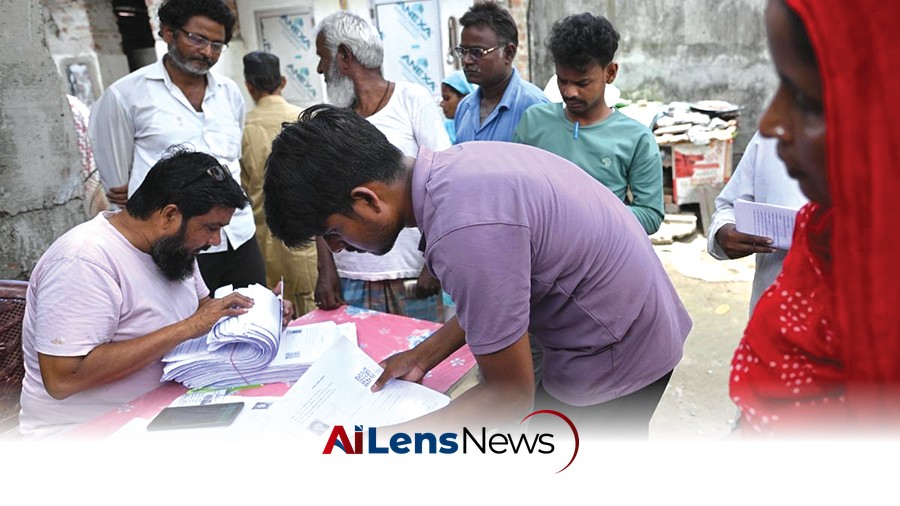


The Supreme Court ruled that the Election Commission is not a constitutional authority for determining citizenship, emphasizing its control over electoral rolls.
New Delhi, India Jul 18, 2026 ALN: New Delhi: The Supreme Court of India recently clarified the role of the Election Commission in relation to the determination of citizenship, emphasizing that the Election Commission is not a constitutional authority in this domain. This statement came during a hearing that addressed concerns regarding the electoral roll and the Special Intensive Revision (SIR) process in West Bengal.
In its ruling, the Supreme Court stated, "The Election Commission has control and superintendence over the electoral roll," delineating the boundaries of the Commission's responsibilities. This clarification is significant as it underscores the Election Commission's role primarily as an organizer and overseer of elections rather than a body that adjudicates issues of citizenship.
The bench, which included Chief Justice Surya Kant and Justices Joymalya Bagchi and V Mohana, was responding to a petition filed by Prasenjit Bose, who serves as the chairperson of the SIR committee of the West Bengal Pradesh Congress Committee. The case highlighted the complexities and challenges faced in the electoral process, particularly in the context of citizenship and voter eligibility.
The court referenced a previous judgment related to the Bihar SIR case, which established that when a tribunal determines that an individual cannot be included in the SIR list, it is the responsibility of the Election Commission to refer the case to the Union Ministry for a formal determination of citizenship under the Citizenship Act. This linkage between the Election Commission and the Ministry of Home Affairs is crucial, as it delineates the procedural steps that must be followed when discrepancies arise regarding a voter's citizenship status.
As part of the ongoing proceedings, the Supreme Court sought responses from the Election Commission, the West Bengal government, and the state election panel regarding a Public Interest Litigation (PIL) that called for the disclosure of Assembly constituency-wise data concerning claims and objections filed by voters who were deleted from the electoral rolls during the SIR process. The petition, represented by lawyer Neha Rathi, aimed to enhance transparency in the electoral revision process.
The PIL requested detailed data related to the SIR process in West Bengal, including the number of Forms 6 and 7 (which pertain to the inclusion and deletion of voters, respectively) that were filed, accepted, or rejected, as well as information on the pendency and disposal of appeals before the appellate tribunals. This data is critical for understanding the scope and impact of the SIR process, particularly in a state like West Bengal, where electoral politics is highly contested and sensitive.
During the hearing, senior advocate Gopal Sankaranarayan, representing Bose, raised serious concerns about the functioning of the 18 tribunals established to handle claims and objections from deleted voters. He pointed out that these tribunals were contributing to significant discrepancies and delays, which had real-world consequences for individuals who were being excluded from essential welfare measures, such as public distribution systems and Annapurna schemes. This exclusion also affected their ability to obtain caste certificates, which are vital for accessing various government benefits.
Sankaranarayan highlighted alarming statistics, noting that approximately 33.5 lakh appeals remain pending, while the disposed cases showed that about 70 percent of claims were allowed. Despite this, individuals whose claims were still under review were being denied access to critical services, exacerbating their vulnerability.
The Supreme Court bench agreed to consider this fresh plea alongside other pending petitions, including one filed by former West Bengal Chief Minister Mamata Banerjee concerning the SIR process. This indicates the broader implications of the SIR exercise, which has affected millions of voters and raised questions about the enforcement of constitutional rights under Articles 14 (Right to Equality), 19 (Right to Freedom of Speech and Expression), and 21 (Right to Life and Personal Liberty) of the Indian Constitution.
According to the details provided in the PIL, the SIR exercise in West Bengal led to the exclusion of over 58 lakh electors during the enumeration phase. The exercise received 9.64 lakh applications for inclusion (Forms 6 and 6A) and over 99,000 applications for deletion (Form 7) during the claims and objections phase. However, only approximately 1.82 lakh additions were ultimately reflected in the final electoral roll published on February 28. This stark contrast raises questions about the efficacy and fairness of the revision process.
The petitioner also expressed concerns regarding the lack of transparency in the electoral process, noting that the Election Commission had not disclosed constituency-wise data that would reveal how many applications were received, accepted, or rejected. This absence of detailed data limits public scrutiny and accountability in the SIR process.
Furthermore, the PIL raised issues regarding the criteria used to identify over 60 lakh cases of "logical discrepancies". The petitioner alleged that criteria such as parent-child age gaps, multiple family linkages, and name mismatches were introduced without a proper legal basis in the Representation of the People Act, 1950 or the SIR notifications. Such criteria have reportedly resulted in notices and large-scale deletions of voters without adequate transparency, raising concerns about the arbitrary nature of these actions.
Another critical aspect highlighted in the petition was the functioning of the 18 appellate tribunals, which were constituted following the Supreme Court’s orders to address appeals arising from the SIR exercise. The petitioner noted that although a three-member judicial committee had prepared a standard operating procedure (SOP) on April 7, this document had not been made public, further complicating the transparency and accountability of the process.
The PIL ultimately seeks directions from the Supreme Court to publish the SOP and create simplified appeal guidelines in multiple languages, including Bangla and Hindi. This move aims to facilitate greater public participation and accessibility, particularly for rural and economically disadvantaged voters who may struggle to navigate the complexities of the electoral process.
The implications of this case extend beyond the immediate concerns of the SIR process in West Bengal. It raises fundamental questions about the intersection of citizenship, electoral rights, and the role of governmental institutions in safeguarding these rights. As the Supreme Court continues to deliberate on these issues, the outcomes will likely have lasting effects on electoral integrity and the protection of voter rights in India.
To learn more about the latest developments in Political Controversies, stay updated with our exclusive reports and analyses on AiLensNews.

