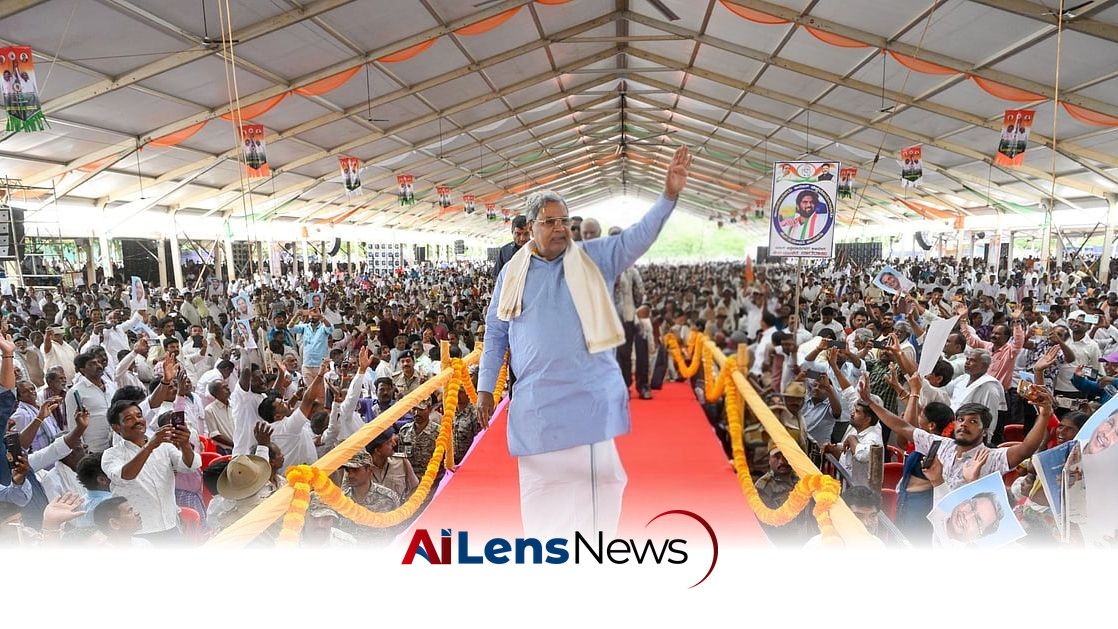


Former Karnataka Chief Minister Siddaramaiah declares he will not run in the 2028 Assembly elections, citing age, health, and corruption in politics.
New Delhi, India Jul 26, 2026 ALN: Former Karnataka Chief Minister and senior Congress leader Siddaramaiah made headlines on Sunday when he announced that he would not be contesting in the 2028 Karnataka Assembly elections. This decision comes as he reflects on his age, health, and the prevailing corruption in politics, which he believes has tainted the electoral process.
At 79 years old, Siddaramaiah's announcement carries weight not only due to his long-standing political career but also because of the implications it holds for his constituency and the Congress party in Karnataka. In a post shared on X in Kannada, he expressed his commitment to remain active in public life, despite stepping away from electoral politics. His statement underscores a growing concern among seasoned politicians regarding the integrity of the political landscape.
"Since the political field has become corrupted today, I will not contest in the 2028 assembly elections. However, remaining active in politics, I will continue to stand as a voice for the people's hardships and joys," Siddaramaiah articulated in his post. This declaration is significant as it highlights his disillusionment with the current state of politics, which he believes has increasingly become reliant on financial transactions rather than genuine public service.
Siddaramaiah's decision has not come without encouragement from his constituents. Residents of Varuna, his constituency, have been urging him to run for election once more. However, he has firmly resolved not to seek election in the future, indicating a shift in his priorities as he approaches the twilight years of his political career. "The people of Varuna constituency are once again pressing me to contest the elections. But I have decided that I should not contest in any elections henceforth," he stated, emphasizing the pressure he feels from his supporters.
Reflecting on the changes in electoral dynamics, Siddaramaiah noted, "In the past, when I contested elections, it was the people of the constituency who gave us money and ensured our victory. But today, such a situation no longer exists." This observation points to a broader trend in Indian politics where the cost of campaigning has escalated, often leading to a situation where candidates must rely on financial backing rather than grassroots support.
Age and health have also played a pivotal role in Siddaramaiah's decision. He noted that by the time the next Assembly elections are due, he will be nearly 82 years old. "I am now 79 years old. Our government's term still has one and a half years left. By then, I will be 81-82 years old. My health is not as robust as it used to be. It is no longer possible to work with the same enthusiasm as before," he explained. This candid admission speaks to the reality many politicians face as they grapple with the physical demands of public service, particularly in a politically charged environment like Karnataka's.
In a broader context, Siddaramaiah's announcement is a reflection of the changing political landscape in India. As he pointed out, 2028 will mark 50 years since he entered public life, a significant milestone in his political journey that began in 1978 as a taluk board member. "By 2028, I will be 82 years old. That will mark the completion of 50 years in my political life. I began my political journey in 1978 as a taluk board member. I have seen both defeats and victories. But I take satisfaction in the fact that I have not acted against the principles I believed in, nor betrayed my conscience," he remarked, emphasizing his commitment to integrity throughout his career.
His critique of the current political climate is particularly poignant. Siddaramaiah lamented that elections have become increasingly dependent on monetary influence, stating, "The time has come where, if we contest elections, we would have to give money to the people. Politics today is thoroughly corrupted. Honest politics seems to have no leg to stand on. In this backdrop, I have arrived at the decision not to contest in future elections." This sentiment resonates with many citizens who have grown disillusioned with the political process, viewing it as a system that often prioritizes wealth over genuine representation.
Despite his withdrawal from electoral contests, Siddaramaiah reaffirmed his dedication to public service. He articulated, "For five decades, the people of the state have seen me as one among them and affectionately guided me. This debt weighs on me. Therefore, my future life too will be dedicated to public service." This commitment to serving the public, even outside of formal political structures, may inspire younger politicians and activists to pursue change within the system.
Notably, Siddaramaiah stepped down as Karnataka chief minister on May 28 of this year, after completing three years in office, which paved the way for his then-deputy, DK Shivakumar, to take over the role. The transition was marked by a fierce contest for leadership within the Congress party, as both leaders were vying for the top post following the party's victory in the 2023 Assembly elections. Ultimately, the party managed to persuade Shivakumar to accept the deputy chief minister's role, with reports suggesting a potential rotational chief minister arrangement that would see Shivakumar assume office after two-and-a-half years.
The implications of Siddaramaiah's decision extend beyond his personal journey. As he steps back, questions arise regarding the future of the Congress party's AHINDA (an acronym for minorities, backward classes, and Dalits) base in Karnataka. His leadership has been pivotal in galvanizing support from these communities, and his departure from active politics raises concerns about the party's ability to maintain its influence among these groups. Additionally, with Siddaramaiah's exit, there is speculation about how the Kuruba community, to which he belongs, will navigate their political representation in the state.
Siddaramaiah's announcement serves as a reminder of the challenges faced by veteran politicians in adapting to a rapidly evolving political landscape. His reflections on corruption, health, and the changing nature of electoral politics offer valuable insights into the complex dynamics at play in Karnataka and across India. As he prepares to transition from electoral politics, the focus will likely shift to how he continues to influence public discourse and advocate for the issues he has championed throughout his career.
To learn more about the latest developments in Political Controversies, stay updated with our exclusive reports and analyses on AiLensNews.

