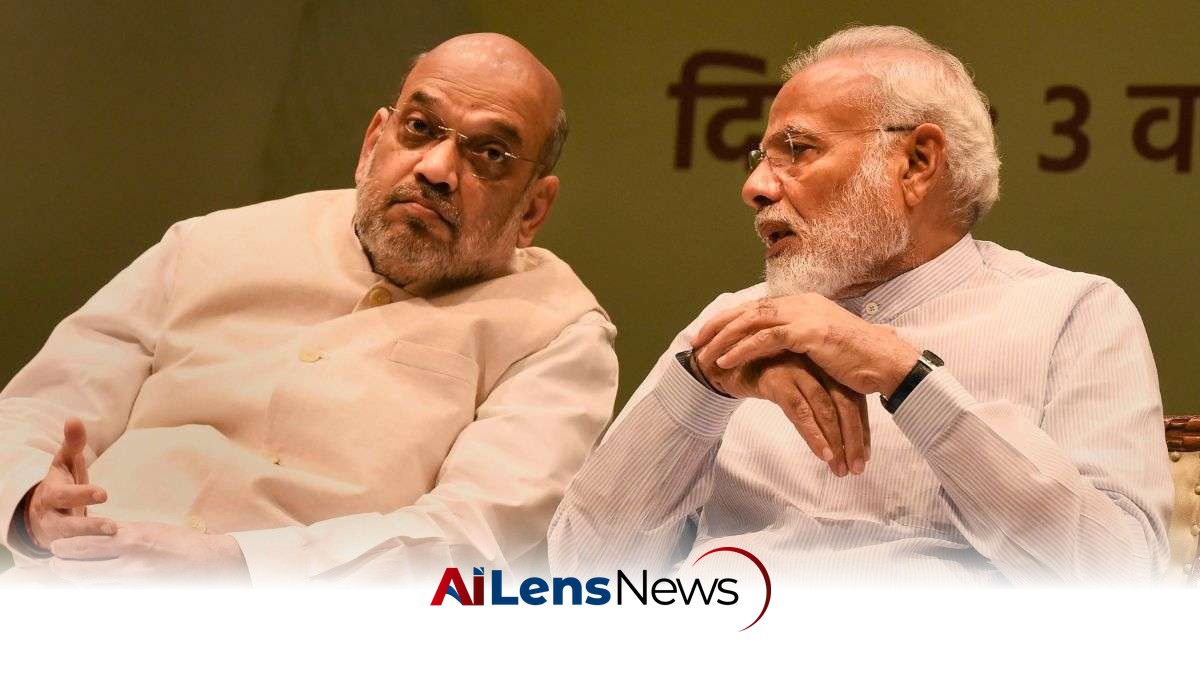


The demand to remove Education Minister Dharmendra Pradhan is a distraction from the deeper political agenda aimed at undermining Prime Minister Modi and Home Minister Shah.
New Delhi, India Jul 23, 2026 ALN: The demand is to ‘Sack Education Minister Dharmendra Pradhan’. That is what the players in this vicious geopolitical game want you to believe. But that is merely a fugazi – an illusion, a distraction. The real target is not Dharmendra Pradhan; it is the leadership of Prime Minister Narendra Modi and Home Minister Amit Shah.
Operation 37 failed. Prime Minister Narendra Modi not only remained in power but continues to enjoy substantial public support despite sustained political and media campaigns against him. In my view, the exposure of Operation 37 forced the US Deep State to retreat, but only tactically. The operation may have been aborted, but the intent, I believe, was never abandoned.
That objective, as I see it, extends well beyond Modi. It also encompasses Home Minister Amit Shah, whom I regard as Modi’s closest political confidant, most trusted strategist, and natural custodian of his political legacy. If Modi represents continuity of leadership, Shah represents continuity of execution. Weakening one without the other would achieve little.
Following the exposure of Operation 37, many of its alleged Indian collaborators appeared to retreat into silence. They disappeared from the public arena, regrouped, and waited. In my assessment, they have been watching developments closely, waiting for the next opportunity to revive the larger campaign through political mobilisation, institutional pressure, media narratives, and civil society activism. The operation, in my view, did not end – it merely entered a different phase.
I do not view the Cockroach Janata Party (CJP) as a spontaneous movement. Rather, I see it as part of a carefully orchestrated effort to manufacture what could be described as a ‘Gen Z revolt’ in India. The NEET paper leak provided the perfect catalyst.
More than 24 lakh students appeared for the examination. Understandably, the controversy generated widespread anger among students and parents alike. It was an open wound with an exposed raw nerve. Every responsible government was expected to address the crisis swiftly and restore confidence in the examination process.
However, I contend that the controversy was transformed from an examination-related crisis into a broader political movement. Instead of focusing exclusively on correcting procedural failures and ensuring justice for affected students, the issue became a powerful instrument to deepen public anger and reinforce the perception that the Modi government was indifferent to the aspirations of India’s youth.
In my assessment, the objective gradually shifted from educational reform to political mobilisation.
The CJP protests were never primarily about securing justice for the students and families affected by the tragic suicides associated with the NEET controversy. Once corrective measures were introduced, re-examinations were conducted where necessary, and the admission process resumed with thousands of students successfully qualifying, the focus should naturally have shifted towards restoring confidence in the system. Instead, the protests evolved into something much larger than NEET itself.
The controversy became a rallying point for those already opposed to the Modi government. Student frustration was merged with broader political discontent. What began as an examination controversy gradually transformed into sustained political agitation. From my perspective, this was no longer solely about education; it had become about building momentum against the government.
I expect these protests, supported by opposition political parties, to spread across India, particularly in BJP-governed states. The objective is not merely to express dissent but to keep the administration under continuous pressure by creating an atmosphere of political instability.
My concern is that prolonged agitation always carries the risk of escalation. Whether by deliberate provocation or unforeseen circumstances, street confrontations can quickly spiral into violence. If casualties occur, the narrative immediately changes from political disagreement to a national crisis. That is precisely where perception becomes the most powerful weapon.
The protests have taken a significant turn after banned pro-Khalistan organisation Sikhs for Justice (SFJ) publicly announced conditional financial support for the agitation. SFJ was declared an unlawful association under the Unlawful Activities (Prevention) Act (UAPA) in 2019, and its leader, Gurpatwant Singh Pannun, has been designated an individual terrorist by the Indian government. Pannun called on protesters to reject negotiations with the Centre, continue demonstrations until Independence Day, and linked the agitation to SFJ’s separatist agenda.
If the protests continue to escalate, I believe we will see organisations and advocacy networks that were prominently associated with opposition to the Citizenship (Amendment) Act (CAA) and the farm laws to once again become active. I also anticipate support from left-leaning student groups, faith-based student organisations representing Hindu, Muslim, and Christian communities, sections of civil society, and voices from Bollywood expressing solidarity with the movement.
I also expect sections of the international media to closely follow such developments. Should protests turn violent, attention would quickly shift from the original issue to wider allegations concerning governance, democracy, civil liberties, and the rule of law. Home Minister Amit Shah, by virtue of his responsibility for internal security, would inevitably become one of the principal targets of criticism. The perception is the real battlefield.
The larger objective extends far beyond organising protests or sustaining political agitation. It is to systematically erode the positive perception Narendra Modi enjoys among millions of Indians and the global Indian diaspora. The strategy, as I see it, is to gradually replace the image of a decisive and popular leader with that of an authoritarian ruler by repeatedly amplifying controversies, confrontations, and images of unrest.
Narratives matter. If enough people begin to question leadership, political consequences inevitably follow. Every protest, every confrontation, every viral image, and every international headline contributes to shaping public perception. That is why I see this battle as one fought simultaneously on the streets, across television screens, through digital platforms, and within international discourse.
Whether one agrees with my conclusions or not, I maintain that the contest today is not simply about political power. It is about controlling the story that India tells about itself. It is about blurring the story that Narendra Modi tells about his government and reshaping the narrative surrounding its achievements. Ultimately, it is about influencing the story the world is encouraged to believe about India.
For me, Amit Shah occupies a central place in that story.
Anyone seeking to politically weaken Narendra Modi would inevitably have to weaken Shah as well. Shah is not merely another Cabinet minister. He has been the organisational architect behind many of the BJP’s electoral victories, one of Modi’s closest political associates, and a leader whose influence extends across the party and the government.
If Modi views Amit Shah as the leader most capable of carrying forward his political vision, then diminishing Shah’s credibility becomes an essential step for anyone attempting to alter India’s political trajectory.
That is why I believe that any major internal crisis inevitably places Amit Shah under intense scrutiny. Every law-and-order challenge, every episode of civil unrest, and every allegation concerning internal security is ultimately projected onto the Home Minister. If Shah’s public credibility can be weakened while Modi’s leadership is simultaneously portrayed as ineffective or authoritarian, the political narrative changes dramatically.
Whether that strategy succeeds is, of course, for the Indian people to decide through the democratic process. My assessment remains unchanged.
Dharmendra Pradhan is not the real target. In my assessment, he is merely the immediate focal point of the campaign. The actual targets are Prime Minister Narendra Modi and Home Minister Amit Shah. The demand to remove the Education Minister is intended to serve a much larger political objective: to weaken Modi’s leadership, undermine Shah’s credibility, and gradually reshape public perception of the Modi-led government.
To learn more about the latest developments in Elections, stay updated with our exclusive reports and analyses on AiLensNews.

