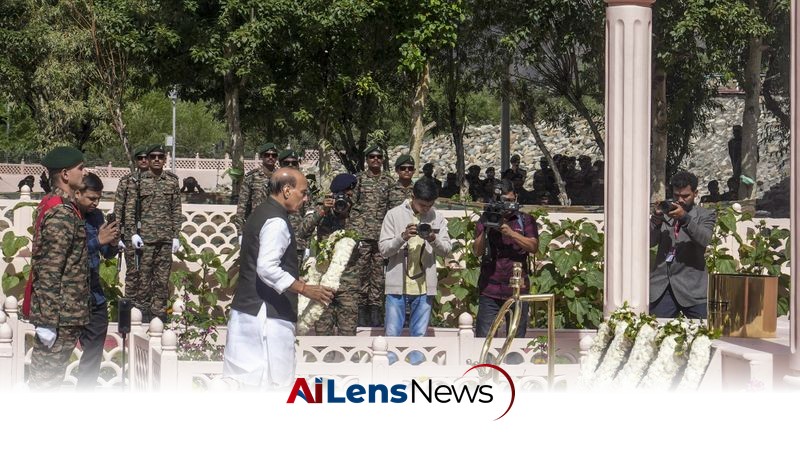


Defence Minister Rajnath Singh emphasizes India's stance on Pakistan, stating future dialogues will center on Pakistan-occupied Kashmir, while reaffirming military readiness.
New Delhi, India Jul 26, 2026 ALN: In a recent statement, Defence Minister Rajnath Singh declared that India will not engage in talks with Pakistan unless the focus is solely on Pakistan-occupied Kashmir (PoK). This announcement underscores India's firm position regarding its territorial claims and the ongoing tensions with its neighbor. The insistence on PoK as the primary agenda item for any future discussions reflects India's long-standing assertion of its sovereignty over the region, which has been a contentious issue since the partition of India in 1947.
Singh highlighted that the intent of infiltrators has remained unchanged since the 1999 Kargil conflict. He assured the nation that the Indian Army is fully prepared to counter any challenges that may arise from cross-border infiltrations. The Kargil conflict, which resulted in significant military engagement between India and Pakistan, serves as a grim reminder of the potential for escalation in the region. The conflict was marked by the infiltration of Pakistani soldiers and militants into Indian territory, leading to intense fighting in the mountainous terrains of the Kargil district.
During his address, Singh emphasized the importance of military readiness in the face of persistent threats. He stated, "The Indian Army is always vigilant and prepared to respond to any infiltration attempts." This declaration aims to reassure the public of the military's capability to protect the nation's borders. The Indian military has been on high alert, particularly along the Line of Control (LoC), which serves as the de facto border between India and Pakistan in the region of Jammu and Kashmir. The Indian government has invested significantly in military infrastructure and capabilities to deter any potential aggression from Pakistan.
In recent years, India has adopted a more proactive stance in its military strategy, including the use of surgical strikes against militant launch pads across the LoC. These operations have been aimed at sending a clear message to Pakistan regarding India's resolve to safeguard its territorial integrity. Singh's remarks can be seen as a continuation of this assertive military posture, reinforcing the notion that India will not shy away from taking decisive action if necessary.
Singh's comments reflect a strategic shift in India's diplomatic approach towards Pakistan. By insisting that future dialogues will only address issues related to PoK, the Indian government aims to reinforce its claim over the region, which has been a point of contention between the two nations for decades. The Indian narrative asserts that PoK is an integral part of its territory, which was illegally occupied by Pakistan during the first Indo-Pakistani war in 1947-48. This perspective is rooted in the belief that the resolution of the Kashmir issue must include the return of PoK to Indian sovereignty.
India's focus on PoK is also likely influenced by the changing geopolitical landscape in South Asia. The rise of China as a regional power and its increasing ties with Pakistan have added another layer of complexity to the India-Pakistan relationship. The China-Pakistan Economic Corridor (CPEC), which passes through Gilgit-Baltistan in PoK, has raised concerns in India regarding the strategic implications of Chinese influence in the region. Singh's emphasis on PoK can be interpreted as an effort to counterbalance this influence by reaffirming India's claim and commitment to the territory.
The Kargil conflict of 1999 serves as a reminder of the volatile relationship between India and Pakistan. The conflict arose when Pakistani soldiers and militants infiltrated positions on the Indian side of the Line of Control (LoC). Since then, India has maintained a strong military presence in the region, continuously monitoring for any signs of infiltration. The aftermath of the Kargil conflict led to a reevaluation of military strategies and policies in both countries, with India adopting a more aggressive posture in dealing with cross-border terrorism and infiltration attempts.
The historical grievances between India and Pakistan date back to the partition, which led to mass migrations and violence. The Kashmir issue has remained unresolved, with both nations claiming the region in its entirety. Several wars and skirmishes have taken place since independence, with the most significant conflicts occurring in 1947, 1965, and the aforementioned Kargil conflict. The ongoing tensions have perpetuated a cycle of mistrust and hostility, making diplomatic engagements fraught with challenges.
As tensions continue to simmer, Singh's statements underscore India's commitment to safeguarding its territorial integrity while also signaling a clear message to Pakistan regarding the terms of any future discussions. The focus on PoK is likely to remain a central theme in India's defense and foreign policy moving forward. This approach may complicate any potential dialogue aimed at resolving other critical issues, such as trade, water sharing, or counter-terrorism efforts.
Furthermore, Singh's insistence on PoK as the sole topic of discussion could lead to a stalemate in diplomatic relations, as Pakistan has historically sought to address the broader Kashmir issue, including its own claims and the rights of the Kashmiri people. The divergence in priorities may hinder efforts to achieve a comprehensive peace agreement and could exacerbate existing tensions.
In conclusion, the recent statements by Rajnath Singh reflect a steadfast commitment by India to assert its claims over PoK while preparing for potential military challenges. The historical context of the India-Pakistan relationship, coupled with current geopolitical dynamics, suggests that the focus on PoK will remain a pivotal aspect of India's defense strategy and diplomatic posture in the foreseeable future. As both nations navigate this complex landscape, the prospects for meaningful dialogue and resolution remain uncertain, with the potential for escalation always looming in the backdrop.
To learn more about the latest developments in Elections, stay updated with our exclusive reports and analyses on AiLensNews.

