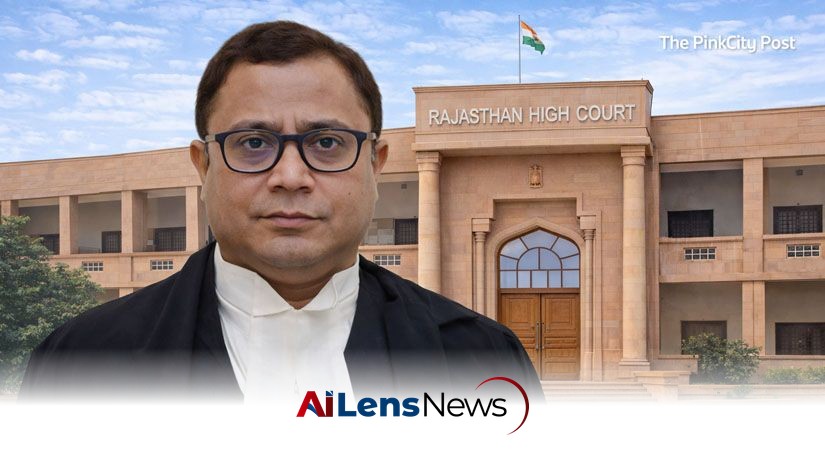


The Rajasthan High Court has dismissed petitions from madrasas and mosques against eviction notices issued for structures near the Indo-Pak border, citing national security.
New Delhi, India Jul 13, 2026 ALN: Jodhpur: The Rajasthan High Court has ruled that principles of natural justice may be curtailed when structures within the 0–50 kilometer belt along the Indo-Pak international border face eviction on national security grounds. This decision came as the court dismissed a series of writ petitions filed by madrasas, mosques, and a dargah located in Jaisalmer, Barmer, and Bikaner.
Justice Sameer Jain, presiding over the lead case Peer Mohammad Shah Jilani Dargah Samiti v. State of Rajasthan (S.B. Civil Writ Petition No. 13243/2026) along with over twenty connected petitions, stated that once the State provides credible material, including intelligence inputs, to justify action in the interest of national security, the strict application of audi alteram partem may be adjusted accordingly.
The Court emphasized: “Liberty thrives in the shadow of law, but the sovereignty of a nation survives on the vigilance of its guardians.”
The petitions were filed by the managing committees, office-bearers, and caretakers of several madrasas, mosques, and a dargah, challenging show-cause and eviction notices issued under Section 90-A and Section 91 of the Rajasthan Land Revenue Act, 1956, and Sections 20, 22, 23, and 24 of the Rajasthan Colonization Act, 1954. The notices claimed unauthorized construction on government and agricultural land without permission or lawful conversion of land use.
According to the State, the notices followed a declaration by the Union Home Minister on June 14, 2026, stating that structures within 15 kilometers—later extended to 50 kilometers—of the Indo-Pak border would be subject to vacation, eviction, or demolition for national security reasons. This was based on a Gazette notification dated October 11, 2021, which enhanced the Border Security Force’s territorial jurisdiction up to 50 kilometers from the international border. The Court acknowledged this notification as a legitimate exercise of statutory power in the interest of national security. The petitioners’ counsel indicated that show-cause notices had been issued for approximately 180 properties in the area.
Senior Advocate Vikas Balia, representing the petitioners, argued that the notices were arbitrary and issued in a predetermined manner, violating safeguards established by the Supreme Court in In Re: Directions in the Matter of Demolition of Structures (2025) 5 SCC 1, and In Re: Manoj Tibrewal Akash, 2024 SCC OnLine SC 3210. These safeguards included prior notice of at least fifteen days, an opportunity for a hearing, survey and demarcation, videography, and reasoned orders before any demolition. Balia contended that Section 90-A of the Act of 1956 allowed for a regularization mechanism, and that coercive eviction without considering regularization was arbitrary and disproportionate. He also criticized the service of notices by chaspa and the inconsistent positions taken by the State regarding national security.
The Advocate General, Additional Solicitor General, and Additional Advocate General, representing the respondents, raised preliminary objections regarding the maintainability of the petitions. They argued that the petitioners lacked locus standi due to the absence of authorization letters or society resolutions linking them to the institutions. They contended that disputed questions of title and possession could not be adjudicated in writ jurisdiction and that the Acts of 1956 and 1954 provided a complete statutory hierarchy of remedies before the Revenue Appellate Authority and the Board of Revenue. They claimed that show-cause notices had been issued and an opportunity for a hearing was provided, but the petitioners chose not to appear, and no permission had been obtained under Sections 5 and 6 of the Rajasthan Religious Buildings and Places Act, 1954, for establishing the structures.
Referencing Madhaymam Broadcasting Ltd. v. Union of India (2023) 13 SCC 401, the Court held that the State must demonstrate, through credible material, that non-disclosure is warranted in the interest of national security. The Court reiterated that a reasonable, prudent person standard governs judicial review of such claims. It stated:
“The Court cannot second-guess the judgment of the State that the purpose identified would violate India’s national security. It is the executive wing and not the judicial wing that has the knowledge of India’s geo-political relationships to assess if an action is in the interest of India’s national security.”
Applying this standard, the Court concluded that the show-cause notices did not direct demolition but merely requested the petitioners to explain their position. It noted that no coercive action had been taken following any of the notices, and that the fear of imminent demolition was speculative. The Court also dismissed claims that the actions had a ‘communal color,’ stating that notices were issued uniformly for unauthorized structures found within the sensitive belt, regardless of community.
The Court distinguished the precedents cited by the petitioners, noting that Abdul Khalek & Ors. v. State of Assam & Ors. (2026 INSC 140) involved encroachments on forest land, while In Re: Directions in the Matter of Demolition of Structures concerned properties belonging to accused individuals, neither of which could be equated with constructions near an international border. It instead relied on Executive Engineer, Bihar State Housing Board v. Ramesh Kumar Singh (1996) 1 SCC 327, asserting that writ petitions against mere show-cause notices are not typically maintainable, and on Council of Civil Service Unions v. Minister for the Civil Service (1985 AC 374), which established that natural justice may yield to national security.
Ultimately, the Court dismissed the petitions for lack of an efficacious alternate remedy and due to disputed questions of fact, with no order as to costs, resolving all pending and stay applications. However, it directed the formation of a committee comprising the District Collector, the Superintendent of Police, and a representative of the Border Security Force to individually examine cases involving sensitive border properties. This committee is empowered to order eviction, dispossession, demolition, or any other appropriate action based on available material and intelligence inputs, clarifying that natural justice would not be entirely disregarded but adjusted to the requirements of national security.
Title: Peer Mohammad Shah Jilani Dargah Samiti v. State of Rajasthan & Ors.
Case No.: S.B. Civil Writ Petition No. 13243/2026 (with more than twenty connected petitions)
Citation: [2026:RJ-JP:30648]
Counsel for petitioners: Mr. Vikas Balia, Senior Advocate, assisted by Mr. Tahir Hakim, Mr. Harish Kumar Purohit, Mr. Iqbal Khan, Mr. Shahbaz Khan, Mr. Mohd. Riyaz, Mr. Abdul Kadir, Mr. C.S. Kotwani, Mr. M.A. Siddiqui, and others.
Counsel for respondents: Mr. Rajendra Prasad, Advocate General, assisted by Mr. Anirudh Singh Shekhawat; Mr. Bharat Vyas, Additional Solicitor General; Mr. B.L. Bhati, Additional Advocate General.
To learn more about the latest developments in Political Controversies, stay updated with our exclusive reports and analyses on AiLensNews.

