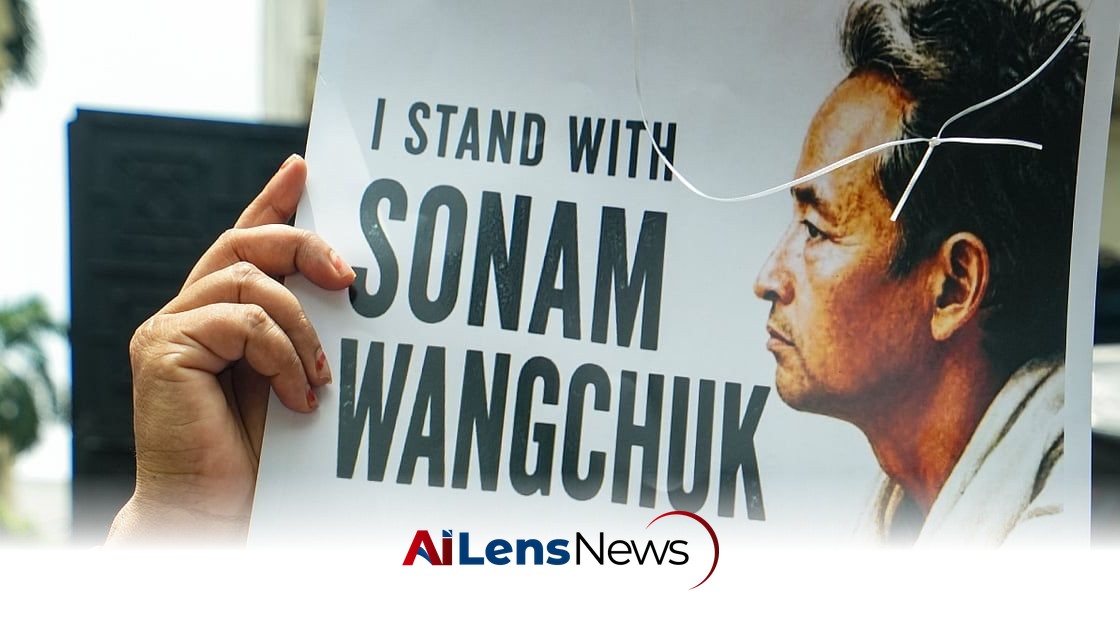


Congress leader Rahul Gandhi criticizes the police removal of activist Sonam Wangchuk from a hunger strike, calling it a violation of democratic rights.
New Delhi, India Jul 18, 2026 ALN: Congress leader Rahul Gandhi has expressed strong disapproval of the police's removal of activist Sonam Wangchuk from Jantar Mantar while he was engaged in an indefinite hunger strike. Gandhi labeled the police action as "wrong" and accused the Narendra Modi government of being guided by "Asatya and Hinsa" (falsehood and violence). This incident has ignited a broader discussion about the state of democracy and civil rights in India, particularly in the context of dissent and the government's response to peaceful protests.
In a post on X, the Leader of Opposition in the Lok Sabha stated, "The removal of Sonam Wangchuk ji from Jantar Mantar while he was on a non-violent hunger strike is wrong." He emphasized that issues such as paper leaks, rising education costs, and student suicides are critical to India's future, asserting that no amount of force could deter students or their supporters from voicing these concerns. The significance of these issues cannot be understated, as they reflect a growing unease among the youth regarding the education system and the integrity of examination processes.
The Congress party also condemned the police action, describing it as a "blot" on the country's democracy and Constitution. In a post in Hindi on X, Congress president Mallikarjun Kharge remarked, "Whether it is Professor G.D. Agarwal, who fasted for 111 days to save Mother Ganga, or the Olympic wrestlers from Haryana; our 750 farmers who feed the nation, Dalits and Adivasis, or the 25 youths and their families affected by exam paper leaks; this authoritarian government has spared no one." This statement underscores the perception that the current government is increasingly intolerant of dissent, a sentiment echoed by various political figures and activists across the country.
Kharge criticized the BJP-led government for branding anyone who raises their voice as "anti-national" or a "parasite." He stated, "What transpired at Jantar Mantar today is yet another blot on our democracy and Constitution." He noted that the "Chhatron ki Goonj (voice of the students)" has begun to resonate from Kota and Dehradun, and it will reach the very doorstep of Delhi. This metaphorical expression highlights the rising tide of student activism and the potential for widespread mobilization against perceived injustices in the education sector.
Pawan Khera, head of Congress' media and publicity department, highlighted that the Constitution guarantees the right to dissent, but the home ministry seems intent on denying it. He stated, "The Delhi Police reports directly to the home ministry, the very ministry that appointed a new police commissioner in Delhi just yesterday. If today's crackdown is his first brief, it sends a chilling message: political obedience takes precedence over Constitutional duty." This assertion raises critical questions about the relationship between law enforcement and political authority in India, particularly regarding the protection of civil liberties.
Khera accused the government of demonstrating contempt for the Constitution, citing instances of police brutality against peaceful protesters. He remarked, "Today's actions lay bare this government's mindset: peaceful protest is not a fundamental democratic right to be protected, but a law-and-order problem to be crushed." This perspective aligns with broader concerns about the erosion of democratic norms in India, where dissenting voices are increasingly met with forceful suppression.
He concluded by stating, "It is a shame that the world's largest democracy is being 'ruled' by the most undemocratic and anti-democratic political party in the world." Such statements reflect a growing sentiment among opposition parties and civil society groups that the current government is undermining the foundational principles of democracy.
Senior party leader Sachin Pilot criticized the Centre for avoiding dialogue and suppressing dissent amid growing public anger regarding issues in the education system. He noted, "The government is not ready to talk to Sonam Wangchuk ji nor accept his demands. When pressure is building from across the country on the issues for which he was on a hunger strike, the government appears rattled." This observation points to a critical moment in Indian politics, where the government's reluctance to engage with dissenting voices may further alienate young voters who are increasingly concerned about their future.
Pilot alleged that instead of engaging with Wangchuk, who was peacefully protesting, the government chose to remove him from the protest site. He stated, "This shows the government neither wants to fulfill the demands nor engage in dialogue. No representative went to speak to Wangchuk or understand the issues. Instead of resolving the matter, they removed him. This is very unfortunate." Such actions may contribute to a perception of the government as authoritarian, further fueling public discontent.
He also claimed that rising public anger, particularly among the youth over paper leaks and lack of accountability, had put the government on the defensive. Students are demanding transparency, action against those responsible for examination irregularities, and clarity from the Centre, including calls for the education minister's resignation. The demand for accountability in the education sector reflects a broader desire for reform and integrity in governance, particularly as these issues directly impact students' futures.
Wangchuk was transferred to Safdarjung Hospital early on Saturday after his health deteriorated on the 21st day of his indefinite hunger strike. The Delhi Police stated that the move was made on medical advice and in compliance with directions from the Delhi High Court. This action raises questions about the balance between ensuring public safety and respecting the rights of individuals to protest peacefully.
Deputy Commissioner of Police (New Delhi) Sachin Sharma confirmed that Wangchuk was admitted after his condition worsened and was receiving necessary medical care. He added that while some protesters attempted to obstruct the operation, police exercised maximum restraint and completed the operation without major incident. This statement suggests that the police sought to manage the situation carefully, but it does not diminish the concerns raised about the legitimacy and appropriateness of their actions.
Following the hospitalization, Cockroach Janta Party (CJP) founder Abhijeet Dipke alleged that protesters were subjected to a police crackdown. Dipke claimed in a post on X, "I have been beaten up and put under detention by Delhi Police." The CJP also shared a video purportedly showing Wangchuk being carried away from the protest site wrapped in a white sheet, stating, "A frail old man, after 20 days of a hunger strike, was picked up, wrapped in white sheets and taken away by Delhi Police. This is a national shame." Such allegations contribute to the narrative of state repression and raise concerns about the treatment of activists and dissenters in India.
Wangchuk and three activists associated with the All India Students' Association (AISA) have been on an indefinite hunger strike since June 28 in support of the CJP-led protest demanding the resignation of Union Education Minister Dharmendra Pradhan over alleged irregularities in the NEET examination and reported student deaths linked to the controversy. The NEET examination, which is critical for aspiring medical students in India, has faced scrutiny over its transparency and fairness, particularly following allegations of malpractice and corruption.
The Congress party had previously appealed to Wangchuk to end his fast, expressing concern over his deteriorating health. This appeal illustrates the complex interplay between political opposition and the health and well-being of activists, highlighting the ethical considerations surrounding hunger strikes as a form of protest. As public outrage continues to grow over the issues raised by Wangchuk and his supporters, the government's response will be closely scrutinized by both the media and the public, potentially shaping the political landscape in the lead-up to future elections.
To learn more about the latest developments in Political Controversies, stay updated with our exclusive reports and analyses on AiLensNews.

