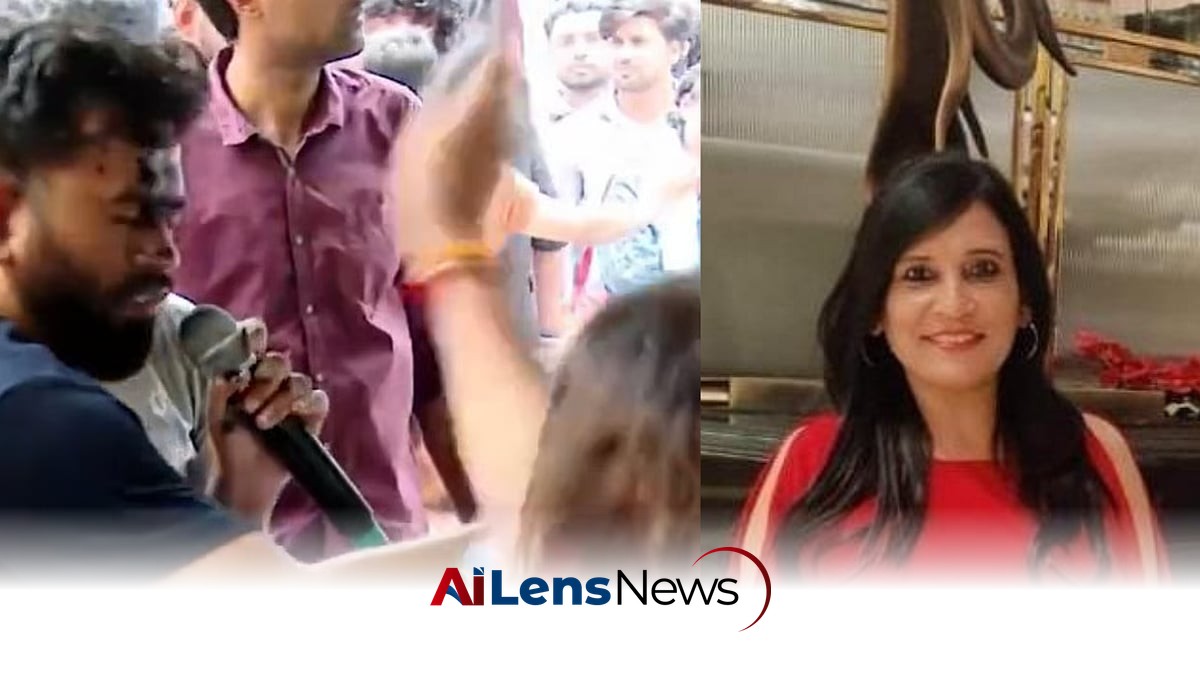


Barkha Trehan claims responsibility for throwing ink at Abhijeet Dipke during a protest, citing disrespect towards Lord Ram as her motive.
New Delhi, India Jul 19, 2026 ALN: Barkha Trehan, the president of the Purush Aayog and a prominent men's rights activist, has recently made headlines for her dramatic protest during a gathering at Jantar Mantar, a well-known site for public demonstrations in Delhi. On Saturday, July 18, Trehan threw ink at Abhijeet Dipke, the founder of the Cockroach Janta Party, an act she described as a response to perceived insults against Lord Ram, a revered figure in Hindu mythology. This incident has sparked significant debate and controversy, both in the media and on social platforms.
In her post-incident statement, Trehan emphasized her motivations for the act, asserting that she was deeply offended by Dipke's laughter during an event where she claims Lord Ram was insulted. Trehan, who identifies herself as a "Kattar Hindu" (a term often used to describe staunch or hardcore Hindus), expressed no remorse for her actions, framing them as a necessary defense of her religious sentiments. The use of the term "Kattar Hindu" reflects a growing trend among some groups in India who advocate for a more assertive stance on Hindu identity and beliefs, often in response to perceived threats or disrespect from other communities or political entities.
Context of the Protest
The incident unfolded during a larger protest at Jantar Mantar, where various groups had gathered to voice their concerns over issues such as alleged irregularities in the NEET (National Eligibility cum Entrance Test) examination, which is crucial for medical college admissions in India. The NEET controversy has been a significant point of contention in recent years, with accusations of corruption and mismanagement leading to widespread public outcry. As a result, the protest attracted a diverse group of individuals, each advocating for different causes, which is characteristic of the multifaceted nature of activism in India.
During the protest, Dipke was addressing the crowd when Trehan approached the stage and interrupted his speech by throwing ink at him. Video footage from the scene shows supporters of Dipke quickly intervening to restrain Trehan, while police personnel were called to escort her away from the venue. Fortunately, there were no immediate reports of injuries, and the situation was contained relatively quickly. However, the incident raised questions about the safety and decorum of public protests in India.
In the context of Indian society, where religion and politics are deeply intertwined, such incidents often reverberate beyond the immediate confrontation. The act of throwing ink at a political figure can be interpreted as a symbolic gesture of dissent, reflecting deeper societal frustrations. The choice of ink as a medium is particularly loaded; it is often associated with the act of writing, hence symbolically suggesting a desire to rewrite narratives perceived as disrespectful or offensive.
Reactions and Implications
The reactions to Trehan's actions have been mixed, reflecting the polarized nature of contemporary Indian society. On social media, some users praised her for taking a stand in defense of religious sentiments, viewing her actions as a form of righteous indignation against what they perceive as disrespect towards Hindu deities. This sentiment is particularly resonant in a country where religion plays a central role in the lives of many citizens, and where any perceived slight against religious figures can provoke strong reactions. Supporters of Trehan argue that her actions highlight the need for greater respect for religious beliefs in public discourse.
Conversely, others have criticized Trehan's actions as an inappropriate and disruptive response to a public event. Critics argue that resorting to physical acts of protest, such as throwing ink, undermines the principles of civil discourse and peaceful assembly that are foundational to democratic societies. This incident has reignited discussions about the boundaries of protest, the role of public figures in fostering respectful dialogue, and the responsibilities of activists in advocating for their causes without resorting to violence or intimidation.
Moreover, the incident has drawn attention to the broader political landscape in India, where religious sentiments often intersect with political ideologies. The Cockroach Janta Party, while not as widely recognized as other political entities, represents a segment of the political spectrum that engages with issues of governance and public welfare. Dipke's party has been involved in various social issues, and his response to this incident could have implications for his political standing and future engagements. How he chooses to address the incident may influence public perception of his party and its alignment with the sentiments of the electorate.
As of now, neither Dipke nor the Cockroach Janta Party has issued a detailed public response to Trehan's statement or the incident itself. Their silence may be strategic, allowing them to gauge public sentiment and formulate a measured response that aligns with their political strategy. However, the lack of immediate commentary could also be interpreted as a missed opportunity to address the concerns raised by Trehan and others about respect for religious sentiments. In a politically charged atmosphere, the way political figures respond to such incidents can either reinforce or undermine their support bases.
This incident also highlights a growing trend of activism that is increasingly characterized by emotional responses to perceived grievances. In recent years, various groups have mobilized around issues of cultural identity, religious sentiment, and political representation, often leading to confrontations that blur the lines between protest and aggression. As such, the implications of Trehan's actions extend beyond this single event, potentially influencing how protests are conducted and perceived in the future.
The use of public spaces like Jantar Mantar for protests is a long-standing tradition in India, where citizens exercise their right to free speech and assembly. However, incidents like this raise important questions about the effectiveness of such forms of protest. While they can draw attention to specific issues, they can also lead to polarization and conflict, detracting from the broader goals of activism.
In conclusion, Barkha Trehan's ink-throwing incident at Jantar Mantar serves as a microcosm of the complex interplay between religion, politics, and activism in contemporary India. As the nation grapples with its diverse identities and the challenges of democratic discourse, incidents like this will continue to provoke debate and reflection on the nature of protest, the sanctity of religious beliefs, and the responsibilities of individuals in advocating for their causes. The future of activism in India may depend on finding a balance between passionate expression and the principles of peaceful dialogue, ensuring that the voices of dissent are heard without descending into chaos or violence.
To learn more about the latest developments in Political Controversies, stay updated with our exclusive reports and analyses on AiLensNews.

