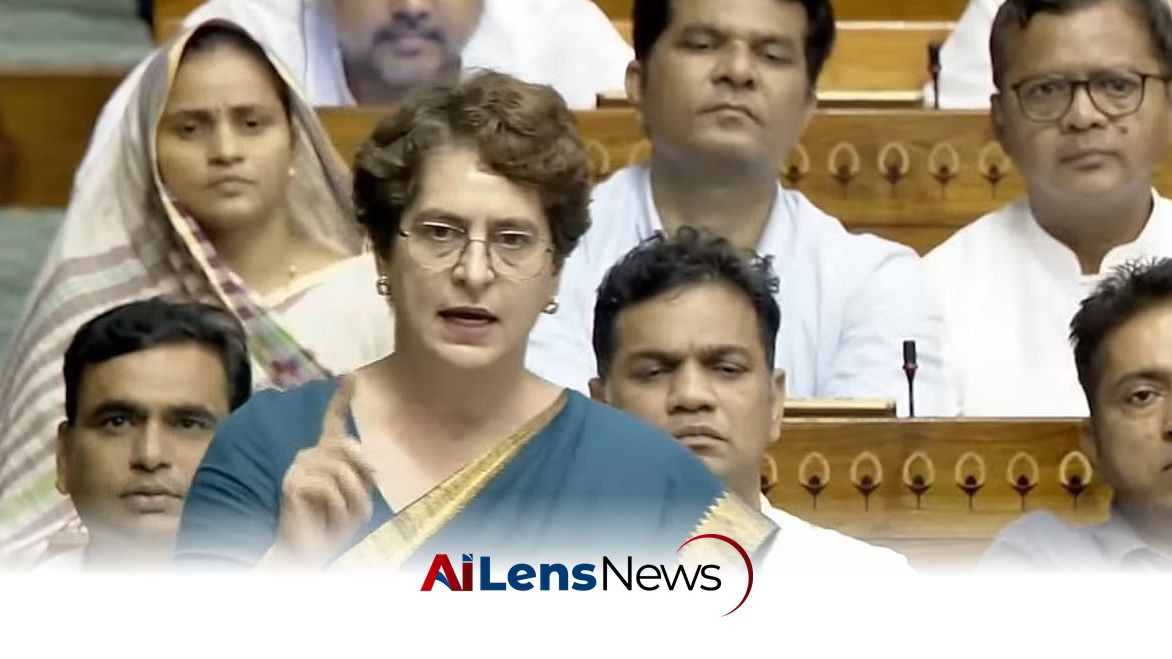


Congress MP Priyanka Gandhi Vadra questions the appointment of IIT Madras director V Kamakoti on the NTA reform panel and condemns police violence against student protesters.
New Delhi, India Jul 28, 2026 ALN: Follow TNM's WhatsApp channel for news updates and story links.
In a recent statement, Congress MP Priyanka Gandhi Vadra has raised serious concerns regarding police violence directed at young protesters in Delhi and the appointment of V Kamakoti as the director of the Indian Institute of Technology (IIT), Madras, to a panel aimed at reforming the National Testing Agency (NTA). These remarks were made in the context of widespread protests across India against alleged irregularities in the NEET (National Eligibility cum Entrance Test) exam, which serves as a gateway for students seeking admission to medical colleges in the country.
The protests erupted after claims of a leak in the NEET exam paper, prompting students to demand accountability and transparency from the government. On July 20, 2025, demonstrators gathered at Jantar Mantar in Delhi, where they faced violent dispersal by police forces. Priyanka Gandhi's questioning of whether these young activists were being labeled as "terrorists" underscores the gravity of the situation, highlighting the tensions between the government and the youth of the nation.
In her address to the Lok Sabha on July 28, Priyanka Gandhi criticized the appointment of Kamakoti, referring to him derogatorily as a ‘gau mutra expert’—a term that suggests a focus on cow urine, which has been promoted by some as a health remedy. Her comments came shortly after the BJP-led Union government announced a six-member task force, headed by Infosys co-founder Nandan Nilekani, to address the ongoing issues surrounding the NEET exam. This task force was seen as a response to the mounting pressure from students and their families for a thorough investigation and reform of the examination process.
Priyanka Gandhi's criticism of the new committee was pointed. She stated that merely forming new committees would not resolve the underlying issues, emphasizing that the government had failed to act on the recommendations made by the K Radhakrishnan Committee, which was established following a similar NEET paper leak controversy in 2024. This historical context is crucial as it illustrates a pattern of governmental inaction in response to repeated crises concerning the NEET exam.
During her speech, she questioned the qualifications of the committee members, which included an ex-Intelligence Bureau chief and an IT company owner, alongside Kamakoti. She expressed skepticism over their understanding of educational issues, asking rhetorically, “What do they know about education?” This criticism reflects a broader concern among students and educators regarding the expertise and intentions of those in charge of educational reform.
The controversy surrounding Kamakoti himself is not new. In January 2025, during a Maatu Pongal event at a cow shelter in Chennai, he made remarks about the health benefits of cow urine, which drew criticism from various sectors, particularly the scientific community. His assertions about cow urine's antibacterial and antifungal properties, as well as anecdotal claims regarding its medicinal benefits, were met with skepticism. Following the backlash, Kamakoti defended his comments by stating that he had relied on published studies, indicating a rift between traditional beliefs and scientific scrutiny.
Priyanka Gandhi's remarks also focused on the police's response to the protests, which included the use of pellet guns, tear gas, and water cannons. She demanded accountability from the government, questioning who had authorized such violent measures against peaceful protesters. Her inquiry into whether the Prime Minister or the Home Minister had given the orders for this crackdown reflects a growing discontent among the populace regarding the government's treatment of dissent. She lamented the humiliation faced by young women protesters, emphasizing the need for a compassionate and respectful approach to dissent.
Additionally, she criticized the manner in which the Bharatiya Janata Party (BJP) leaders welcomed Dharmendra Pradhan back to Parliament after his resignation as Union Education Minister, which was prompted by the protests. Priyanka described the reception as shameless, arguing that it demonstrated a lack of accountability and sensitivity to the circumstances surrounding his resignation. Her comments suggest a broader frustration with the political culture that prioritizes image over genuine accountability.
Furthermore, the appointment of Pralhad Joshi as the new Education Minister has also drawn scrutiny from Priyanka Gandhi. She recalled Joshi's defense of the controversial remission granted to the convicts in the Bilkis Bano gangrape case, questioning the message this sends to women in India. By highlighting Joshi's past comments, she seeks to underscore the perceived insensitivity of the current government towards issues of gender violence and justice.
Priyanka Gandhi's statements reflect a growing sentiment among the youth and opposition parties that the government is out of touch with the realities faced by the younger generation. Her assertion that the Prime Minister and his associates are failing to grasp the truth of the situation resonates with many young people who feel their voices are being ignored. She emphasized that superficial attempts at public relations, such as making videos to connect with the youth, will not suffice. Instead, she called for genuine engagement and acknowledgment of the grievances faced by this demographic.
In concluding her remarks, Priyanka Gandhi urged the government to accept the reality of the injustices faced by the youth under the current administration. Her call for truth and accountability speaks to a larger demand for systemic change within the educational framework and governance in India. The implications of her statements extend beyond the immediate context of the NEET protests, touching on broader themes of youth engagement, government accountability, and the need for reform in how educational policies are formulated and implemented.
As the protests continue and the government faces pressure to address the concerns raised by students, the unfolding situation will likely have significant implications for the political landscape in India. The response of the government to these protests, and the subsequent actions taken by educational institutions and policymakers, will be closely monitored by both supporters and critics alike. The ongoing dialogue surrounding education, youth rights, and the role of government in addressing grievances will be pivotal in shaping the future of India's educational and political environment.
To learn more about the latest developments in Political Controversies, stay updated with our exclusive reports and analyses on AiLensNews.

