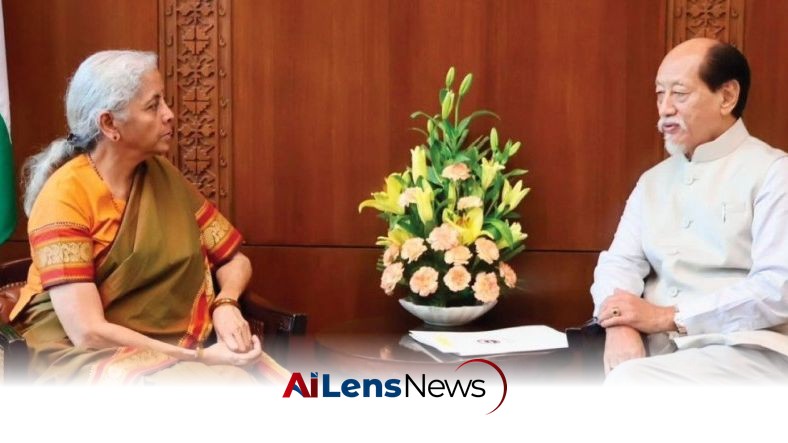


Chief Minister Neiphiu Rio engages with Union Ministers to address 's fiscal health and development priorities amidst financial constraints.
Kohima, India Jul 16, 2026 ALN: Moa Jamir
Kohima | July 16
The fiscal landscape for the State has become increasingly precarious, prompting Chief Minister Dr. Neiphiu Rio to engage with Union Ministers in New Delhi, seeking crucial support. The meetings, which took place on July 16, focused on the State's financial health and ongoing infrastructure and development priorities, reflecting the urgent need for assistance amid tightening fiscal conditions.
During his meeting with Union Finance Minister Nirmala Sitharaman, CM Rio emphasized the need for reconsideration of the recent discontinuation of Revenue Deficit Grants (RDGs). He also sought support under the Special Assistance to States for Capital Investment (SASCI) scheme, which is pivotal for addressing the State's developmental goals. In a post on social media platform X, he expressed gratitude for the Finance Minister's guidance and support, highlighting the importance of these discussions.
The backdrop of these meetings is significant, as the 16th Finance Commission's recommendations have placed the State in a challenging position. The discontinuation of RDGs represents a substantial loss of fiscal support that has been critical for the State over the years. Additionally, the share of the divisible pool of Central taxes has been reduced, further complicating the financial landscape for the State.
CM Rio's advocacy for financial support is not a new development; it has been a recurring theme in his engagements with the Union Government. He previously raised concerns about the State's "serious fiscal challenge" during the 73rd North Eastern Council (NEC) Plenary in Shillong on June 4, where he urged the Union Government to consider providing annual special grants throughout the 16th Finance Commission award period. This request was framed as essential for maintaining fiscal stability and ensuring continuity in governance and the delivery of essential public services.
On the same day as his meeting with Sitharaman, CM Rio, accompanied by Deputy Chief Ministers TR Zeliang and Y Patton, also met with Union Minister for Road Transport and Highways Nitin Gadkari. The discussions centered on the urgent need for support regarding the State's national highway priorities. The delegation advocated for the expedited implementation of pending National Highway projects and the declaration of vital corridors, such as the Foothill Road, as National Highways. Improved road connectivity is seen as critical for the State’s development and economic growth.
In a further effort to bolster connectivity and economic opportunities, CM Rio and Patton also met with Union Minister for Ports, Shipping and Waterways Sarbananda Sonowal to discuss the potential development of inland waterways. This initiative aims to enhance connectivity while opening avenues for economic development within the State.
The Chief Minister's recent meetings with Union Ministers highlight the urgency of addressing the State's fiscal challenges. In his presentation of the 2026–27 Budget on March 26, CM Rio warned that the State would encounter a more difficult fiscal environment under the 16th Finance Commission (2026–31). He characterized the budget as a roadmap toward a "Developed State," yet underscored the financial hurdles that lie ahead.
One of the most pressing issues is the reduction in the State's share of Central taxes, which has decreased by approximately 15% in relative terms—from 0.569% to 0.481%. This adjustment has brought the State's projected devolution for the 2026–27 fiscal year down to Rs 7,341 crore, a significant drop from the estimated Rs 8,684 crore that would have been allocated under the previous formula. This reduction places additional strain on the State's financial resources.
Moreover, the discontinuation of Post-RDGs under the 16th Finance Commission poses a substantial challenge. The State had previously received Rs 21,249 crore in RDGs, averaging around Rs 4,248 crore annually, alongside Rs 525 crore in State-specific grants. The absence of RDGs in the current financial cycle creates a significant gap in assured fiscal support, which the State heavily relied upon to fund various development initiatives.
In earlier discussions, CM Rio estimated that the withdrawal of RDGs could result in an annual loss of approximately Rs 8,000–9,000 crore. Such a deficit would severely impact development activities and could jeopardize the timely payment of government salaries. In light of this looming financial crisis, the Chief Minister had submitted a representation to the Union Finance Minister on February 4, advocating for grants-in-aid to mitigate the impending revenue deficit. In his representation, he emphasized the need to safeguard the State's unique constitutional position and ensure fiscal stability.
Despite the urgency of the situation, no formal response from the Union Government regarding these requests has been made public to date. This lack of communication adds to the uncertainty surrounding the State's fiscal future.
The 16th Finance Commission has also revised the devolution formula, which may further diminish the State's share of funds. The changes have reduced the weight assigned to factors such as income distance, area, and demographic performance, which could have long-term implications for the State's financial health.
While local body grants have seen an increase from Rs 1,038 crore to Rs 1,364 crore over the next five years, these funds are tied transfers and do not provide the same level of financial assurance as unrestricted grants. The State's Own Tax and Non-Tax Revenue is projected to rise to Rs 2,714.44 crore in 2026–27; however, this increase is still insufficient to bridge the anticipated fiscal gap.
The lifting of the Prohibition Act has been suggested as a potential means to augment revenues, yet this remains a politically and socially contentious issue that complicates the decision-making process. Additionally, while a tripartite Memorandum of Understanding (MoU) on oil and gas exploration in the disputed Assam-border belt has been established, meaningful revenue generation from this initiative is unlikely in the short term due to various legal, political, and operational challenges.
In March, the State was allocated Rs 3,880 crore under the "Pride of Hills: Special Development Assistance for the Hill States" scheme for the 2026–27 fiscal year. However, it remains uncertain whether such assistance will persist beyond the current financial year or adequately compensate for the loss of RDGs.
In light of these challenges, austerity measures have been implemented, directing departments to rationalize expenditures and prioritize essential spending. As a result, frequent visits to New Delhi have become a crucial component of the State Government's strategy to secure additional assistance from the Union Government through various available avenues.
In summary, the fiscal challenges facing the State are multifaceted and complex, influenced by changes in funding formulas, the discontinuation of vital grants, and the need for enhanced infrastructure. As the Chief Minister continues to advocate for support at the national level, the implications of these financial constraints will likely resonate throughout the State's governance and development efforts for the foreseeable future.
To learn more about the latest developments in Political Controversies, stay updated with our exclusive reports and analyses on AiLensNews.

