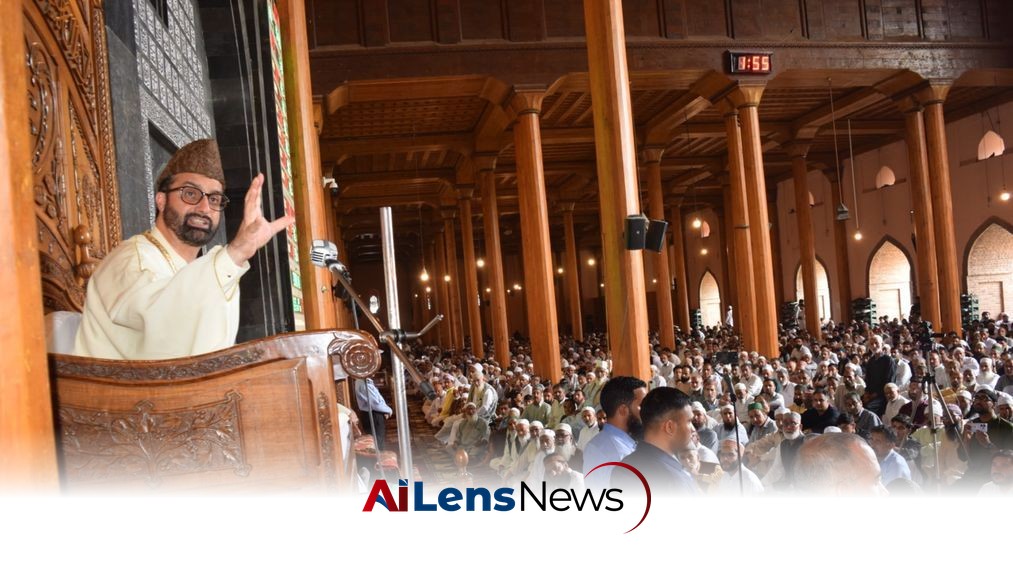


Mirwaiz-e-Kashmir Dr. Moulvi Mohammad Umar Farooq criticizes the government's plan to move liquor shops to residential areas, emphasizing its negative impact on local communities.
New Delhi, India Jul 17, 2026 ALN: Mirwaiz-e-Kashmir Dr. Moulvi Mohammad Umar Farooq, a prominent religious leader and the chief cleric of Kashmir, while addressing the Friday congregation at the historic Jama Masjid Srinagar, strongly condemned the reported move to relocate liquor shops from the National Highway to residential areas in and around Pantha Chowk in view of the ongoing Amarnath Yatra.
The Amarnath Yatra is a significant annual pilgrimage for Hindus, where thousands of devotees travel to the Amarnath Cave to pay homage to Lord Shiva. This pilgrimage not only holds religious importance but also brings economic activity to the region, with many local businesses relying on the influx of pilgrims. However, the presence of alcohol-related establishments near such a sacred route raises concerns among the local population, particularly among the Muslim community, which constitutes a majority in Jammu and Kashmir.
In a statement, Mirwaiz said that a delegation from the area visited him and conveyed their grave concern and anguish over the proposed relocation. These densely populated residential localities are home to families, schools, masjids, educational and religious institutions, and public spaces. Relocating liquor shops into their vicinity will badly affect the social and moral fabric of the area, which is completely unacceptable to the people. The juxtaposition of liquor outlets with family-oriented environments is particularly troubling for residents who prioritize the well-being of their children and community.
The issue of alcohol consumption in Muslim-majority regions is sensitive, as Islam unequivocally prohibits alcohol and commands believers to stay away from it. Mirwaiz emphasized that the proposed relocation reflects a disregard for the religious sentiments of the majority population. He stated that the government’s decision to bring liquor outlets closer to people’s homes is a stark contradiction to the values held by the community, further complicating the relationship between the local populace and the authorities.
Mirwaiz said that in the Muslim-majority region of Jammu and Kashmir, the government, instead of taking steps to restrict the availability and consumption of alcohol, is bringing liquor outlets closer to people’s homes, in complete disregard for the religious character and moral sensitivities of the society. This raises questions about the priorities of the government and its understanding of the cultural landscape of the region, which has a long history of resistance against policies perceived as imposed or contrary to local values.
He expressed that the people of Kashmir will not accept the promotion and normalization of alcohol in their society. “We have raised our voice against the spread of liquor in Kashmir in the past, and we will continue to do so. Alcohol destroys individuals, breaks families, harms the youth and weakens the moral and social fabric of society,” he said. These statements echo a broader sentiment among many community leaders who view the proliferation of alcohol as detrimental to the social structure of Kashmir, which has already faced numerous challenges due to conflict and socio-economic instability.
Questioning the government’s reasoning, Mirwaiz posed a critical inquiry: “If, due to the religious sanctity of the Amarnath Yatra, liquor outlets are considered inappropriate on the pilgrimage route taken by yatris, how is it considered appropriate to relocate them into residential areas where families—whose religion strictly prohibits alcohol consumption—live with their children? If liquor is inappropriate and harmful in both religions, why not ban it altogether instead? Respect for religious sentiments should not be selective or time-bound.” This line of questioning highlights the perceived hypocrisy in the government's approach to regulating alcohol, suggesting that the decision-making process lacks coherence and fails to consider the broader implications for community welfare.
In response to the proposed relocation, Mirwaiz noted that the delegation conveyed to him that all people of the affected area of Pantha Chowk have decided to protest against the proposed relocation, and he extended his full solidarity and support to the residents. “A society that does not defend its values risks gradually losing them. People cannot remain silent when decisions are imposed that directly affect their homes, their children and the moral environment in which future generations are being raised,” he said. This sentiment reflects a growing trend of community activism in Kashmir, where residents are increasingly vocal about issues that threaten their cultural and religious values.
Mirwaiz asked the government to immediately withdraw the proposal and ensure that no liquor shop is opened or relocated near residential neighborhoods, schools, masjids or other public institutions. He urged the authorities to listen to the people rather than enforce decisions that violate the religious ethos and shared value system of the people of Jammu and Kashmir. The call for government accountability underscores a demand for more participatory governance, where the voices of local communities are taken into consideration in policy-making processes.
The implications of this controversy extend beyond the immediate concerns of liquor shop relocations. It raises fundamental questions about the role of government in managing cultural sensitivities in a diverse society. The balancing act between economic development, tourism, and the preservation of local values is a complex challenge that requires careful navigation. Furthermore, the backlash against the relocation plan could signal a resurgence of community activism, potentially leading to more organized efforts to influence local governance and policy decisions in the future.
As the situation unfolds, it will be important to monitor not only the government's response to the protests but also the broader societal implications of such decisions in a region that has long been grappling with the impacts of conflict, identity, and cultural preservation. The dialogue surrounding alcohol consumption, religious values, and community welfare in Kashmir continues to be a critical issue that reflects the intersection of local traditions with modern governance challenges.
To learn more about the latest developments in Political Controversies, stay updated with our exclusive reports and analyses on AiLensNews.

