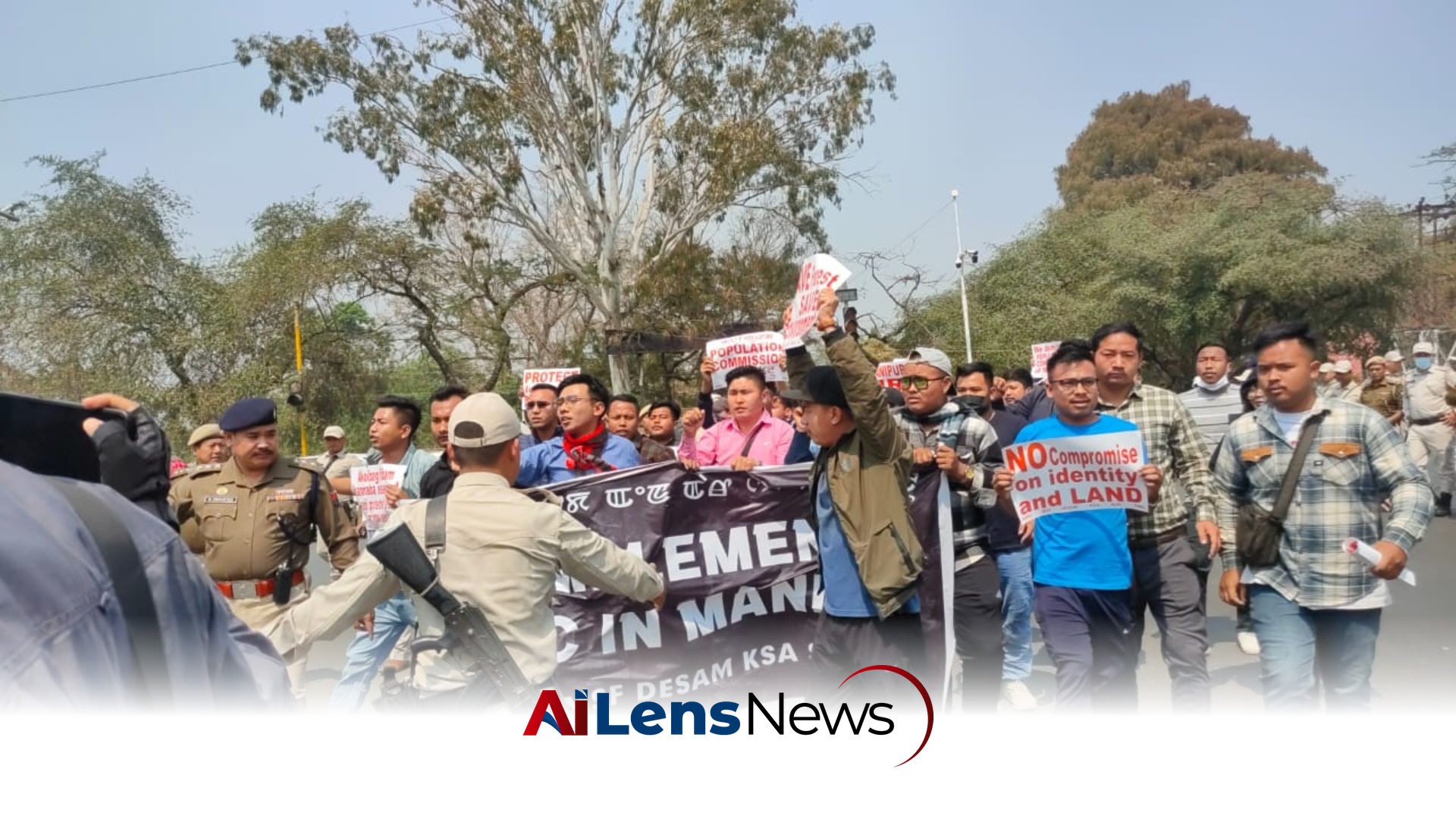


A new political alliance between the Meitei and Naga communities is forming in Northeast India, driven by shared territorial concerns and conflicts with the Kuki-Zo community.
Imphal, India Jul 16, 2026 ALN: As Northeast India grapples with multi-ethnic violence, particularly following recent Naga-Kuki clashes that resulted in the deaths of six Naga civilians in Senapati district, a notable political alliance is quietly taking shape. This alliance signals a closer convergence between the Meitei and Naga communities over shared territorial and political aspirations, as well as ongoing conflicts with the Kuki-Zo community.
This emerging alliance has manifested through joint protests, public meetings, and collaborative committees, framed by participants as a common fight of "indigenous communities" against "outsiders." The alliance is driven by shared concerns over perceived illegal immigration, land encroachment, poppy cultivation, and issues related to militancy.
As the alliance expands, Kuki organizations and scholars view it as a strategic realignment that could consolidate Meitei and Naga political interests while isolating and diminishing the Kuki community's space in any future political settlement.
“We have a great demographic threat from the Kuki people, who have now started to demand a separate administration to safeguard their illegal immigrants and ‘so-called’ refugees,” stated Ashang Kasar, convenor of the Native People’s Committee (NPCM), a joint Meitei-Naga civil body formed on May 26. He emphasized the need for the landowners to defend their territory, leading to the formation of this joint committee.
Santa Nahakam, spokesperson of the Coordinating Committee on Integrity (COCOMI), echoed these sentiments, asserting that this is a common fight for both communities. “It is not like Kukis are fighting with the Nagas or with the Meiteis, and we remain silent. It is a very common fight,” he added.
Nahakam clarified that the mobilization is not against any Kuki group, but rather against what he termed ‘narco-terrorists.’ He noted that the villages of Nagas and Meiteis have recognized that the common Kuki populace, who have lived alongside them for generations, are now being influenced by these groups.
Janghaolun Haokip, information secretary of Kuki Inpi, the apex body of the Kuki-Zo community, views the Meitei-Naga convergence as a long-standing political alignment, suggesting that former Chief Minister Biren Singh played a role in fostering this relationship, primarily driven by territorial and land dominance motives.
“To my mind, this is a strategic alliance that was forged from around 2010 onwards; there is a very uncanny convergence of territorial as well as indigenous politics between the Nagas and the Meiteis,” remarked Dr. Kham Khan Suan Hausing, a leading expert on ethnopolitics in Northeast India.
One of the key objectives of the alliance is the safeguarding of ‘indignity’ and land rights. Kasar stressed the historic primacy of the Nagas and Meiteis as the first settlers in the state, claiming that they are the only indigenous people, while others arrived later. He linked this to illegal immigration, alleging a significant influx of Kuki immigrants from Myanmar.
Prof. Hausing critiqued this premise, arguing that defining indignity through “first occupancy” is historically flawed and difficult to substantiate. He questioned the claims of large-scale illegal immigration, stating that there is no reliable empirical evidence to support such assertions.
Kasar suggested that the National Register of Citizens (NRC) could be a solution, proposing an update with a base year of 1951 or 1961. He indicated that if the NRC reflects that some Kukis were present before this year, they would not object to their inclusion. However, he noted that once updated, there would be no Kuki presence in certain districts.
Hausing raised concerns about the practicality of such an exercise, highlighting the absence of reliable census data from the proposed years. He warned that such a political project could be dangerous.
The emerging Meitei-Naga alignment has strongly advocated for the abrogation of the Suspension of Operations (SoO) agreements with Kuki armed groups, viewing them as facilitators of militancy and narco-related activities.
COCOMI explained that since the agreements were established, the common Kuki populace has been increasingly controlled by narco-terrorists. Kasar alleged that SoO militants are involved in extortion and violence.
The Kuki Inpi spokesperson challenged the narrative of narco-terrorism, asserting that all communities have militant groups and engage in narcotics-related activities. He emphasized that Kuki-Zo civil bodies have consistently appealed to refrain from such activities.
Hausing noted that the issue of narco-terrorism is complex, involving a network of transnational players and local elites. He highlighted that poppy cultivation began in Naga-inhabited areas before spreading to Kuki regions, suggesting selective targeting of the Kukis.
The Kuki Inpi spokesperson expressed concern that the growing Meitei-Naga convergence has already begun to affect the Kuki-Zo community, which is now operating with greater coordination. They pointed to economic blockades and selective security operations as evidence of increasing political coordination against them.
Prof. Hausing argued that the political exclusion of the Kuki-Zo community has become institutionalized, describing the trajectory as one towards an ethnocracy.
For NPCM, the convergence is expected to deepen. Kasar indicated that the committee plans to expand its outreach and jointly submit a memorandum to the Prime Minister and Union Home Minister regarding issues of indigenous identity and land rights.
However, the longevity of this alliance remains uncertain. Hausing noted that internal contradictions between the Meiteis and Nagas could eventually surface, particularly regarding territorial integrity and aspirations for Greater Nagalim.
In summary, while the Meitei-Naga alliance appears to be strengthening, it is built on a complex web of historical grievances and political aspirations that may lead to future conflicts.
To learn more about the latest developments in Political Controversies, stay updated with our exclusive reports and analyses on AiLensNews.

