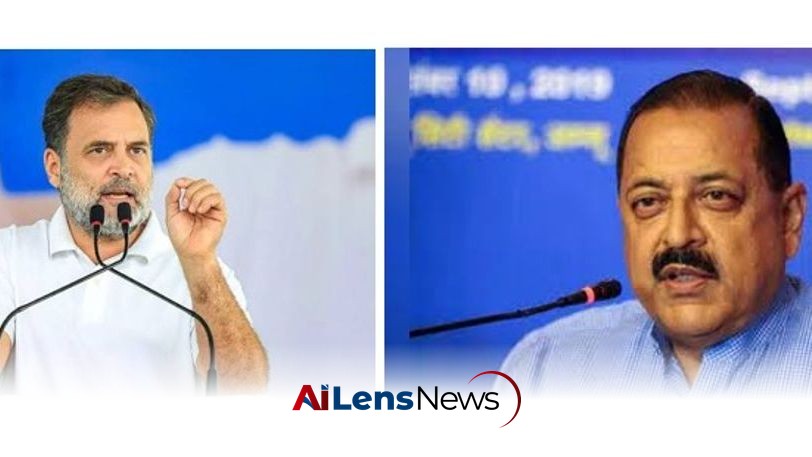


Union Minister Jitendra Singh met with Congress leaders, including Rahul Gandhi, during a protest outside PM Modi's residence, demanding accountability for police actions against students.
Leh, India Jul 21, 2026 ALN: New Delhi [India], July 21: Union Science and Technology Minister Jitendra Singh arrived at the site of a protest outside the residence of Prime Minister Narendra Modi, where Congress leaders, including Rahul Gandhi, were demonstrating. This gathering is emblematic of the heightened political tensions in India, particularly surrounding issues related to education and student welfare, which have become focal points for opposition parties.
Singh, who also serves as the Minister of State in the Prime Minister's Office, was seen briefly conversing with Rahul Gandhi during the protest. Such interactions, while brief, highlight the ongoing dialogue between the ruling party and the opposition, albeit within a charged atmosphere. The presence of high-profile leaders like Singh and Gandhi at the same location underscores the significance of the issues being raised, as well as the potential for political repercussions stemming from these events.
Earlier, Delhi Police detained several Congress leaders who were participating in the demonstration. Among those present were Congress President Mallikarjun Kharge, Priyanka Gandhi Vadra, KC Venugopal, Pawan Khera, Pariniti Shinde, and Manickam Tagore, who gathered at Lok Kalyan Marg to demand the resignations of both the Prime Minister and Education Minister Dharmendra Pradhan. The participation of such a diverse group of leaders indicates a united front from the Congress party, aiming to amplify their message and rally public support against the current government’s policies.
Kerala Chief Minister V D Satheesan also joined the protest, reflecting the broader regional discontent with the central government's handling of educational issues. The inclusion of state leaders in a national protest illustrates the interconnectedness of state and national politics in India, where local grievances often resonate on a larger scale.
The protest began with a foot march from Rajaji Marg towards PM Modi's residence, alleging “brutalities against students” from the previous day. This march is part of a larger narrative of student activism in India, where young people are increasingly vocal about their rights and the failures of the educational system. The allegations of police brutality during the earlier protests have intensified these sentiments, fostering a climate of unrest among students and their supporters.
Eighty-four-year-old Mallikarjun Kharge, celebrating his birthday, was seen during the protest with his hands raised and tied with tags that Rahul Gandhi distributed to the MPs and protesters. This symbolic act served to draw attention to the perceived suppression of dissenting voices in the country, particularly among the youth. Kharge's presence at the protest, especially on his birthday, signifies his commitment to the cause and serves as a rallying point for the Congress party and its supporters.
Kharge was later taken away in a vehicle, a move that could be interpreted as an attempt by authorities to defuse the situation but also raises questions about the treatment of political leaders during protests. Congress MP K Suresh, who was detained, stated from inside the bus, “Our students were very cruelly attacked. The Honourable PM is not saying anything, and Home Minister Amit Shah is also silent, which is why Congress MPs from both the Lok Sabha and the Rajya Sabha are protesting.” This statement encapsulates the frustration felt by many in the opposition regarding the government's perceived inaction in response to student grievances.
The protest was a response to police actions during the Cockroach Janata Party's (CJP) march to Parliament the previous day. The CJP, a relatively new political entity, has been vocal in its criticism of the government, particularly regarding issues that affect students and the educational landscape in India. Their involvement in the protest signifies a growing coalition of political forces united against the ruling party's policies.
Chairperson of the Punjab Congress Campaign Committee, Charanjit Singh Channi, criticized the BJP, stating, “This is BJP's terrorism. They don't listen to the students...” amid chants of “Shame shame” and “BJP murdabad.” Such rhetoric is common in political protests, where emotional appeals are made to galvanize support and highlight perceived injustices. The use of terms like "terrorism" in this context reflects the deep-seated animosity between the ruling and opposition parties, as well as the high stakes involved in the political discourse surrounding education.
Earlier in the day, Rahul Gandhi, Priyanka Gandhi Vadra, and KC Venugopal met with student protesters who were injured in a police crackdown in the national capital, with Congress asserting that PM Modi should apologize for what they termed “brutality” against the youth of the country. This direct engagement with the injured students serves to humanize the political struggle and connect the leaders more closely with the grievances of the populace. It also reinforces the narrative of the Congress party as a defender of student rights and welfare.
Union Health Minister JP Nadda also visited RML Hospital to meet the injured protesters, indicating that the government is aware of the situation and is attempting to mitigate the fallout from the protests. Nadda's involvement demonstrates the government's strategy to address public concerns while also attempting to maintain a semblance of order and control over the narrative surrounding the protests.
The Congress party emphasized that the protesting students' demands were clear: the Centre must take accountability for the alleged NEET paper leak and the immediate resignation of Union Education Minister Dharmendra Pradhan. The NEET (National Eligibility cum Entrance Test) paper leak incident has become a significant flashpoint, as it directly impacts the future of countless students aspiring to enter medical colleges across the country. The demand for accountability reflects broader concerns regarding transparency and integrity within the education system, which has faced increasing scrutiny in recent years.
Union Health Minister JP Nadda had earlier met a delegation from the Cockroach Janata Party (CJP), which presented three demands to the government. He urged the protesters to conclude their sit-in. Nadda, who is the Leader of the House in the Rajya Sabha, mentioned in a post on X that for the first time, a proposal came from the protesters to hold discussions with the government. This indicates a potential shift in the dynamics of the protest, as dialogue may pave the way for resolution, albeit under the watchful eyes of the political landscape.
He stated that discussions commenced around 11:50 am and were conducted in a cordial atmosphere. “There was a detailed verbal discussion first, and a written petition was given to me around 4 pm. I requested all the protesters to end their protest and assist the administration in restoring normalcy,” he added. The emphasis on a cordial atmosphere suggests that there may be opportunities for negotiation, though the effectiveness of such discussions remains to be seen amid the charged political environment.
Cockroach Janata Party (CJP) chief spokesperson Saurav Das later indicated that they had placed three demands before Nadda, including the resignation of Education Minister Dharmendra Pradhan and compensation of Rs 1 crore to the families of the NEET aspirants, “more than 20 of whom have lost their lives.” This stark statistic highlights the severe consequences that have arisen from the alleged mismanagement of the NEET examination process, further intensifying calls for accountability from the government.
In conclusion, the protest outside PM Modi's residence serves as a microcosm of the larger political and social struggles in India today. It reflects the growing discontent among students and opposition parties regarding the government's handling of education and student welfare issues. The engagement between Congress leaders and Union ministers during the protest highlights the complexities of Indian politics, where dialogue and dissent coexist amid a backdrop of intense rivalry. As the situation unfolds, it remains to be seen how the government will respond to the demands of the protesters and whether this will lead to meaningful changes in policy or governance regarding education in India.
To learn more about the latest developments in Elections, stay updated with our exclusive reports and analyses on AiLensNews.

