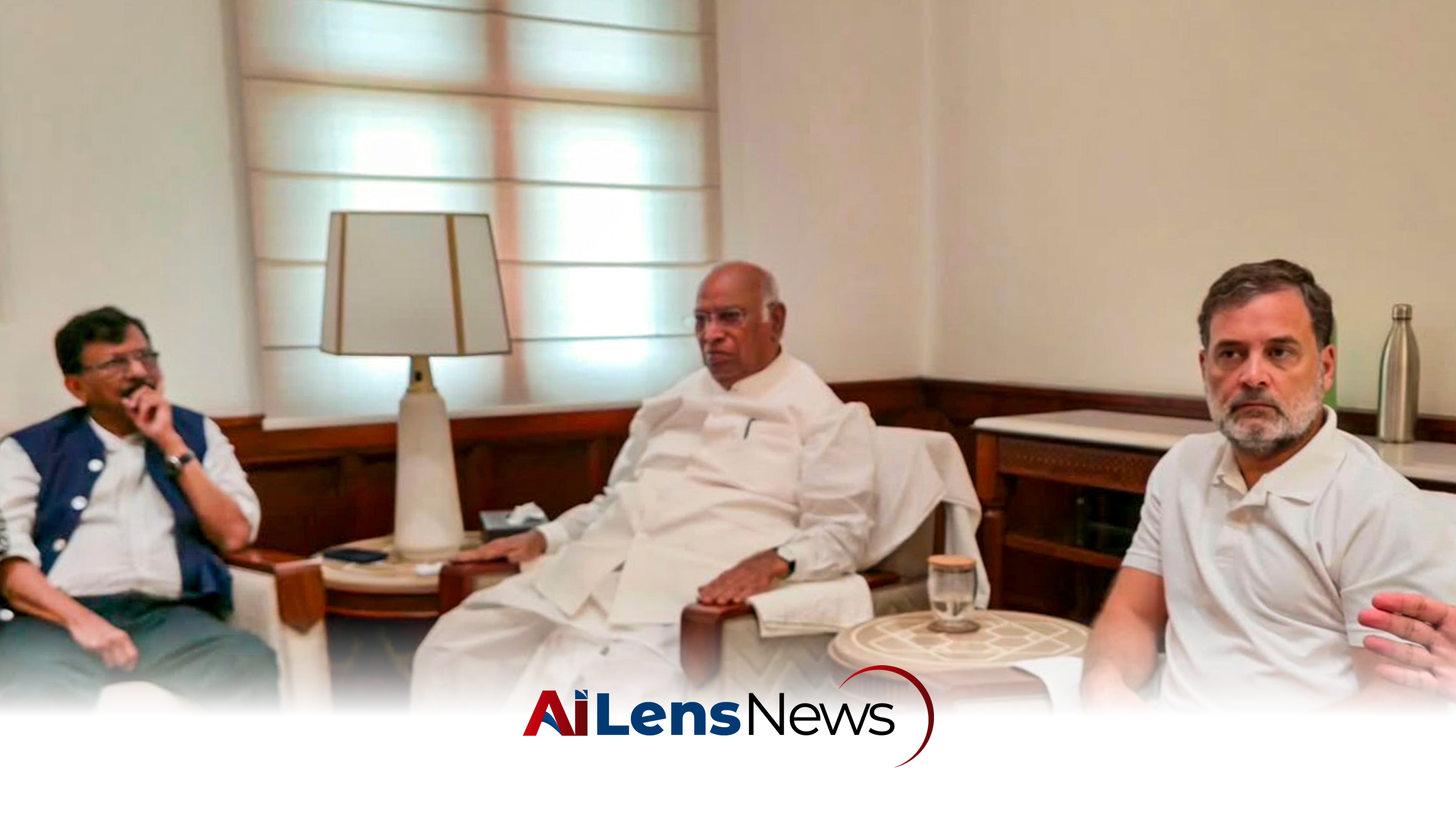


Mallikarjun Kharge expresses outrage over police crackdown on student protesters, choosing not to celebrate his birthday in protest.
New Delhi, India Jul 21, 2026 ALN: New Delhi: Leaders of the INDIA bloc gathered for a crucial strategy meeting at Parliament House in New Delhi on Tuesday morning to coordinate their joint approach and finalize floor tactics ahead of the ongoing Monsoon Session proceedings. The INDIA bloc, an alliance formed by various opposition parties in India, aims to present a united front against the ruling government, particularly in light of recent controversies surrounding student protests and examination irregularities.
Intensifying opposition coordination during the ongoing session, key leaders from the INDIA bloc, including Lok Sabha Leader of Opposition Rahul Gandhi and members of allied parties such as the Samajwadi Party (SP), Left parties, and Shiv Sena, held a formal meeting with the Lok Sabha Speaker inside Parliament House. This gathering reflects the growing urgency among opposition leaders to consolidate their strategies as they face the ruling Bharatiya Janata Party (BJP) in a politically charged environment.
Expressing deep anguish over the police crackdown on student protesters, Rajya Sabha Leader of Opposition and Congress President Mallikarjun Kharge announced that he has chosen not to celebrate his birthday, condemning the use of force against youth demanding justice. His decision to forgo celebrations underscores the gravity of the situation and highlights the emotional toll that the crackdown has taken on the political landscape.
Mallikarjun Kharge stated in a post on X, expressing his outrage over the administrative crackdown. He articulated his concerns regarding the treatment of students, who are often viewed as the future of the nation. In his statement, Kharge wrote, "Yesterday, the nation witnessed lathicharges, tear gas shells, and the crushing of a peaceful Democratic protest by the Government. The voices of students demanding justice were met with force instead of answers. This is not how a 'Mother of Democracy' treats its young children. In these painful circumstances, I have decided not to celebrate my birthday today."
Kharge's comments reflect a broader sentiment among opposition leaders who believe that the government’s response to dissent has crossed a line. The use of force against peaceful protesters, especially students, raises significant questions about the state of democracy in India and the government's commitment to upholding civil liberties. In his statement, Kharge further emphasized, "I am deeply grateful to all Congress leaders, workers, supporters, well-wishers, and every citizen who has conveyed their warm wishes. Your affection means a great deal to me, and I thank each one of you from the bottom of my heart. But today is not a day for celebration. It is a day to seek accountability. Restore Democracy."
Kharge posed several critical questions regarding the government's handling of the situation: "Why were students demanding justice met with brutal lathis and tear gas? Why was the Parliament virtually sealed and the internet shutdown? Who will take responsibility for repeated paper leaks and the suffering of lakhs of young people?" These inquiries highlight the frustration and anger felt by many in the opposition regarding the government's approach to student-related issues, particularly in the context of the National Eligibility cum Entrance Test (NEET) examination paper leak scandal.
In his call for accountability, Kharge demanded immediate discussions in Parliament regarding the treatment of student protesters and the overall examination system. He asserted that Union Education Minister Dharmendra Pradhan should resign, taking moral and political responsibility for the matter. Kharge proposed several reforms, including the establishment of a 21st-century student-centric examination system with secure digital question banks and randomized papers. He also called for an independent and merit-driven education system, with increased funding for education, free from political interference, particularly from the Rashtriya Swayamsevak Sangh , a right-wing Hindu nationalist organization closely associated with the BJP.
Moreover, Kharge emphasized the need for statutory protections for students, advocating for mandatory re-examinations and compensation whenever examination irregularities occur. His assertions resonate with a growing demand among students and their families for a fair and transparent examination process. Kharge concluded his remarks by stating, "Our children deserve justice, not repression," encapsulating the sentiments of many who feel that the current system is failing to protect the rights and futures of young people.
Meanwhile, on Tuesday, Union Parliamentary Affairs Minister Kiren Rijiju addressed the media, stating that Prime Minister Narendra Modi has expressed his support for students during a National Democratic Alliance (NDA) meeting held in Parliament. Rijiju conveyed that the Prime Minister emphasized the government's commitment to standing with students amid concerns over the NEET examination paper leak and called for strict action against those involved in the irregularities. This statement aims to reassure the public that the government is taking the issue seriously, even as opposition leaders voice their criticisms.
Addressing reporters after the NDA Parliamentary Party 'Mangal Milan' meeting, Rijiju stated, "The Prime Minister made it clear that the government stands with students and that paper leaks are a matter of national concern that should not be politicized." This assertion reflects the government's attempt to distance itself from the backlash while also acknowledging the seriousness of the allegations surrounding the examination process. However, the opposition remains skeptical, viewing these statements as insufficient in the face of the ongoing protests and demands for accountability.
The Monsoon Session of Parliament commenced on Monday and is scheduled to continue until August 13. This session is particularly significant as it serves as a platform for various political parties to address pressing national issues, including education, employment, and governance. The heightened tensions between the opposition and the ruling party during this session are likely to shape the political discourse in the coming weeks, especially as the INDIA bloc seeks to leverage the current unrest to galvanize public support against the government.
As the session progresses, the actions taken by both the government and the opposition will be closely scrutinized by the public and the media. The outcome of this political confrontation could have lasting implications for the future of governance in India, particularly in terms of how dissent is handled and the degree to which student voices are acknowledged and respected in the political arena. The ongoing dialogue surrounding education reform and the treatment of young people in protests will likely remain at the forefront of political discussions, influencing the strategies of both the ruling party and the opposition as they navigate this complex landscape.
To learn more about the latest developments in Political Controversies, stay updated with our exclusive reports and analyses on AiLensNews.

