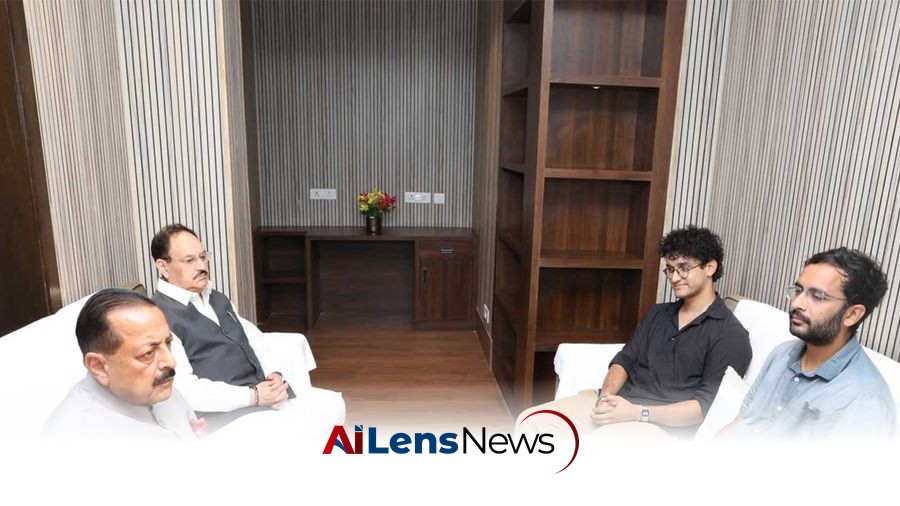


Union Ministers JP Nadda and Jitendra Singh met with the Cockroach Janata Party (CJP) for a crucial third round of discussions, following the resignation of Dharmendra Pradhan amid ongoing protests over examination irregularities.
New Delhi, India Jul 25, 2026 ALN: A delegation of the Cockroach Janata Party (CJP) on Saturday met with Union Ministers JP Nadda and Jitendra Singh at the Constitution Club of India for their third round of talks, as the government continued its engagement with the protesting group following the resignation of Union Education Minister Dharmendra Pradhan over the NEET-UG paper leak.
Union Ministers JP Nadda and Jitendra Singh arrived at the Constitution Club to hold discussions with the CJP delegation. Earlier in the day, both ministers were seen leaving their respective residences for the scheduled meeting. The third round of negotiations assumes significance as it comes hours after Pradhan stepped down from the Union Cabinet, citing the larger interests of students and the nation.
In his resignation letter addressed to Prime Minister Narendra Modi, Pradhan stated that he had resigned to ensure that the ongoing protests over examination irregularities were not exploited by "anti-national forces." His resignation was a response to the growing discontent among students and their families regarding the integrity of the examination process, which is crucial for aspiring medical students in India.
Pradhan's letter highlighted the seriousness of the situation, noting that "the situation that has emerged at Jantar Mantar and elsewhere in the country should not be exploited by anti-national forces. The unity of the country must remain intact. The future of every student in India should not get entangled in legal complications." This statement reflects the government's concern not only about the protests but also about the potential for unrest that could arise from the ongoing agitation.
His resignation followed weeks of nationwide protests over examination irregularities and a 26-day hunger strike led by activist Sonam Wangchuk at Jantar Mantar. The agitation has been spearheaded by the Cockroach Janata Party (CJP), which has been demanding accountability over examination paper leaks. The NEET-UG examination, which is a gateway for students seeking admission to medical colleges in India, has faced scrutiny and criticism due to allegations of malpractice and corruption.
Despite welcoming the minister's resignation, the CJP has maintained that its protest at Jantar Mantar will continue until all of its demands are fulfilled. The CJP has emerged as a significant voice in the student community, advocating for transparency and accountability in the education system. Addressing supporters after the resignation, CJP leader Abhijeet Dipke expressed a sense of triumph, stating, "Kaha jaata tha iss sarkar main istife nahi hote. Jhukti hai duniya, jhukaane vaala chahiye. We have done it," describing the resignation as the first by a Union Minister under Prime Minister Narendra Modi's government.
Visuals from the protest site showed demonstrators celebrating and raising slogans after the announcement, indicating a temporary victory for the protesters who have been vocal about their grievances. Dipke further elaborated on the organisation's remaining demands, which include compensation of Rs 1 crore for the families of students who died by suicide over examination-related issues, assurance that no action will be taken against student protesters, and action against Delhi Police personnel accused of using force against demonstrators.
Activist Sonam Wangchuk also welcomed Pradhan's resignation, calling it a "victory of democracy, peace, and perseverance." In a post on X, Wangchuk wrote, "IT'S A VICTORY OF DEMOCRACY. direct democracy... straight from the streets. It's a victory of peace, patience & perseverance. Congratulations CJP, Gen Z of the nation and thank you all citizens for shedding fear and the fear of fear and rising up from every corner of the nation. FROM ACCOUNTABILITY, NOW TO REFORMS." Wangchuk's remarks underscore the growing sentiment among youth and activists that they are taking charge of their future and demanding accountability from their leaders.
Pradhan, in his resignation letter, defended the Centre's handling of the NEET-UG controversy, stating that after irregularities surfaced in the May 3 examination, the government transferred the investigation to the CBI, cancelled the examination, and conducted a re-test for more than two million candidates on June 21. This step was seen as an attempt to restore faith in the examination process, which had been severely undermined by the allegations of misconduct.
To further enhance the integrity of the examination process, Pradhan also announced that the NEET-UG examination would be conducted entirely in Computer-Based Test (CBT) mode from next year. This move is aimed at increasing transparency and reducing the likelihood of malpractices that have plagued traditional paper-based examinations.
Meanwhile, the Centre is preparing to introduce a stringent anti-paper leak law, which is expected to provide for Special Fast-Track Courts, a Special Task Force (STF), and other measures aimed at preventing examination malpractices across the country. This legislative effort reflects the government's acknowledgment of the need for systemic reforms to address the long-standing issues of corruption and irregularities in the examination process.
The implications of Dharmendra Pradhan's resignation and the ongoing protests are significant for the Indian education system. The NEET-UG examination is a critical component of the pathway for medical education in India, and any disruption to the process can have far-reaching consequences for students and the healthcare sector. The protests led by the CJP have highlighted the urgent need for reforms in the examination system, and the government's response will be closely scrutinized by both students and the public.
As the situation unfolds, it remains to be seen how the government will address the demands of the CJP and other student groups. The ongoing dialogue between the CJP and Union Ministers is a crucial step in this process, and the outcome of these negotiations could set a precedent for how the government handles similar issues in the future. The events surrounding the NEET-UG controversy serve as a reminder of the power of collective action and the importance of accountability in governance.
In conclusion, the resignation of Union Minister Dharmendra Pradhan marks a pivotal moment in the ongoing struggle for accountability within India's education system. The CJP's persistent efforts to advocate for student rights and the government's response will shape the narrative around educational reforms and the integrity of examination processes in the country. As both sides continue their negotiations, the focus will remain on achieving a resolution that addresses the concerns of students while ensuring the integrity of the examination system for future generations.
To learn more about the latest developments in Political Controversies, stay updated with our exclusive reports and analyses on AiLensNews.

