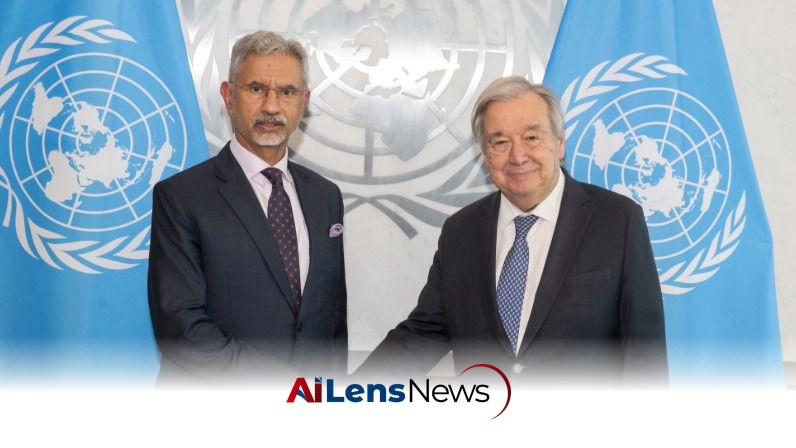


External Affairs Minister S. Jaishankar met UN Secretary-General Antonio Guterres to discuss global crises, including West Asia, Ukraine, and Sudan.
New Delhi, India Jul 14, 2026 ALN: External Affairs Minister (EAM) S. Jaishankar engaged in discussions regarding various global hotspots during a meeting with United Nations Secretary-General Antonio Guterres on Monday (local time).
Jaishankar highlighted that their talks encompassed India's cooperation with the UN, as he noted in a post on X. This meeting is part of India's broader diplomatic efforts to enhance its role on the global stage, particularly in multilateral forums like the United Nations. The growing geopolitical dynamics have made it essential for nations to collaborate and address pressing issues collectively.
During their discussions, they addressed significant global developments, including the situations in West Asia, Ukraine, and Sudan, he stated. Each of these regions is currently experiencing substantial turmoil, which poses challenges not only to regional stability but also to global peace and security.
“We also recognized the strength of India-UN cooperation,” he added. This acknowledgment is particularly pertinent given India's long-standing relationship with the UN, which has evolved through various global challenges. India has been an active participant in UN peacekeeping missions and has consistently advocated for reforms within the organization, including a permanent seat on the Security Council.
The situation in West Asia, particularly the renewed tensions between the US and Iran, is of deep concern for India, which relies heavily on energy supplies passing through the Strait of Hormuz. The ongoing conflict has adversely affected these supplies. India’s energy security is intricately linked to this region, as a significant portion of its crude oil imports comes from the Gulf nations. Any disruption in this supply chain could have serious ramifications for India's economy, making it crucial for the Indian government to engage in diplomatic efforts to mitigate tensions.
Jaishankar's visit to New York was brief, aimed at launching India’s candidature for the upcoming election to the Security Council. This election is particularly significant as it reflects India’s aspirations to play a larger role in global governance. The Security Council, comprising 15 member states, is responsible for maintaining international peace and security, and India’s election would enhance its ability to influence decisions on critical global issues.
Following the event, he met with Guterres to outline India’s agenda for the Council amid a backdrop of escalating conflict, violence, and instability that threatens even distant nations. The discussions underscore the interconnectedness of global security issues and the need for collaborative solutions. As conflicts in one region can have ripple effects worldwide, India’s active participation in the Security Council would enable it to address these challenges more effectively.
While addressing delegates and diplomats responsible for electing a country to represent the Asia-Pacific region for the term starting in 2028, Jaishankar emphasized, “In a world with too many conflicts and tensions, India has consistently espoused dialogue and diplomacy. We have sought to bridge differences.” This statement reflects India's foreign policy approach, which prioritizes peaceful negotiations and conflict resolution over military interventions. India’s historical experience with colonialism and its commitment to non-alignment have shaped this diplomatic philosophy.
He also presented a six-point manifesto focused on the acronym Shanti, which stands for “Securing Holistic Advancement through Norms, Trust (and) Integrity.” This manifesto is indicative of India's vision for a more equitable and peaceful world order, emphasizing the importance of international norms and trust-building measures in fostering cooperation among nations. The use of the term 'Shanti,' which means peace in Hindi, aligns with India's cultural ethos and its longstanding commitment to promoting peace and stability globally.
The discussions centered on urgent international crises and the ongoing collaboration between India and the United Nations on various global issues. India's proactive stance on global governance is not only aimed at securing its interests but also at contributing to global peace and security. By advocating for multilateralism and a rules-based international order, India seeks to enhance its standing in the international community.
India is set to contest next year’s election at the UN General Assembly for the Asia-Pacific non-permanent seat on the Security Council for the 2028–2029 term. If successful, this will mark India’s ninth term as an elected member of the 15-member Council. This repeated election to the Council demonstrates the international community's recognition of India’s growing influence and its potential to contribute positively to global governance.
Moreover, India's candidacy is supported by its track record of engaging with various global issues, including climate change, terrorism, and sustainable development. As a rapidly growing economy with a significant population, India plays a crucial role in addressing these challenges. Its election to the Security Council would not only enhance its diplomatic clout but also provide an opportunity to advocate for the interests of developing nations.
The implications of Jaishankar's discussions with Guterres extend beyond the immediate context of the Security Council election. They reflect a broader trend of increasing engagement between India and multilateral institutions. As global challenges become more complex, the need for collaborative approaches to governance becomes even more critical. India’s active participation in the UN and its aspirations for a permanent seat on the Security Council highlight its commitment to being a responsible global player.
In conclusion, the meeting between EAM Jaishankar and UN Secretary-General Guterres underscores the importance of dialogue and cooperation in addressing global challenges. As India prepares for its bid for a non-permanent seat on the Security Council, it is poised to play a significant role in shaping international responses to crises, advocating for peace, and promoting sustainable development across the globe.
To learn more about the latest developments in Elections, stay updated with our exclusive reports and analyses on AiLensNews.

