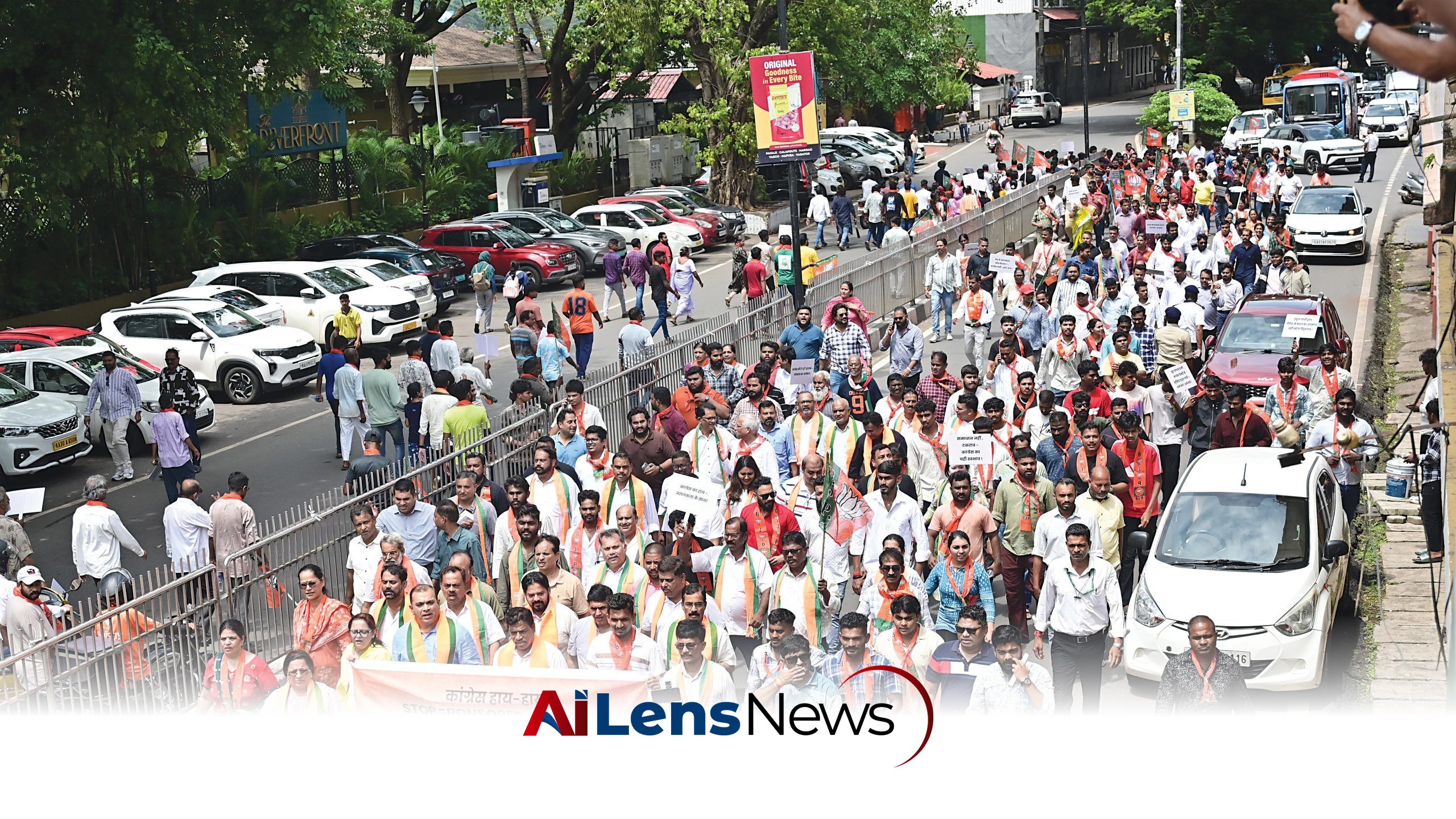


The BJP Goa unit, led by Damodar Naik, staged a protest accusing Congress of promoting chaos, amidst heavy rain disrupting the demonstration.
Panaji, India Jul 23, 2026 ALN: The political landscape in Goa has recently been marked by heightened tensions between the Bharatiya Janata Party (BJP) and the Indian National Congress (INC), with protests and counter-protests becoming increasingly common as both parties seek to assert their influence in the region. On Wednesday, the BJP Goa unit, under the leadership of president Damodar ‘Damu’ Naik, organized a protest outside Congress House in Panaji. This demonstration was part of a broader strategy by the BJP to challenge the Congress party's actions and to rally support among its base.
The BJP's accusations against the Congress party are not new; they have been a recurring theme in the ongoing political rivalry in India. In this instance, the BJP labeled the Congress as a promoter of "sponsored anarchy" and "manufactured chaos," terms that suggest a deliberate attempt by the Congress to undermine governmental stability and order. Such language is often employed in political discourse to frame opponents as irresponsible or dangerous, which can resonate with voters who prioritize stability and security.
Key figures in the BJP, including several state ministers, participated in the demonstration, highlighting the party's commitment to addressing what they perceive as threats to national integrity. Among those present were Tourism Minister Rohan Khaunte and Fisheries Minister Nilkanth Halarnkar, both of whom are influential in their respective sectors and serve as important voices for the party in Goa. Their involvement underscores the BJP's strategy of mobilizing high-profile leaders to lend credibility and urgency to their protests.
The immediate catalyst for this protest was a demonstration led by Rahul Gandhi outside the Prime Minister’s residence in New Delhi. The BJP described Gandhi's actions as a "dangerous act" and a "serious security breach," reflecting their view that such protests could incite unrest or undermine public safety. This framing is significant, as it positions the BJP as a defender of national security, a narrative that is often appealing to voters, particularly in a country where security concerns can dominate public discourse.
In response to the BJP's claims, Rohan Khaunte articulated a strong stance, asserting that the people of India would not tolerate any attempts to destabilize the country. This statement is indicative of the BJP's broader messaging strategy, which seeks to portray the party as a stabilizing force in contrast to the Congress, which they depict as chaotic and disruptive. The emphasis on public sentiment in Khaunte's remarks suggests that the BJP is keenly aware of the need to connect with voters on an emotional level, particularly in a state like Goa, where tourism and local industries are sensitive to political stability.
The protest was notably interrupted by heavy rain, a development that added an unexpected twist to the event. The inclement weather forced BJP workers to take shelter under the Congress House, which some interpreted as a symbolic irony given the context of their protest. The imagery of BJP members seeking refuge under a building associated with their political rivals could be seen as a humorous turn of events, but it also highlights the unpredictable nature of political rallies and public demonstrations.
In the wake of the protest, Goa Pradesh Congress Committee working president Sunil Kawthankar responded to the BJP's actions with a pointed critique. He remarked, "Even nature has been fed up of BJP’s arrogance and lies," suggesting that the rain served as a metaphorical cleansing of the political landscape, washing away what he described as the BJP's derogatory rhetoric. Kawthankar's comments reflect a common tactic in political discourse where weather events are used to frame narratives, suggesting that even the elements are aligned with one's political stance.
The ongoing conflict between the BJP and Congress in Goa is emblematic of a larger national struggle for power between these two prominent political parties. Goa, with its unique demographic and cultural identity, often serves as a microcosm for broader trends in Indian politics. The BJP, which has been in power in Goa since 2012, faces challenges from the Congress, which seeks to regain its foothold in the state. The dynamics of this rivalry are influenced by various factors, including local governance issues, economic concerns related to tourism, and the impact of national-level politics on state affairs.
Goa's political landscape is particularly complex due to its unique demographic makeup, which includes a mix of various communities, religions, and languages. This diversity means that political parties must navigate a range of interests and issues, from environmental concerns related to tourism development to the preservation of local culture and identity. The BJP's governance in Goa has been marked by initiatives aimed at boosting tourism, which is a critical component of the state's economy, but these initiatives have also sparked debates about sustainability and the impact on local communities.
As the political climate continues to evolve, the implications of such protests extend beyond immediate party rivalries. They reflect the growing polarization in Indian politics, where public demonstrations have become a common means of expressing dissent or support. The BJP's framing of the Congress as a source of chaos may resonate with certain voter demographics, particularly those who prioritize stability and security in governance.
Furthermore, the use of provocative language and the staging of public protests can also be seen as a strategic move to mobilize party supporters and energize the base ahead of upcoming elections. In a state like Goa, where electoral outcomes can be influenced by a relatively small number of voters, such tactics may have a significant impact on voter sentiment and turnout. The BJP's ability to successfully convey their narrative of stability against the Congress's perceived chaos may play a crucial role in shaping the electoral landscape.
As both parties prepare for the future, the ongoing exchanges and protests are likely to shape the political narrative in Goa and beyond. The BJP's ability to frame the Congress as a destabilizing force may play a crucial role in their electoral strategy, while the Congress will need to counter these narratives effectively to regain public trust and support. The interplay of these factors will be essential in determining the direction of Goa's political future and the broader implications for national politics in India.
In conclusion, the protests and counter-protests between the BJP and Congress in Goa illustrate the intense political rivalry that characterizes the state's governance. Both parties are engaged in a battle for public perception, utilizing various strategies to appeal to voters and assert their dominance. The outcome of this ongoing struggle will not only influence the future of Goa but may also reflect broader trends in Indian politics as the nation approaches critical electoral milestones.
To learn more about the latest developments in Political Controversies, stay updated with our exclusive reports and analyses on AiLensNews.

