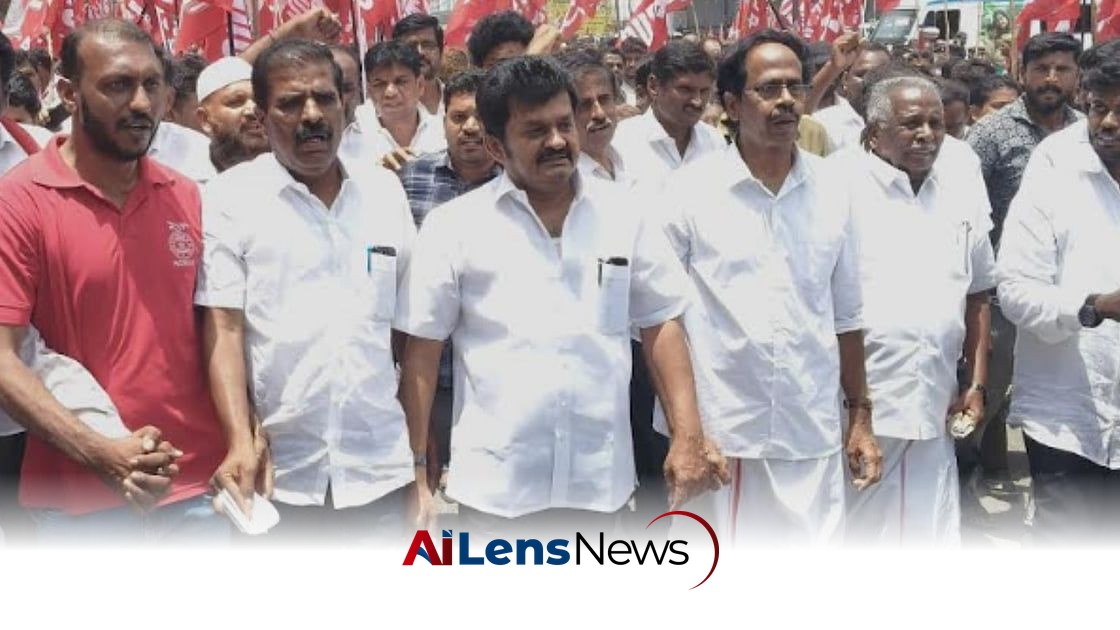


CPI state secretary R Veerapandian indicated the party's willingness to join the TVK government’s cabinet if political conditions necessitate it, while opposing the Mekedatu dam project.
New Delhi, India Jul 14, 2026 ALN: CPI state secretary R Veerapandian announced on Tuesday that his party is prepared to join the TVK government’s cabinet if the political situation warrants such a move. This statement comes at a time when Tamil Nadu's political landscape is experiencing notable shifts, particularly with the ongoing discussions around coalition dynamics and the potential for realignment among various political parties.
Speaking to the media before initiating a protest march organized by the party and the Tamil Nadu Farmers Association from Hosur in Krishnagiri, Veerapandian emphasized that if the political circumstances require, "we will join the cabinet in the state." This openness to collaboration indicates the CPI's strategic positioning, aiming to enhance its influence within the state's governance framework. The potential for the CPI to join the cabinet could signal a significant shift in the balance of power among the ruling coalition, particularly if it leads to increased representation for leftist ideologies within the government.
He added, "Then it will be an opportunity for someone from this soil to become a minister," highlighting the potential for local representation in government. This emphasis on local leadership resonates with the broader political narrative in Tamil Nadu, where regional identity and grassroots representation are often prioritized in electoral politics. The CPI's willingness to take on ministerial roles could also reflect a strategic move to appeal to local voters who may feel disconnected from state-level decision-making processes.
Veerapandian also mentioned that if necessary, the Communist parties would contest local body elections independently. He stated, "Such a decision will be taken in consultation with other democratic forces," indicating a collaborative approach to political strategy. This willingness to consider independent electoral participation underscores the CPI's commitment to maintaining its political identity while also exploring alliances that could strengthen its position in local governance. The upcoming local body elections are crucial, as they often serve as a barometer for the political climate ahead of larger electoral contests, including state and national elections.
Addressing concerns about political defections, he criticized the culture of horse-trading prevalent in some northern states, asserting, "Whoever indulges in horse-trading is unacceptable." This statement reflects the CPI's stance against unethical political practices. The mention of horse-trading highlights ongoing concerns about the integrity of political processes in India, where party-switching and opportunistic alliances can undermine democratic principles. By condemning such practices, the CPI aims to position itself as a party committed to transparency and ethical governance, appealing to voters who prioritize integrity in their political representatives.
In addition to these political discussions, Veerapandian voiced strong opposition to Karnataka's proposed construction of the Mekedatu dam. He warned that the dam would devastate 25 lakh acres of Delta farmland and severely impact the state’s drinking water sources. The Mekedatu dam project has been a contentious issue between Tamil Nadu and Karnataka, with significant implications for water resource management in the region. The Cauvery River, a vital water source for both states, has been at the center of disputes for decades, and the proposed dam raises concerns about equitable water distribution and the environmental impact on agricultural land.
"It is the responsibility of the Karnataka government to release Cauvery water to Tamil Nadu and abandon its attempt to construct the dam," he urged, emphasizing the need for responsible water management between the two states. This statement not only reflects the CPI's commitment to protecting farmers' interests but also highlights the party's role in advocating for regional cooperation over resource management. The ongoing water dispute is emblematic of larger inter-state tensions in India, where resource allocation often becomes a flashpoint for political conflict.
The political landscape in Tamil Nadu is characterized by a complex interplay of regional parties, national parties, and emerging coalitions. The CPI, traditionally aligned with leftist ideologies, faces challenges in a state where Dravidian politics dominate. The party's willingness to join the cabinet could be seen as a strategic maneuver to regain relevance and influence in a rapidly changing political environment. As the state approaches local body elections, the CPI's decisions and strategies will be closely monitored by both political analysts and the electorate.
The implications of the CPI's potential entry into the cabinet extend beyond mere political representation. It could signify a shift towards more inclusive governance, where diverse voices from different ideological backgrounds are represented in decision-making processes. This could also foster a more collaborative political culture in Tamil Nadu, encouraging dialogue and cooperation among various parties, which is essential for addressing pressing issues such as water management, agricultural sustainability, and social welfare.
Moreover, the CPI's stance on the Mekedatu dam also reflects broader environmental and agricultural concerns that resonate with a significant portion of the Tamil Nadu electorate. Farmers and agricultural workers are particularly sensitive to issues of water availability and land use, making this a critical issue for the CPI as it seeks to solidify its support base among rural voters. The party's active engagement in these discussions positions it as a champion of farmers' rights, potentially attracting support from those who feel their livelihoods are threatened by large-scale infrastructure projects.
As political developments unfold in Tamil Nadu, the CPI's actions and decisions will likely play a crucial role in shaping the future of the state's governance. The party's readiness to adapt to changing political circumstances, whether through coalition-building or independent electoral strategies, underscores its commitment to remaining a relevant player in Tamil Nadu's dynamic political arena. The coming months will reveal how these strategies will impact not only the CPI's fortunes but also the broader political landscape in the state.
To learn more about the latest developments in Political Controversies, stay updated with our exclusive reports and analyses on AiLensNews.

