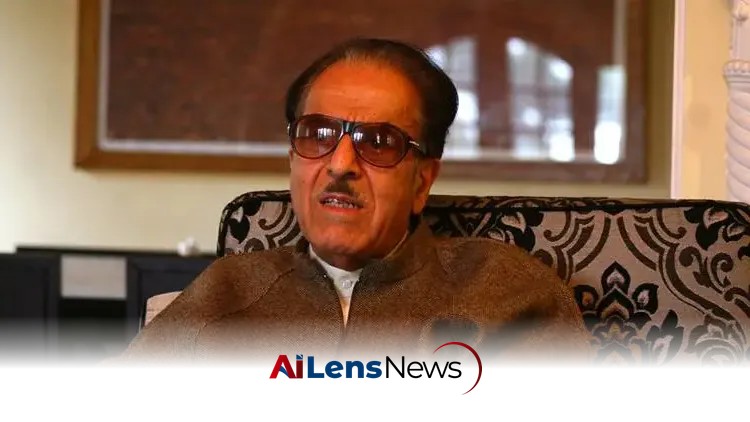


Saifuddin Soz emphasizes the need for the National Conference to advocate for the reinstatement of Article 370 alongside statehood restoration during protests.
New Delhi, India Jul 16, 2026 ALN: Srinagar: On a recent Wednesday, prominent Congress leader Saifuddin Soz made a significant statement urging the National Conference (NC) to expand its protest agenda regarding Jammu and Kashmir. He emphasized that the NC should not limit its demands solely to the restoration of statehood but should also advocate for the reinstatement of the region's special status under Article 370 of the Indian Constitution.
Article 370 was initially incorporated into the Constitution to grant special autonomy to Jammu and Kashmir, allowing it to maintain its own constitution and a significant degree of legislative independence. However, this status was revoked by the Government of India on August 5, 2019, leading to the reorganization of the region into two Union Territories: Jammu & Kashmir and Ladakh. This move was met with widespread political and social backlash, both locally and nationally, as it altered the historical and constitutional framework that had governed the region since its accession to India in 1947.
The revocation of Article 370 not only stripped Jammu and Kashmir of its special status but also raised significant concerns regarding the political representation and governance of the region. The change was justified by the central government on the grounds of integrating Jammu and Kashmir more closely with the rest of India, promoting development, and enhancing security. However, many local leaders and residents argue that this integration has come at the cost of local identity and autonomy.
Soz's call for the NC to broaden its agenda reflects a growing sentiment among various political factions in Jammu and Kashmir that the revocation of Article 370 has not only stripped the region of its autonomy but has also led to a sense of disenfranchisement among its residents. He pointed out that the current status of Jammu and Kashmir as a Union Territory is not a permanent solution and questioned the authority of the central government to maintain this status indefinitely. His comments highlight a significant concern regarding the governance and political representation in the region, which has historically been a focal point of contention between local leaders and the central government.
Soz's political history is notable. He previously served as a member of the Lok Sabha when the National Conference was allied with the National Democratic Alliance (NDA) led by Atal Behari Vajpayee. His political career took a dramatic turn in 1999 when he defied the party whip during a crucial vote of confidence, which ultimately led to the collapse of Vajpayee's government. This act of defiance resulted in his expulsion from the NC, and he subsequently joined the Congress party, where he has continued to be an influential voice on issues pertaining to Jammu and Kashmir.
During his recent visit to pay respects to NC leader and former minister Sheikh Mustafa Kamal, who recently passed away, Soz expressed his views on the importance of addressing the larger issues facing the people of Jammu and Kashmir. "The National Conference should not limit its discussions to statehood at Jantar Mantar. Our issue transcends statehood," Soz stated. His remarks underscore the belief that the restoration of Article 370 is crucial for the region’s political identity and autonomy.
Soz also articulated concerns regarding the perceptions of the youth in Jammu and Kashmir, noting that many feel disillusioned and believe that they will not receive support from the government. He characterized this sentiment as misguided, suggesting that it reflects a broader sense of hopelessness among the younger population. "Our young generation should recognize that we, a Muslim-majority state, chose to accede to India, which has a Hindu majority. Sheikh Mohammad Abdullah deemed it appropriate at that time, considering there were eight crore Muslims in India. Today, there are 23-24 crore Muslims, affirming our decision to remain in India. However, our internal autonomy must be restored on our own terms," he articulated, emphasizing the historical context of Jammu and Kashmir's accession to India.
The implications of Soz's statements are significant, particularly as they resonate with the ongoing discussions about the political future of Jammu and Kashmir. The call for the restoration of Article 370 is not merely a political demand; it encapsulates the aspirations of many in the region who seek a return to a governance model that allows for greater local autonomy and representation. This demand is likely to play a critical role in shaping the political landscape of Jammu and Kashmir in the coming years, especially as the central government continues to grapple with the complexities of governance in the region.
Moreover, the National Conference's response to Soz's call will be pivotal. As one of the major political parties in Jammu and Kashmir, the NC has historically championed the cause of autonomy and self-determination for the region. The party's leadership will need to consider the broader implications of aligning its agenda with the restoration of Article 370, as this could galvanize support among the electorate who feel marginalized since the revocation of special status.
As the political climate continues to evolve, the voices of leaders like Soz will be essential in framing the discourse around Jammu and Kashmir's future. The upcoming Monsoon session of Parliament is expected to be a critical juncture for discussions on the region, and the extent to which local parties can mobilize public sentiment around these issues will likely influence their political fortunes.
In conclusion, Saifuddin Soz's recent comments reflect a growing call for a reevaluation of Jammu and Kashmir's political status and identity. By urging the National Conference to expand its agenda, he highlights the need for a comprehensive approach that addresses not only statehood but also the fundamental rights and autonomy of the people of Jammu and Kashmir. The path forward remains complex, but the demand for the restoration of Article 370 signifies a crucial aspect of the ongoing dialogue surrounding the region's future.
In the broader context, the discussion surrounding Article 370 and the political status of Jammu and Kashmir is not only a regional issue but also a national one that touches upon the principles of democracy, federalism, and the rights of minority communities in India. The implications of any potential restoration of Article 370 could set a precedent for how other regions with special statuses are treated and could influence the central government’s approach towards federalism and regional autonomy.
Furthermore, the sentiments expressed by Soz and other leaders reflect a deeper socio-political reality in Jammu and Kashmir, where the aspirations of the people often clash with the central government's policies. The need for dialogue, understanding, and a nuanced approach to governance is paramount in addressing the grievances of the residents of Jammu and Kashmir. As the region continues to navigate its complex identity within the Indian Union, the ongoing discussions around Article 370 will remain central to the political narrative of Jammu and Kashmir.
To learn more about the latest developments in Political Controversies, stay updated with our exclusive reports and analyses on AiLensNews.

